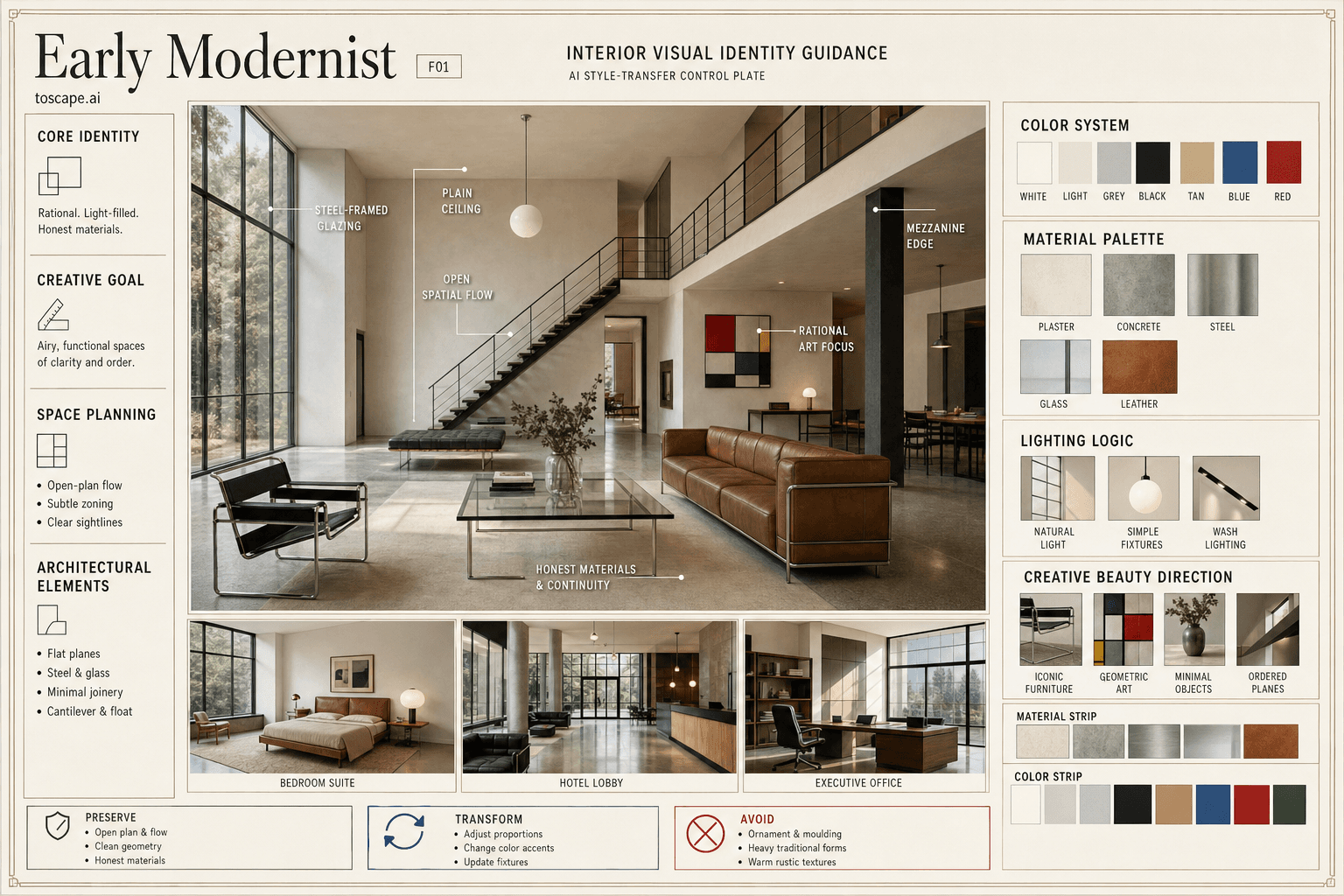
Early Modernist
F01 / Modern / Rationalist / Bauhaus / International
A rational, gallery-like Modernist interior style defined by pure geometry, honest materials, open-plan clarity, and iconic Bauhaus-era furnishings.
Overview
Early Modernist is an interior design style defined by A rational, light-filled, functionalist interior style defined by clean geometry, honest materials, clarity of form, and visual order without ornament. To celebrate human reason, clarity, and the intrinsic beauty of space, form, and materials, providing a bright, healthy, and orderly visual environment.
Visual DNA
Spatial Feeling
Open, airy, rational, calm, and ordered-spaces feel poised and light rather than warm or enclosed.
Form Language
Rectilinear planes, planar geometry, right angles, open spans, occasional rhythmic gridded details, and balanced pure curves (where used) generally by furniture, not architecture. Balanced, often modular grid-based...
Composition
Open-plan, loosely zoned, free-flowing or L-shaped spaces; never compartmentalized, but not chaotic. Strongest focal points are architectural-large window walls, curved stairs, a striking Modernist sofa, unique table or a select art...
Interior Elements
Crisp white or pale smooth plaster, fine lime-wash, or painted render; wall planes are uninterrupted except for rational divisions or essential joinery. Ceilings are flat, plain, and silent; no decorative mouldings or features. Feature...
Color System
White, off-white, warm/cool grey, black, pale wood, tan leather, and polished steel with a primary pop in accessory. Strictly curated palette-let large planes remain crisp; introduce color only as a sharp accent or material note....
Material Palette
Planar, smooth, hard or cool to the touch; textures are subtle-felt only in authentic leather, raw wood grain, or unpolished stone. Walls and ceilings are pure plaster or render; flooring sets the tone; steel/glass for structural...
Lighting Logic
Discreet indirect lighting-recessed strips, concealed wall-wash, or geometric flush-mounts. Harness sharp daylight, long shadows, and layered glazing to create graphics on white planes; leverage evening glow for crisp outline. Lighting...
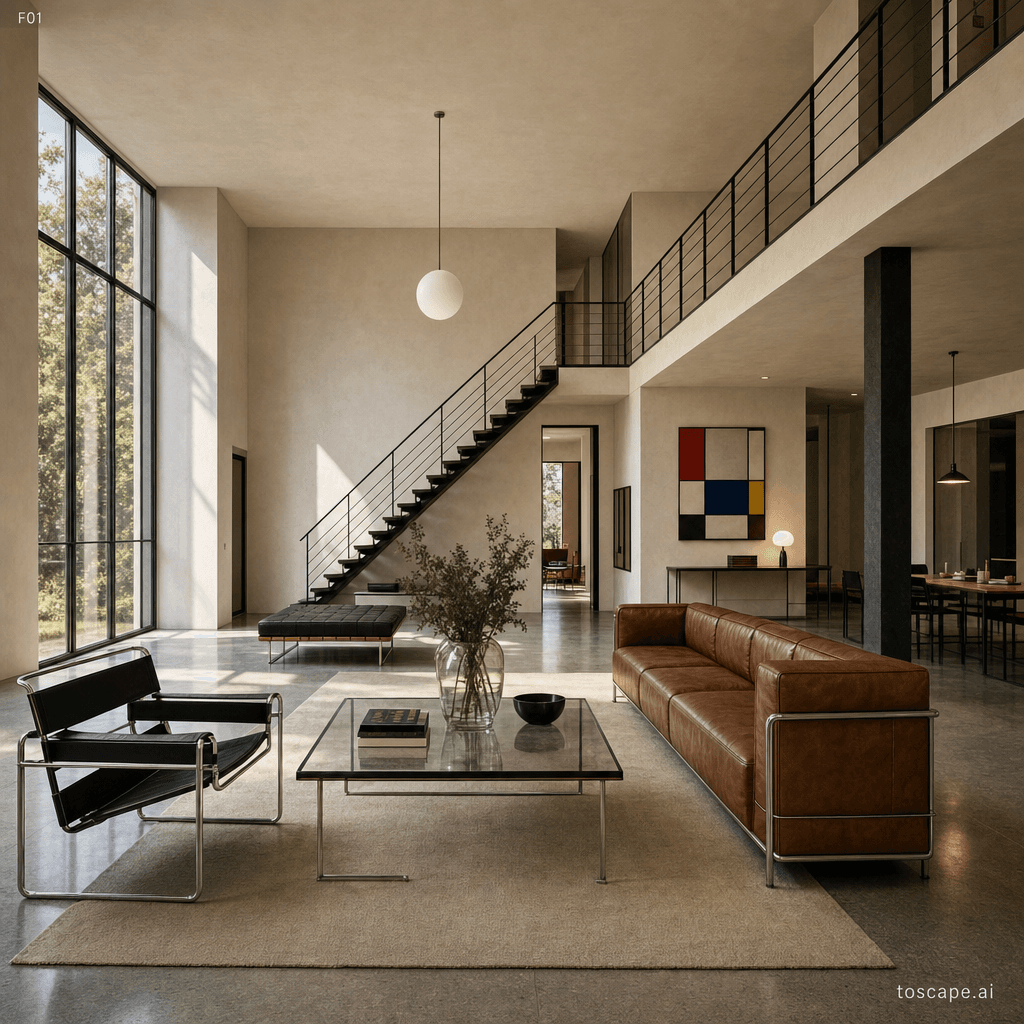
Interior reference image
Early Modernist composition, material palette, furniture language, and lighting direction.
Context Snapshot
Emerging in the early 20th century (circa 1920-1935), Early Modernist design responded to industrialization, social change,... Revived by designers, collectors, and clients seeking gallery-like clarity, integrity, and a design-forward spirit in urban homes, curated hospitality, and creative workspaces. Use generous daylight and refined proportions, authentic period or inspired furniture, balanced color restraint, and sharp but inviting material transitions to create a sense of purity without austerity.
Composition And Planning
Open-plan, loosely zoned, free-flowing or L-shaped spaces; never compartmentalized, but not chaotic. Movement is logical, fluid, and unimpeded, with clear sightlines, often framed by structure or glass. Best viewed at eye-level or slightly below, focusing on depth through layered glazing/walls with clear planar lines; foreground and midground furniture, background window, and spatial depth.
Furniture Grammar
Rectilinear or pure curved forms with planar arms, visible structure, and no decorative carving or bracket feet. Float furniture off walls, align parallel or at right angles, and leave sufficient open space-arrangement should read as balanced, modern, and intentional. - Mies van der Rohe Barcelona chair or daybed - LC2 or LC4 chairs by Le Corbusier/Jeanneret/Perriand - Marcel Breuer Wassily chair - Eileen Gray adjustable table - Early tubular steel desk or console
Creative Direction
A serene, daylight-filled, meticulously composed living space with floating iconic Modernist furniture, pure white planes, restrained pale wood or stone, bold artwork, and graphic shadowplay over silence and order. Pristine, curated, with sparse but compelling objects, strong perspective, iconic chairs, neutral palette, and art photography referencing architectural lines. Vivid, bright daylight casting long graphic shadows over chromed steel and white plaster, with key color accents from pure Modernist art or furniture details. - Exemplary material quality and coherent detail - Authenticated designer furniture - Architectural precision in...
Best Project Applications
- Urban apartments, galleries, design-forward living rooms, studios, creative offices.
Preserve, Transform, Avoid
Preserve
- Pure, rational geometric order and open-plan clarity
- Negative space and unadorned architectural planes
- Authentic Modernist materials (chrome, glass, white plaster, vegetable-tanned leather, pale timber)
- Floating, iconic Modernist furniture arrangements
Transform
- Refine material transitions for higher-quality execution
- Lightly update furniture comfort (seat height, upholstery) while keeping visual DNA
- Soften overall lighting carefully, but do not romanticize spatial clarity
- Use contemporary art fitting the Modernist compositional logic, never pastiche
Avoid
- Ornamental, classical, or historicist detailing
- Midcentury, rustic, or postmodern furniture
- Gold, brass, or copper metallic accents
- Overly warm, taupe, pastel, or retro palettes
- Heavy decorative lighting, drapery, or excessive planting
Use this style in Toscape
Explore Early Modernist inside Toscape using interior-focused rendering workflows and gallery references.
Open interior references