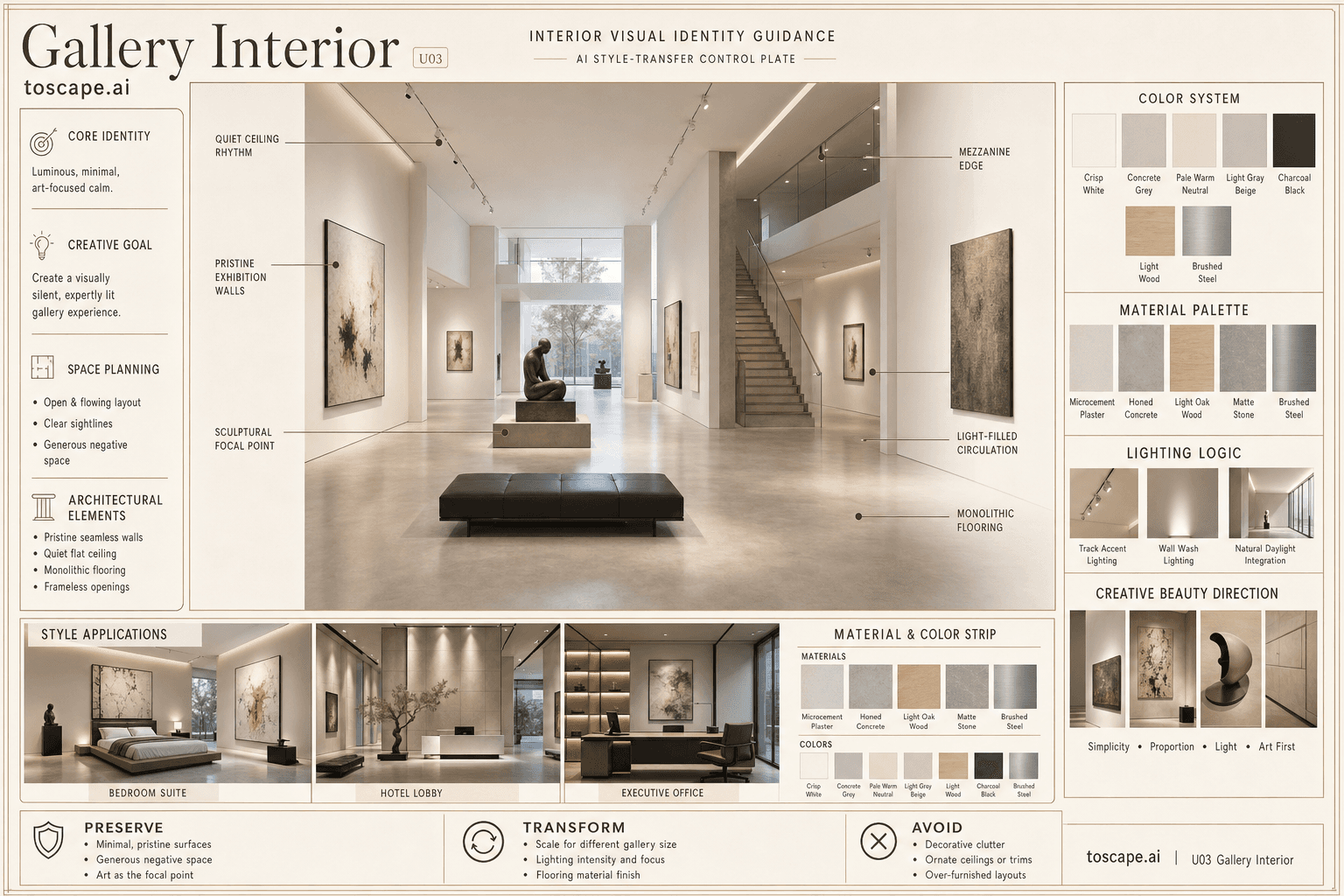
Gallery Interior
U03 / Contemporary / Minimal / Commercial / Hospitality / Modern
A calm, luminous, and precisely minimal interior dedicated to showcasing art with spatial silence, flawless surfaces, and perfect light.
Overview
Gallery Interior is an interior design style defined by A luminous, intentionally minimal, and pristine interior dedicated to showcasing art through spatial calm, pure surfaces, and precise composition. To create a spatial environment that honors art with visual clarity, enhances viewer focus, and evokes a sense of stillness, sophistication, and intentionality.
Visual DNA
Spatial Feeling
Calm, contemplative, spacious, luminous, restrained, and gallery-like in its silence and visual clarity.
Form Language
Crisp rectilinear volumes, floating planes, soft reveals, monolithic walls, and clean geometric transitions; gentle curves are limited unless used as a deliberate sculptural feature. Balanced scale with generous ceiling height enhances...
Composition
Open, flowing, axial or grid-based, with flexible circulation and clearly preserved sightlines for art appreciation. Key artworks, sculptural objects on plinths, framed sightlines, and feature walls; never architectural decor. Mid to...
Interior Elements
Pristine painted drywall, fine-finish plaster, or seamless architectural panel; minimal to invisible trim. Not a decorative driver in this style; use a quiet flat ceiling with clean shadow lines, soft integrated lighting, and no...
Color System
White, off-white, pale grey, matte concrete, light wood, with rare black or steel accents. Continuous, harmonious neutrals that support and never fight with displayed art; tonality is subtle with art and object color treated as the only...
Material Palette
Ultra-smooth, subtle, and low-sheen; tactile contrasts are reserved for art objects or sculptural seating, not applied to architectural surfaces. Walls and ceilings are pure and light-reflective; floors ground the space; any timber or...
Lighting Logic
Track, recessed, or cove lighting; general illumination is uniform but subtly layered to prevent optical flatness. Use carefully directed beams, luminous wall grazing, and gentle shadows to give dimensionality to art and space; avoid...
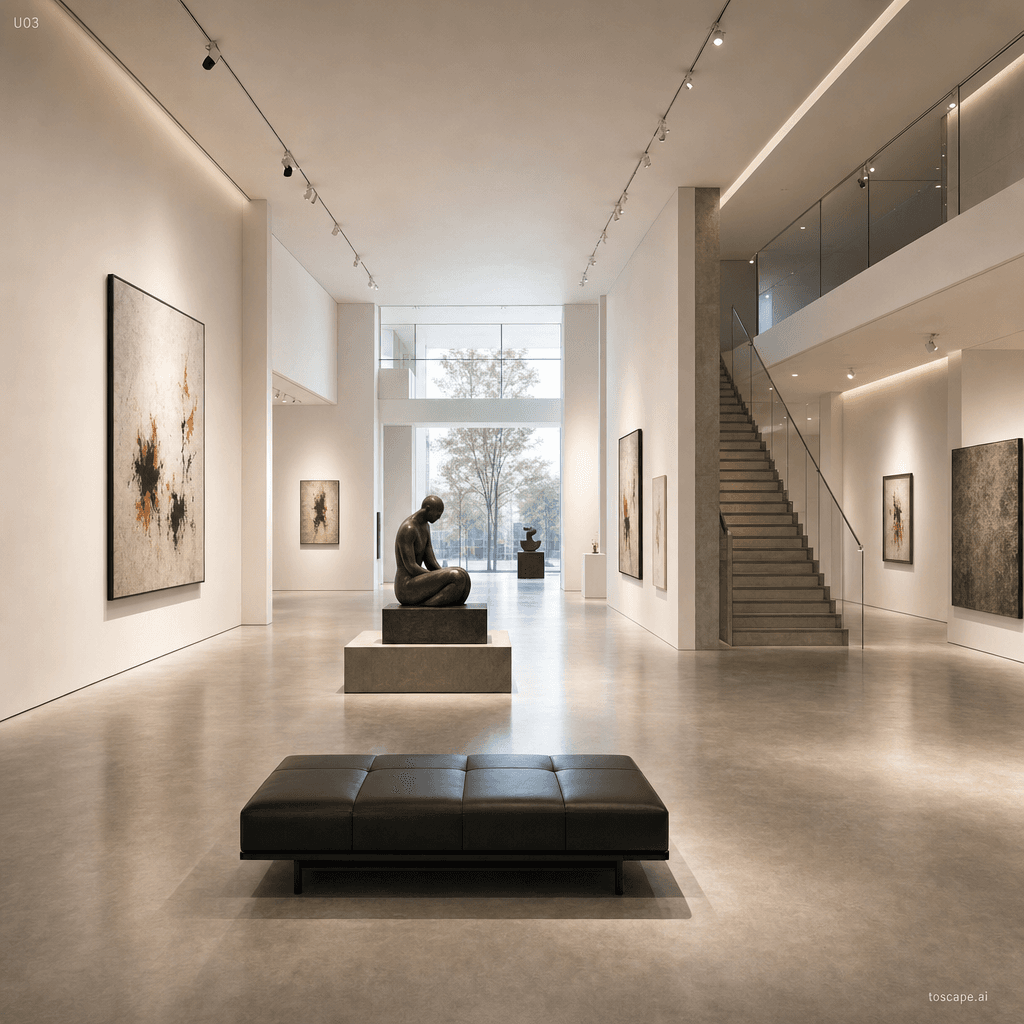
Interior reference image
Gallery Interior composition, material palette, furniture language, and lighting direction.
Context Snapshot
Rooted in post-war and contemporary museum and gallery design, this style evolved for premium art display, adopting minimal... Used in premium galleries, auction houses, limited-edition boutiques, architectural showrooms, and luxury residences seeking a curated, art-centered identity. Modern gallery interiors should feature seamless wall and ceiling planes, subtle but precise material richness, contour lighting, carefully orchestrated sightlines, and flexible space for changing displays.
Composition And Planning
Open, flowing, axial or grid-based, with flexible circulation and clearly preserved sightlines for art appreciation. Encourages slow, deliberate movement and frequent pausing; circulation allows for meandering as well as clear lines to key works. Mid to slightly high camera angle; wide perspective emphasizing wall planes, artwork, and layered foreground/midground/background for visual depth.
Furniture Grammar
Minimal, monolithic, rectilinear, with floating or block-like form; if sculptural, it is intentional and understated. Benches or seating should float in the space or anchor a viewing point; always secondary to spatial axis and artwork. - Minimal floating bench - Monolithic plinth - Invisible glass side table
Creative Direction
A luminous, precisely composed gallery hall with flawless white walls, an axis of sculptural art, floating low benches, and chiaroscuro-focused lighting inviting quiet contemplation. Expertly photographed wide-angle view; artwork perfectly placed, wall planes impeccable, seating monolithic and minimal, every material flawless, with art commanding the room. High drama achieved through dimmed ambient light, spotlit art or sculpture, inky shadow pools, and bold sightline; space feels immersive but never theatrical. - Impeccable material finishing - Museum-grade lighting and shadow - Seamless construction with invisible details
Best Project Applications
- Art galleries, museums, showrooms, curated residential halls.
Preserve, Transform, Avoid
Preserve
- Pristine luminous wall and ceiling planes.
- Gallery-scale negative space around all art.
- Professional-grade lighting and shadow control.
- Minimal furniture and architectural silence.
Transform
- Subtly vary wall or ceiling surface with material if it preserves retinal calm.
- Introduce sculptural plinths or curated benches as spatial accents.
- Use occasional dark zones or moody lighting for purposeful art display drama.
- Allow one architectural "cut" or reveal to clarify circulation or frame an axis.
Avoid
- Decorative trim, baseboards, or cornices.
- Plush residential sofas, patterned rugs, or accent chairs.
- Retail merchandising racks, signage, or visual noise.
- Ornamentation or "feature walls" without clear curatorial intent.
- Uniform flat LED lighting with no focus or shadow.
Use this style in Toscape
Explore Gallery Interior inside Toscape using interior-focused rendering workflows and gallery references.
Open interior references