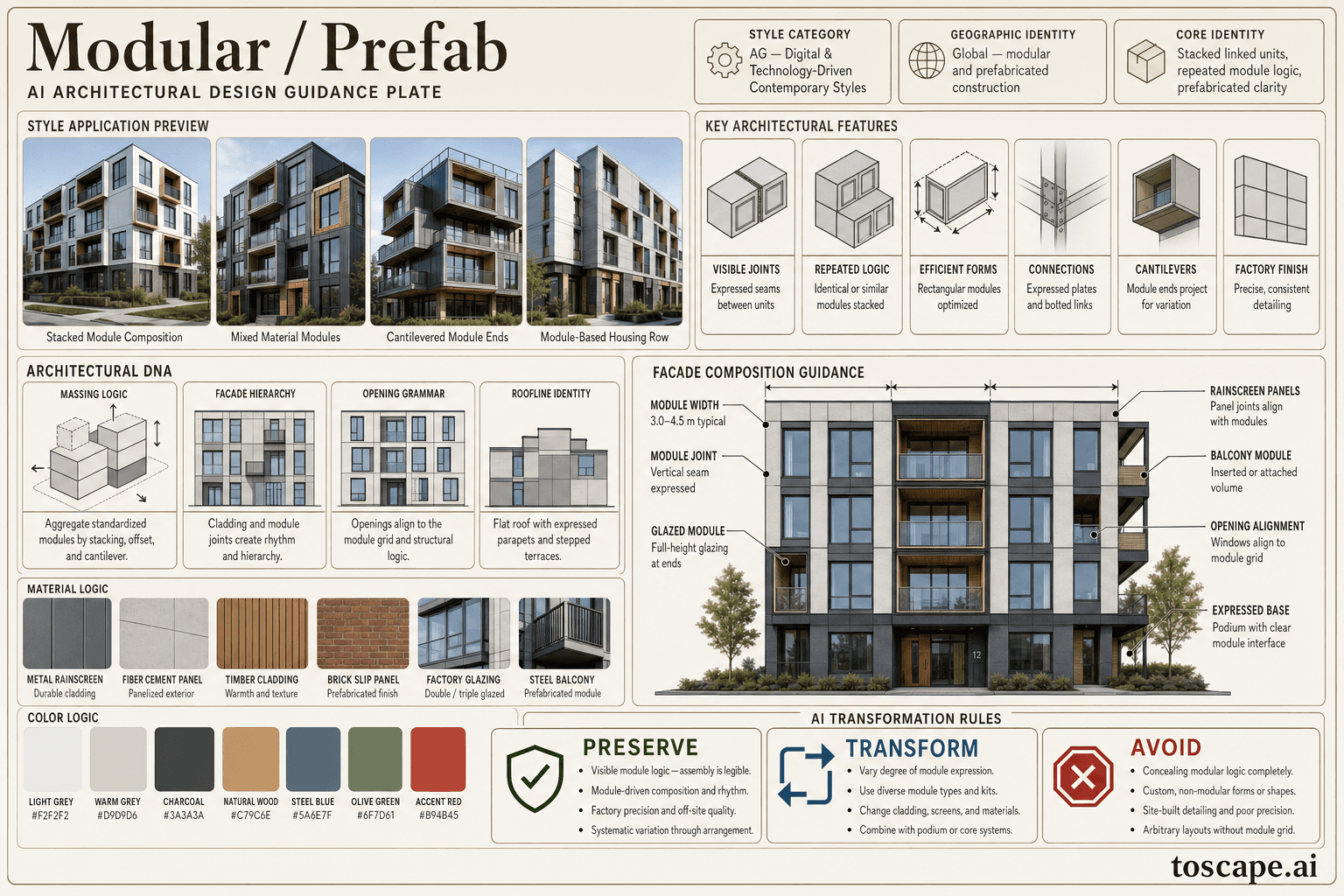
Modular / Prefab
Global - modular and prefabricated construction has roots in early 20th-century industria... / Digital and technology
Stacked linked units, repeated module logic, prefabricated clarity, and efficient compositional variation.
Overview
Modular / Prefab is a global architectural style rooted in Global - modular and prefabricated construction has roots in early 20th-century industrialized building (Sears Catalog Homes, German Siedlungen, Japanese metabolic architecture). The contemporary modular movement gained momentum in the 2010s-2020s with advances in digital fabrication, BIM coordination, and factory-controlled quality. Leading exemplars include projects in Europe (BoKlok by IKEA/Skanska), North America (FullStack Modular), Japan (Sekisui Heim), and the UK...
Visual DNA
Massing & Form
Massing is aggregative. the building is composed by stacking, linking, and arranging standardized modules.
Facade Language
The facade expresses the module. vertical and horizontal joints between units are typically visible or subtly expressed through panel breaks, shadow gaps, or material changes.
Materials & Texture
Module structure: light-gauge steel frame, structural insulated panels (SIPs), or CLT Facade cladding: metal rainscreen, fiber cement, brick slip panels, timber, or composite. panelized for efficient installation Module joints: expressed...
Color Palette
Primary tones: varied. modular architecture has no fixed color palette Monochromatic schemes emphasize the modular composition.
Ornament & Detail
Visible module logic. the building must read as an assembly of prefabricated units.
Climate Response
Global. modular and prefabricated construction has roots in early 20th-century industrialized building (Sears Catalog Homes, German Siedlungen, Japanese metabolic architecture).
Landscape & Ground
Global. modular and prefabricated construction has roots in early 20th-century industrialized building (Sears Catalog Homes, German Siedlungen, Japanese metabolic architecture).
Reference elevation
Modular / Prefab - characteristic facade composition within the digital and technology.
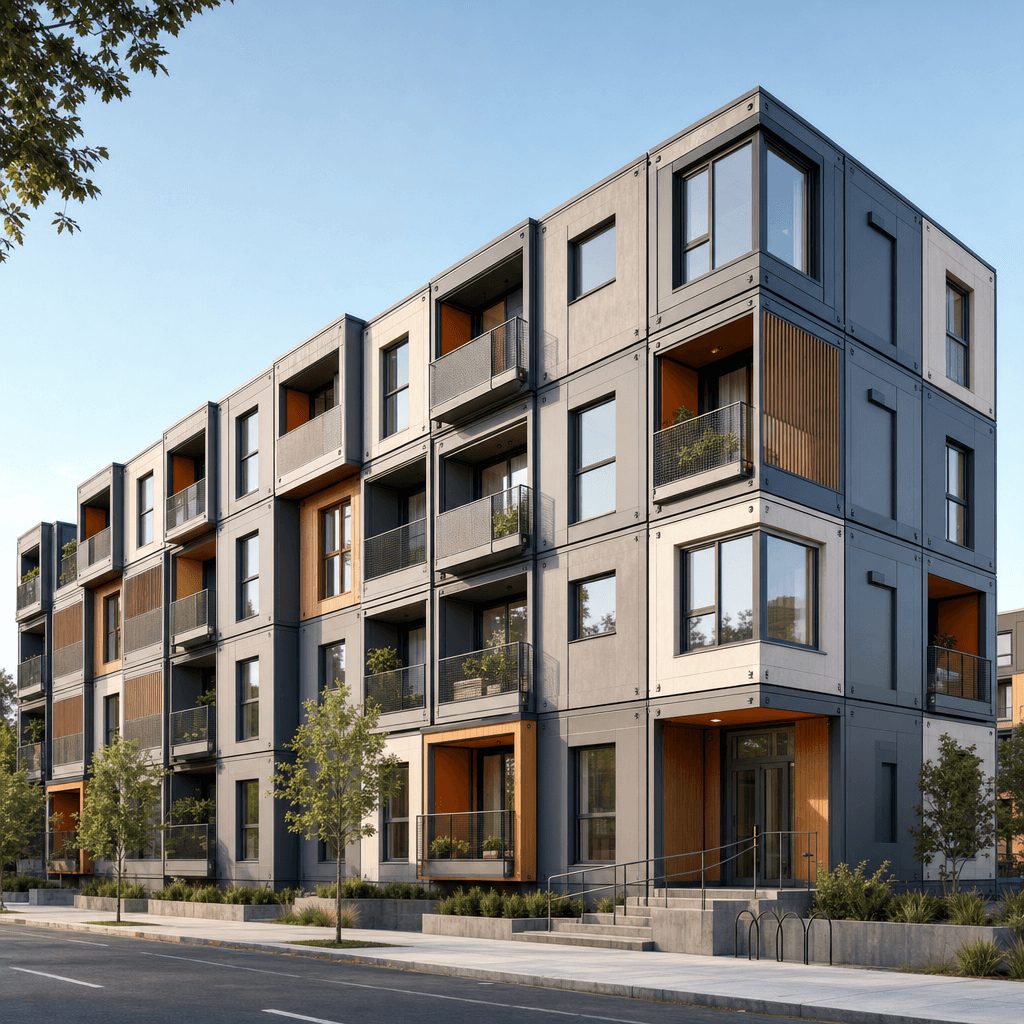
Context Snapshot
Systematic, efficient, and compositionally articulate. Massing is aggregative - the building is composed by stacking, linking, and arranging standardized modules. Global - modular and prefabricated construction has roots in early 20th-century industrialized building (Sears Catalog Homes, German Siedlungen, Japanese metabolic architecture).
Contemporary Relevance
Today, Modular / Prefab remains relevant wherever projects need digital and technology cues without losing performance or contemporary usability. In Toscape it responds best when prompts emphasize massing is aggregative - the building is composed by stacking, linking, and arranging standardized modules. module structure: light-gauge steel frame, structural insulated panels (sips), or clt facade cladding: metal rainscreen, fiber cement, brick slip panels,...
Use this style in Toscape
Explore Modular / Prefab directly inside Toscape using Facade Re-Style and design workflow prompts tuned for global architectural references.
Open Modular / Prefab in the gallery