Abha Highlands Traditional
Saudi Arabia · Abha Highlands
Full-strength faithful interpretation of Asir mountain vernacular heritage
Overview
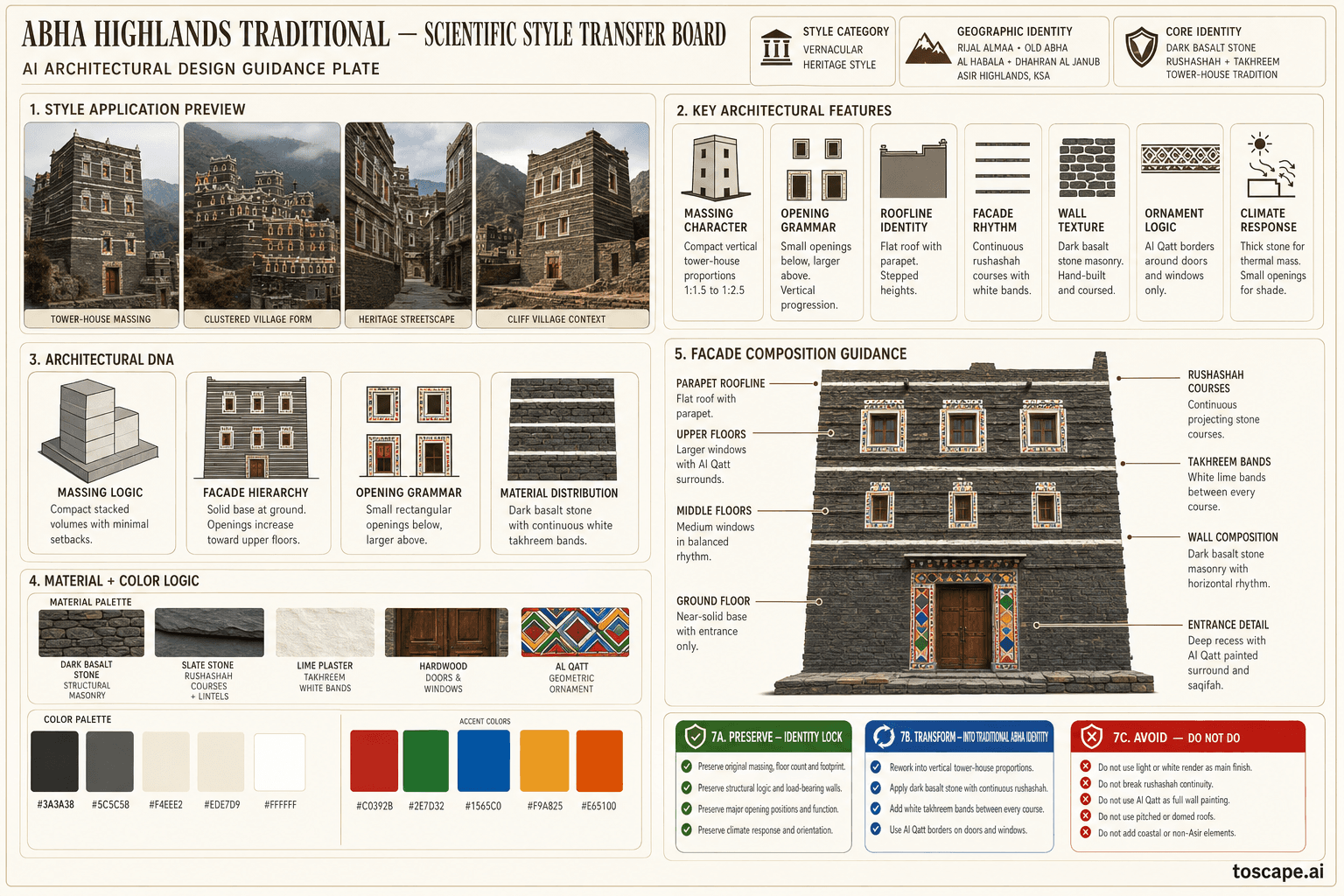
Abha Highlands Traditional is a Saudi architectural identity rooted in Abha Highlands. Southwest Arabian highland masonry + terraced stone construction + Asiri Al Qatt painted ornament + fortified tower houses (qasr) + dense ridge-top settlement patterns. Rijal Almaa heritage settlement — Old Abha historic district — Al Habala cliff village — Dhahran Al Janub heritage streetscapes — all heritage zones and conservation areas in the Asir highlands, 1500–3000m elevation.
Visual DNA
Massing & Form
Traditional Abha Highlands buildings are compact, strongly vertical rectilinear tower houses with a width-to-height ratio typically between 1:1.5 and 1:2.5. The form reads as a fortified column: widest at the base where the walls are thickest and openings fewest, progressively becoming lighter and more open toward the...
Facade Language
Facade rhythm comes from three superimposed layers: (1) the structural rhythm of rushashah projecting stone courses running continuously at 30–50cm vertical intervals across the entire wall; (2) the white takhreem lime-wash bands between courses creating a strong dark-and-white horizontal stripe pattern; and (3) the pa...
Materials & Texture
Materials must faithfully use genuine traditional sources. Basalt, slate, and granite are the primary wall materials — rough-hewn, coursed, and dry-set or lime-mortared.
Color Palette
Stone greys, lime white, sun-aged timber, and selective mineral accents shape the palette. Highland and escarpment identities can carry stronger painted or stratified contrast, but the wall mass should still feel geologic and rooted in terrain.
Ornament & Detail
Ornament operates in two modes: Structural surface ornament (Rushashah): The continuous projecting stone courses are the primary ornamental system — integral to the structure and simultaneously giving the facade its defining texture, grain, and shadow depth. This ornament cannot be separated from the tectonic logic.
Climate Response
The architecture responds to a cool highland climate with wide daily temperature ranges, seasonal mist and fog, and the highest annual rainfall in Saudi Arabia. Thick stone walls (60–100cm) provide thermal mass — warming slowly by day and releasing heat at night.
Landscape & Ground
Rijal Almaa heritage settlement — Old Abha historic district — Al Habala cliff village — Dhahran Al Janub heritage streetscapes — all heritage zones and conservation areas in the Asir highlands, 1500–3000m elevation. The architecture responds to a cool highland climate with wide daily temperature ranges, seasonal mist...
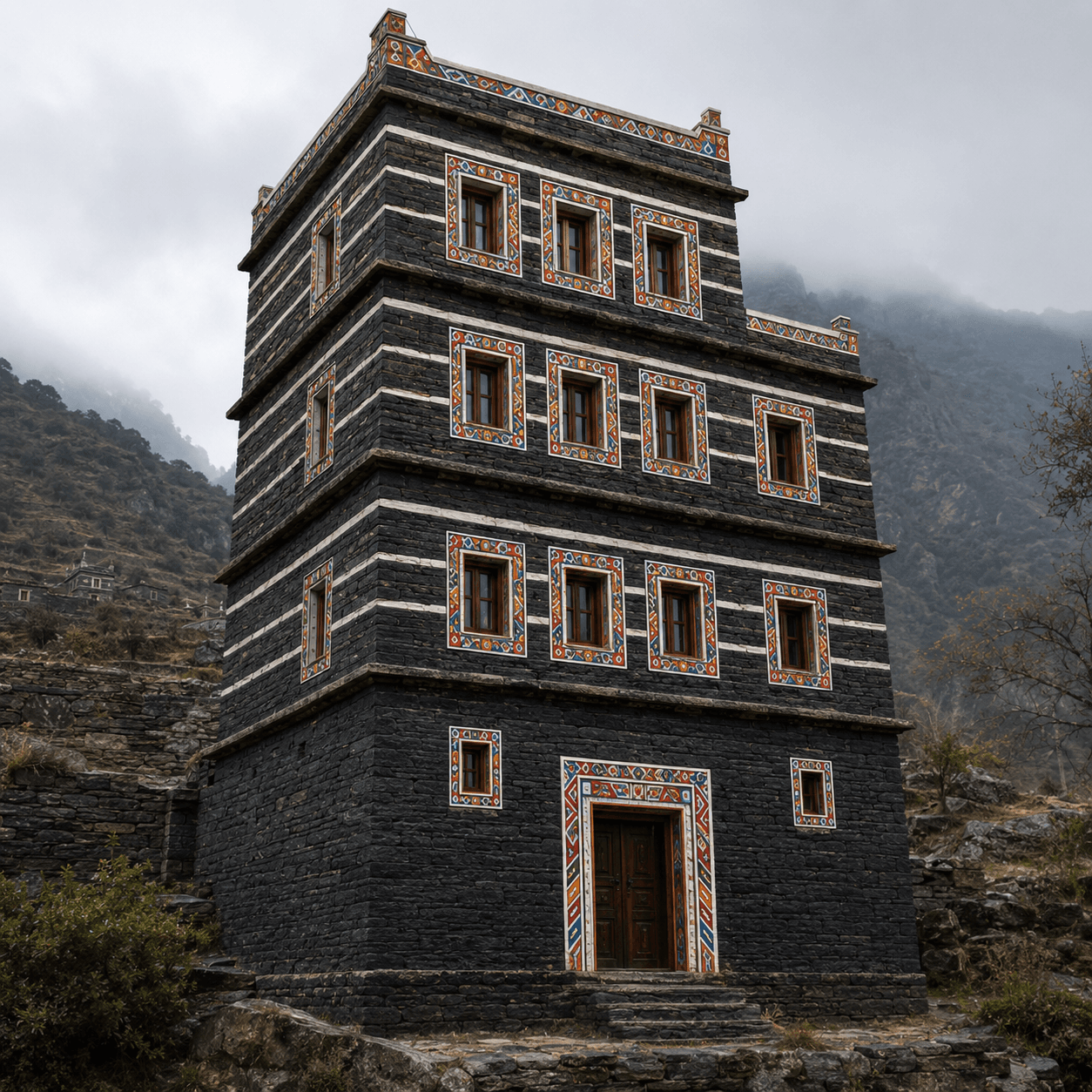
Reference elevation
Abha Highlands Traditional — characteristic facade composition, Abha Highlands.
Context Snapshot
Full-strength faithful interpretation of Asir mountain vernacular — genuine materials, maximum craft fidelity, no modern substitutions Southwest Arabian highland masonry + terraced stone construction + Asiri Al Qatt painted ornament + fortified tower houses (qasr) + dense ridge-top settlement patterns Rijal Almaa heritage settlement — Old Abha historic district — Al Habala cliff village — Dhahran Al Janub heritage streetscapes — all heritage zones and conservation areas in the Asir highlands, 1500–3000m elevation
Contemporary Relevance
Abha Highlands Traditional operates as the heritage reference layer for Abha Highlands and is most useful today in conservation work, cultural tourism districts, and accurate AI rendering direction. Its value in current practice comes from preserving proportion, material hierarchy, and climate logic without flattening them into generic nostalgia.
Use this style in Toscape
Explore Abha Highlands Traditional directly inside Toscape using the Facade Re-Style and Design Options workflows.
Open Abha Highlands Traditional in the gallery