Abu Dhabi City
United Arab Emirates · architectural identity system of Abu Dhabi City as defined by the Department of...
The regulated architectural identity of the UAE capital — wind towers (barjeel), courtyard houses, mashrabiya screens, and the Estidama sustainability framework shaping a contempor...
Overview
Abu Dhabi City is a regional architectural identity in UAE. The architectural identity system of Abu Dhabi City as defined by the Department of Urban Planning & Municipalities (DPM) Architectural Identity Guidelines — a regulatory framework with three primary goals: enhance the architectural image of the region, enforce architectural coherence across development types, and capture the unique architectural identities of the United Arab Emirates. This operates within the Estida...
Visual DNA
Massing & Form
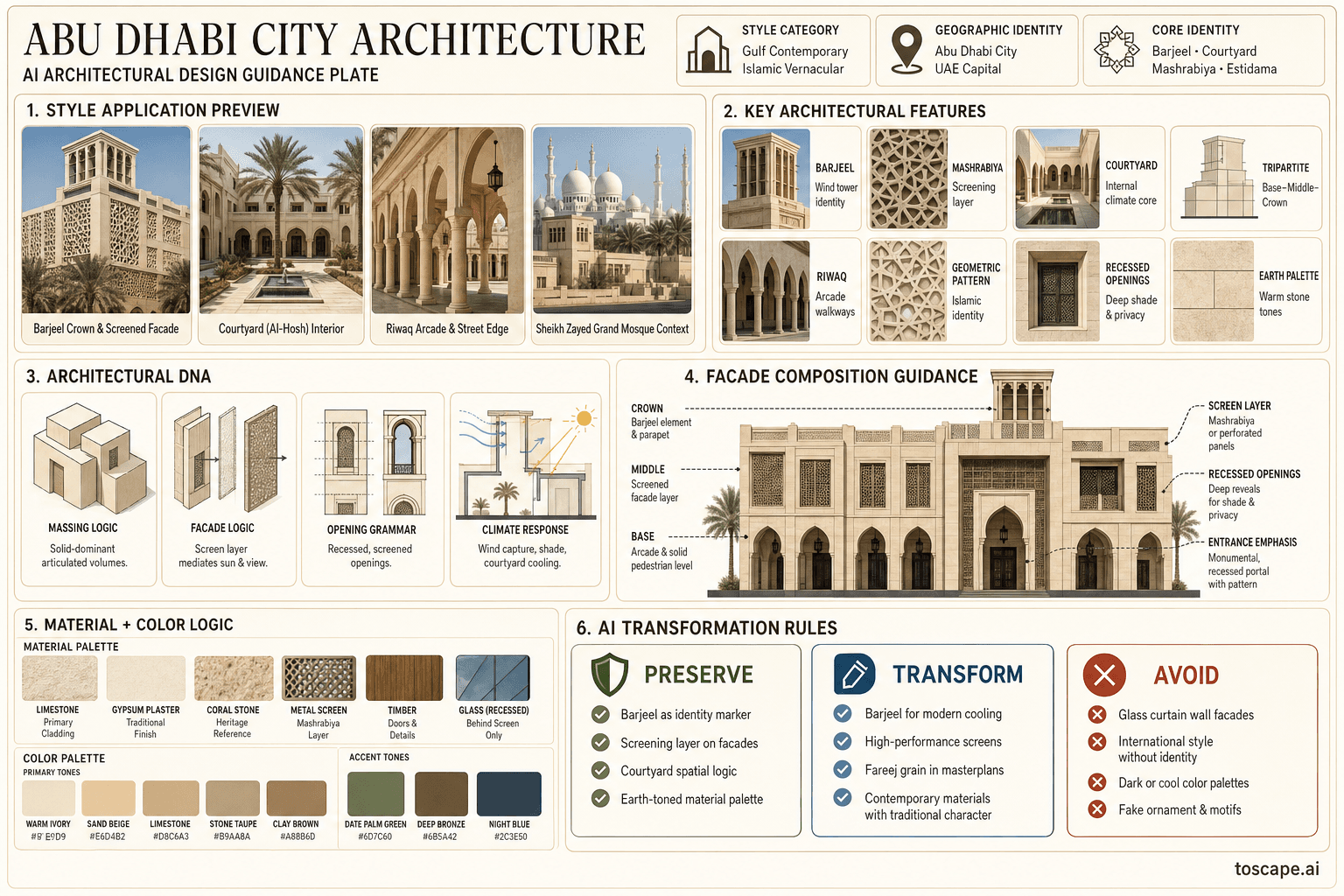
Abu Dhabi's architectural identity guidelines prescribe a hierarchy of massing that respects traditional Gulf proportions. Buildings are conceived as articulated cubic volumes — the mass reads as a primary solid form with secondary volumes, recesses, and screening layers.
Facade Language
The Abu Dhabi facade as prescribed by the Identity Guidelines is organized around four principles: Tripartite division: Base (2–4 storeys — solid, pedestrian-scaled, with retail or entrance articulation), middle/shaft (tower floors — screened fenestration, vertical or horizontal emphasis), and crown (top 2–3 floors + p...
Materials & Texture
Limestone — warm cream to beige, the primary cladding material for contemporary buildings Gypsum plaster — traditional wall render, white to cream, smooth finish Coral stone (farrush) — heritage material, used as accent in sensitive locations Perforated metal screens — aluminum, brass, or powder-coated steel with geome...
Color Palette
White, cream, pale sand, warm timber, and shadow-driven dark metal accents define the palette. The facade should stay bright and climate-aware rather than heavy, gray, or over-saturated.
Ornament & Detail
Abu Dhabi ornament derives from Islamic geometric tradition and Emirati cultural heritage: (1) Islamic star patterns — 8-point, 10-point, and 12-point star compositions at multiple scales — from building-height screens to door-panel detailing, (2) palm tree (nakheel) motifs — abstracted palm frond and trunk patterns re...
Climate Response
Abu Dhabi's extreme hot-humid climate drives the architectural response: (1) Courtyard as microclimate — the internal hosh with shade trees and water features provides a cool outdoor zone. (2) Barjeel passive cooling — wind towers capture prevailing north-west winds, channeling air into interiors — the traditional air...
Landscape & Ground
The architectural identity system of Abu Dhabi City as defined by the Department of Urban Planning & Municipalities (DPM) Architectural Identity Guidelines — a regulatory framework with three primary goals: enhance the architectural image of the region, enforce architectural coherence across development types, and capt...
Reference elevation
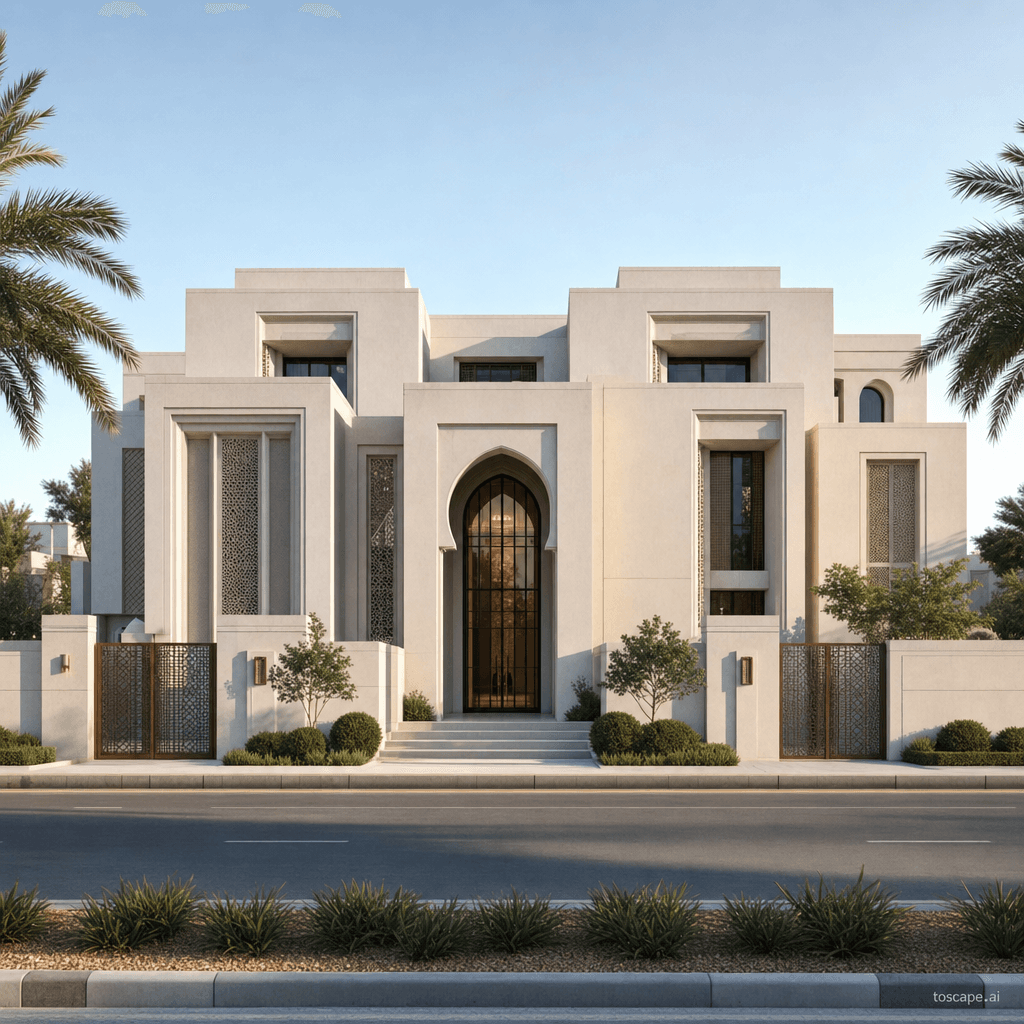
Abu Dhabi City — characteristic facade composition, architectural identity system of Abu Dhabi City as defined by the Department of....
Context Snapshot
The architectural identity system of Abu Dhabi City as defined by the Department of Urban Planning & Municipalities (DPM) Architectural Identity Guidelines — a regulatory framework with three primary... Abu Dhabi's extreme hot-humid climate drives the architectural response: (1) Courtyard as microclimate — the internal hosh with shade trees and water features provides a cool outdoor zone.
Contemporary Relevance
Abu Dhabi City is useful today for residential, hospitality, civic, and place-branding work that needs UAE-specific character grounded in local massing, material tone, climate response, and settlement logic rather than generic international styling.
Use this style in Toscape
Explore Abu Dhabi City directly inside Toscape using the Facade Re-Style and Design Options workflows.
Open Abu Dhabi City in the gallery