Afar Mat-Tent
Ethiopia · architectural identity of the Afar people
The domed palm-mat tent of the Afar nomads — the ari (dabou) of the Danakil Depression, where arched acacia-pole frameworks are draped with woven doum-palm mats to create a low-pro...
Overview
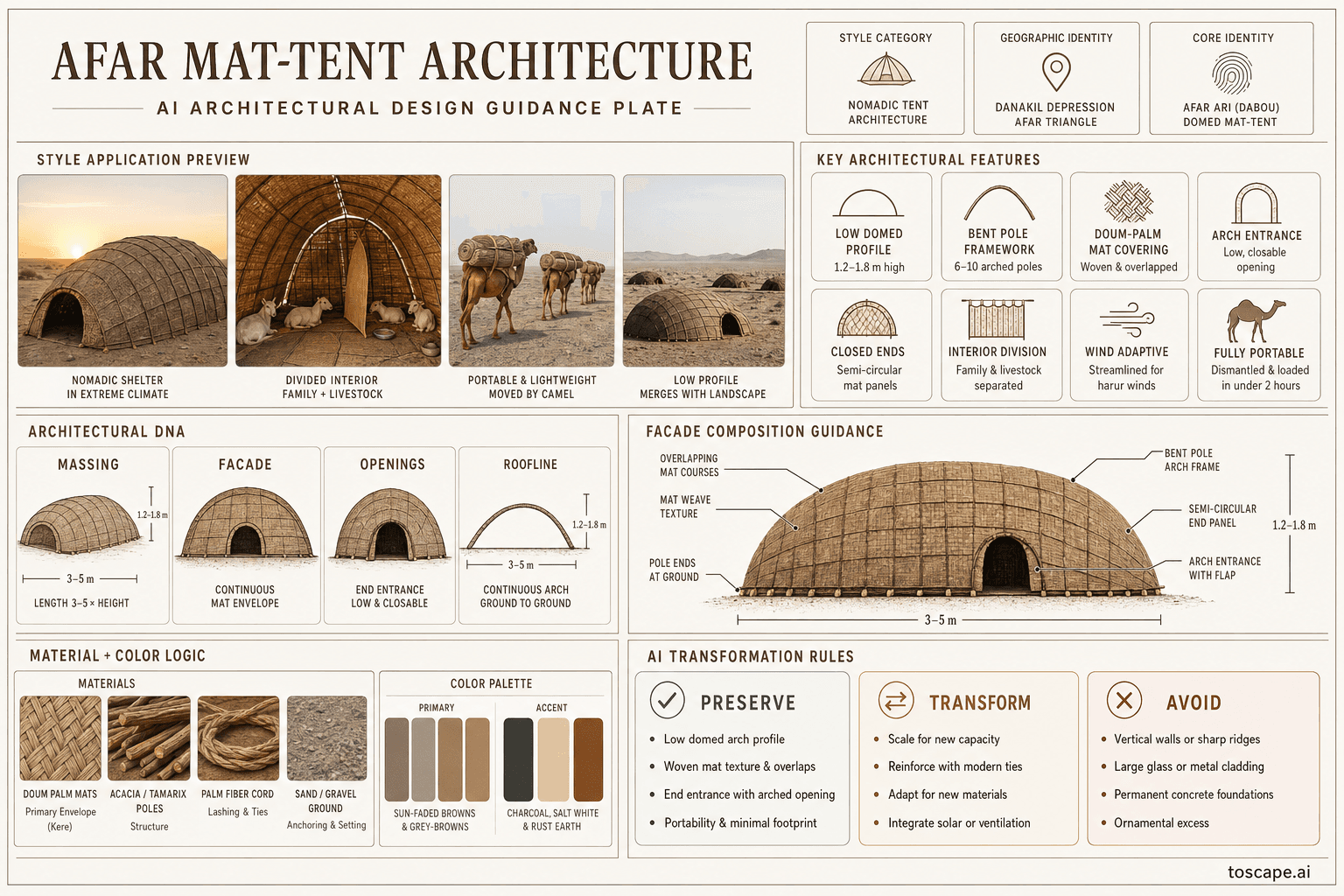
Afar Mat-Tent is a regional architectural identity in Ethiopia. The architectural identity of the Afar people — the nomadic pastoralists of the Danakil Depression (Afar Triangle, 100–150 m below sea level, one of the hottest places on Earth with daily temperatures of 40–50°C and an average annual temperature of 34.5°C) — the ari (also called dabou or kere), a portable domed tent constructed from a framework of bent acacia poles (6–10 poles, arched into semi-circles, their ends dr...
Visual DNA
Massing & Form
The ari is a low barrel-vault of bent poles — a continuous curved arch profile that reads as a half-cylinder or elongated hemisphere sitting directly on the ground. There is no vertical wall — the curved envelope springs from the ground plane and returns to it, creating a streamlined form that presents minimal resistan...
Facade Language
The ari has no distinct facade — the entire envelope is a single continuous mat-textured surface. The mat weave creates a rhythmic diagonal or grid texture in golden-brown to grey-brown tones, with visible overlaps where mats meet (creating horizontal banding at the lap joints).
Materials & Texture
The palette is entirely organic and gathered from the Afar environment: (1) Doum palm (Hyphaene thebaica) — the fronds are harvested, dried, split, and woven into mats (kere) by Afar women — the primary cladding and defining material. (2) Acacia wood (Acacia tortilis, Acacia nubica) — the flexible young branches used f...
Color Palette
Warm earth, sandy beige, ochre, clay brown, and sun-softened mineral tones should dominate, with palm green or weathered timber as secondary accents. The palette should read as land-derived rather than polished or urban-generic.
Ornament & Detail
There is no applied ornament. The aesthetic is derived entirely from the making: (1) The doum-palm mat weave pattern — variations in weave density and direction (plain weave, diagonal twill, checkerboard) create the visual texture — some mats incorporate darker palm fibers to create simple stripe or geometric patterns.
Climate Response
The Danakil Depression is an extreme environment: one of the lowest (100–155 m below sea level) and hottest places on Earth, with daytime temperatures regularly 40–50°C, ground temperatures exceeding 60°C, annual rainfall under 200 mm, and fierce hot dry winds (harur). The ari is a masterclass in passive climate adapta...
Landscape & Ground
The architectural identity of the Afar people — the nomadic pastoralists of the Danakil Depression (Afar Triangle, 100–150 m below sea level, one of the hottest places on Earth with daily temperatures of 40–50°C and an average annual temperature of 34.5°C) — the ari (also called dabou or kere), a portable domed tent co...
Reference elevation
Afar Mat-Tent — characteristic facade composition, architectural identity of the Afar people.
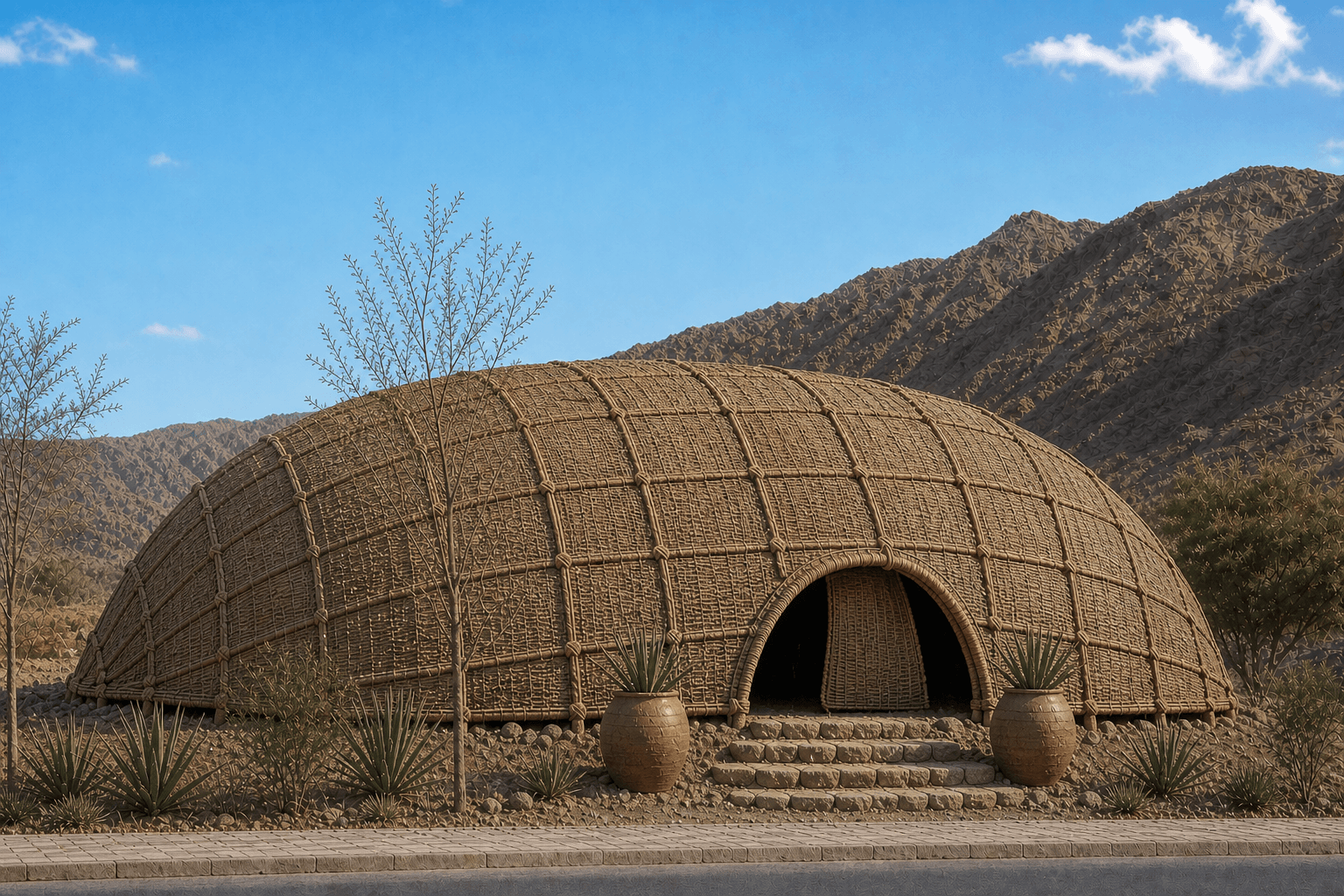
Context Snapshot
The architectural identity of the Afar people — the nomadic pastoralists of the Danakil Depression (Afar Triangle, 100–150 m below sea level, one of the hottest places on Earth with daily temperatures... The Danakil Depression is an extreme environment: one of the lowest (100–155 m below sea level) and hottest places on Earth, with daytime temperatures regularly 40–50°C, ground temperatures exceeding 60°C, annual rainfal...
Contemporary Relevance
Afar Mat-Tent is useful today for residential, hospitality, civic, and place-branding work that needs Ethiopia-specific character grounded in local massing, material tone, climate response, and settlement logic rather than generic international styling.
Use this style in Toscape
Explore Afar Mat-Tent directly inside Toscape using the Facade Re-Style and Design Options workflows.
Open Afar Mat-Tent in the gallery