Aleppo Courtyard House
Syria · Aleppine courtyard house of the late Mamluk and Ottoman periods (15th–19th centu...
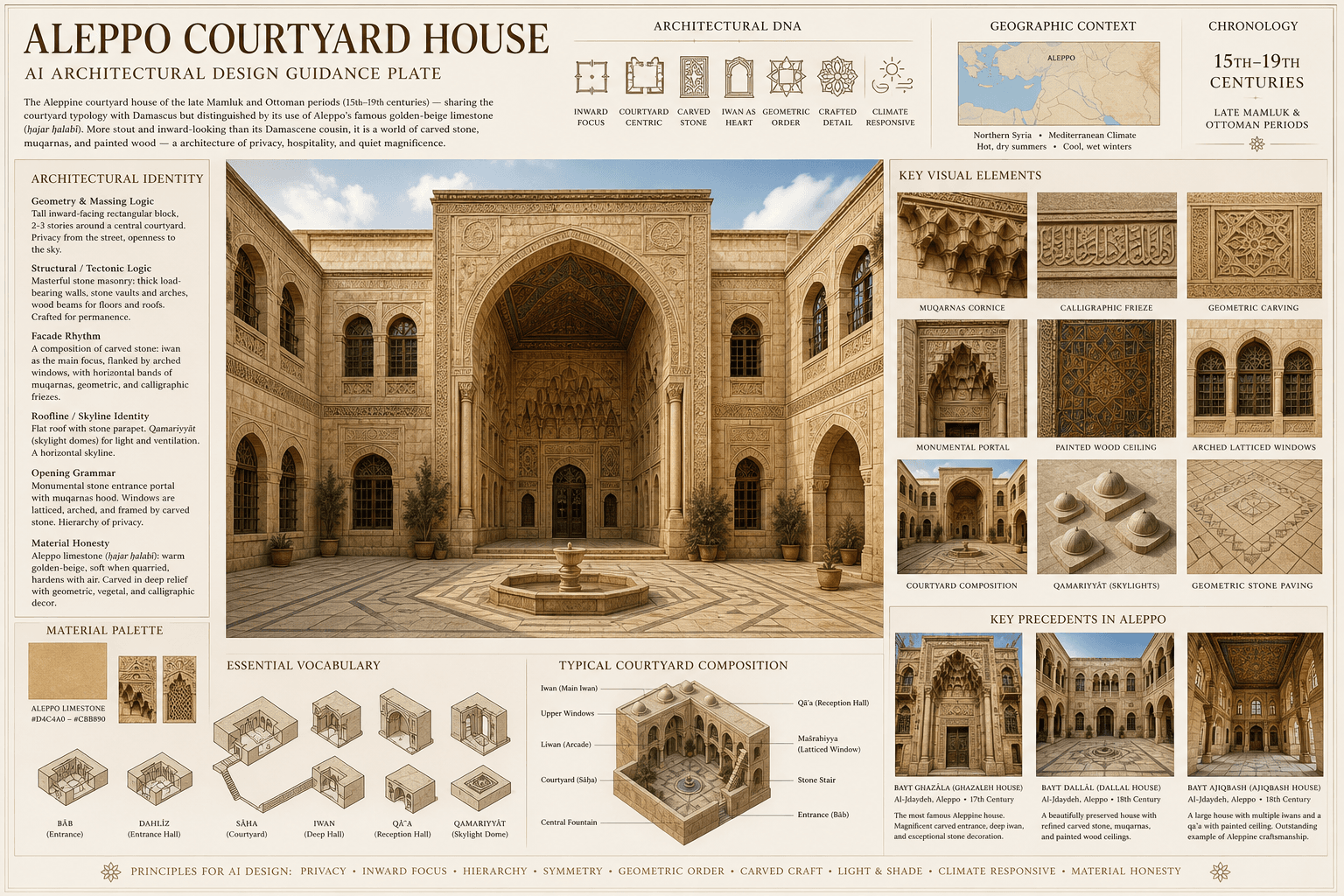
The Bayt Ḥalabī (Aleppine courtyard house) — the traditional urban house of Aleppo, built from the distinctive warm golden-beige limestone (ḥajar ḥalabī) that gives the city its mo...
Overview
Aleppo Courtyard House is a regional architectural identity in Syria. The Aleppine courtyard house of the late Mamluk and Ottoman periods (15th–19th centuries) — sharing the courtyard typology with Damascus but distinguished by its use of Aleppo's famous golden-beige limestone (a soft, easily carved stone that hardens on exposure to air) — the Aleppo house is more stone-intensive than Damascus: where Damascus uses ablāq (two-color stone), Aleppo achieves its ornament through deep relie...
Visual DNA
Massing & Form
The Aleppine house is a tall inward-facing rectangular block of golden limestone, 2–3 stories, with a flat roof and stone parapet. The central courtyard (ḥawsh) is typically larger than Damascus (12–18 m × 15–25 m), proportional to the greater wealth of Aleppo's merchant class.
Facade Language
The courtyard elevations are a composition of carved stone: (1) The iwan — the south wall of the courtyard is dominated by the great arch of the north-facing iwan — the arch is framed by a carved stone band of geometric ornament and often a muqarnas cornice above — the iwan's rear wall has carved stone niches (ḥaniyya)...
Materials & Texture
Aleppo limestone (ḥajar ḥalabī) — warm golden-beige (#D4C4A0 to #C8B890), a soft, easily carved Eocene limestone that hardens on exposure — the stone weathers to a slightly darker, softer gold (#B8A880). The stone is the material of walls, paving, and ornament — the Aleppo house is a monochrome stone object.
Color Palette
White, cream, pale sand, warm timber, and shadow-driven dark metal accents define the palette. The facade should stay bright and climate-aware rather than heavy, gray, or over-saturated.
Ornament & Detail
Aleppine ornament is carved in stone: (1) Geometric stone carving — bands of interlocking star patterns, strap-work, and running geometric friezes carved in deep relief on the courtyard walls — the carving is typically 2–5 cm deep, creating strong shadow lines in the Aleppo sun. (2) Muqarnas — the stalactite-like honey...
Climate Response
Aleppo's climate is continental — hot dry summers (35–40°C), cold winters (sometimes below freezing) — the courtyard provides summer cooling through thermal mass and fountain evaporation — the north-facing iwan captures the prevailing breeze — the thick stone walls (0.8–1.2 m) provide both thermal mass against summer h...
Landscape & Ground
The Aleppine courtyard house of the late Mamluk and Ottoman periods (15th–19th centuries) — sharing the courtyard typology with Damascus but distinguished by its use of Aleppo's famous golden-beige limestone (a soft, easily carved stone that hardens on exposure to air) — the Aleppo house is more stone-intensive than Da...
Reference elevation
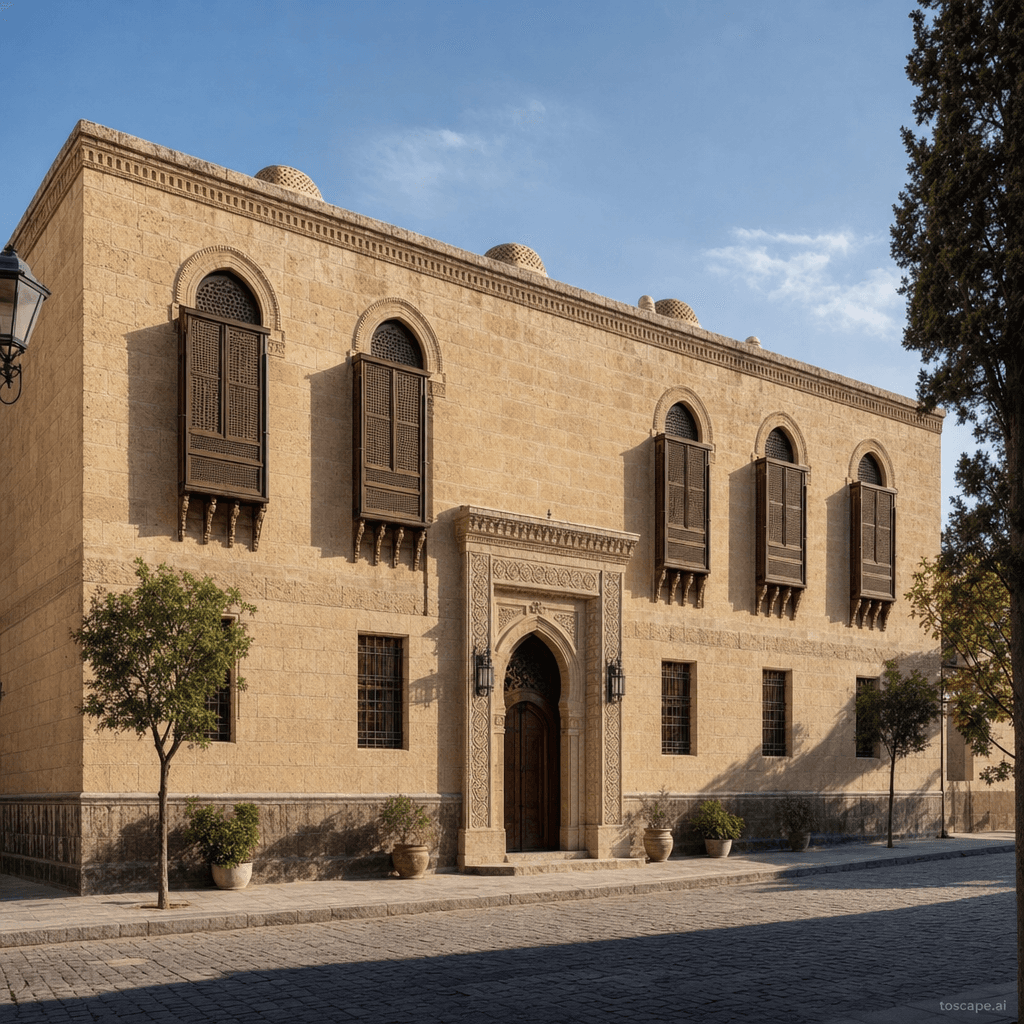
Aleppo Courtyard House — characteristic facade composition, Aleppine courtyard house of the late Mamluk and Ottoman periods (15th–19th centu....
Context Snapshot
The Aleppine courtyard house of the late Mamluk and Ottoman periods (15th–19th centuries) — sharing the courtyard typology with Damascus but distinguished by its use of Aleppo's famous golden-beige li... Aleppo's climate is continental — hot dry summers (35–40°C), cold winters (sometimes below freezing) — the courtyard provides summer cooling through thermal mass and fountain evaporation — the north-facing iwan captures...
Contemporary Relevance
Aleppo Courtyard House is useful today for residential, hospitality, civic, and place-branding work that needs Syria-specific character grounded in local massing, material tone, climate response, and settlement logic rather than generic international styling.
Use this style in Toscape
Explore Aleppo Courtyard House directly inside Toscape using the Facade Re-Style and Design Options workflows.
Open Aleppo Courtyard House in the gallery