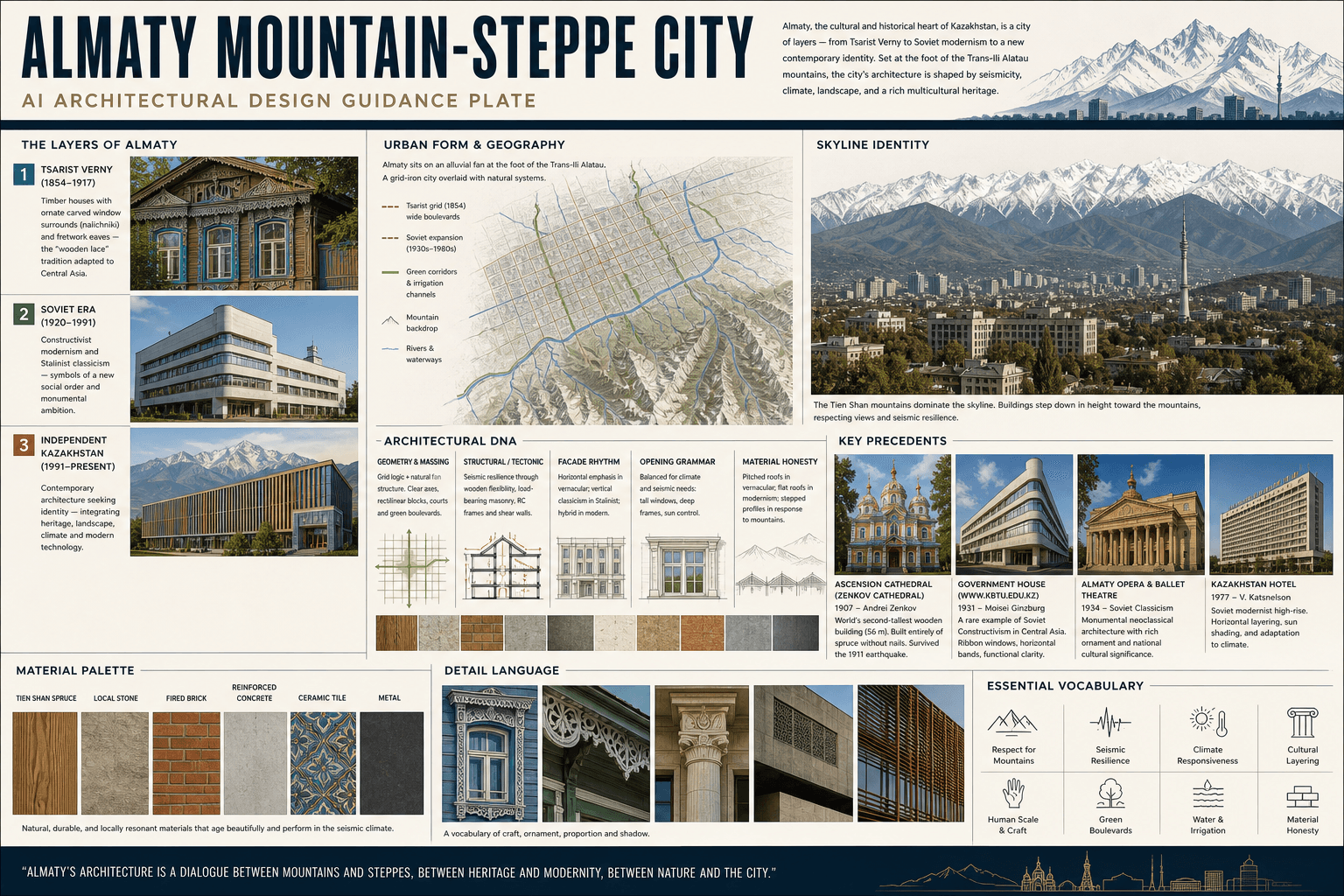
Almaty Mountain-Steppe City
Kazakhstan · architectural identity of Almaty (Alma-Ata during the Soviet period, renamed 199...
Kazakhstan's cultural capital at the foot of the Trans-Ili Alatau — a garden city of tree-lined boulevards where Tsarist Russian timber-lace houses, Soviet Constructivist administr...
Overview
Almaty Mountain-Steppe City is a regional architectural identity in Kazakhstan. The architectural identity of Almaty (Alma-Ata during the Soviet period, renamed 1993), the former capital and largest city of Kazakhstan — founded as the Russian fort of Verny in 1854, the city developed through distinct architectural layers: Tsarist colonial wooden vernacular (the "wooden lace" houses of the late 19th century), Soviet Constructivist and Stalinist Neoclassical structures (1920s–1950s), Soviet Modern...
Visual DNA
Massing & Form
Almaty's urban form is a grid-iron city overlaid on an alluvial fan: (1) The Tsarist grid — wide, straight boulevards (40–60 m) planted with rows of poplars (the iconic Almaty pyramidal poplar, Populus alba var. pyramidalis) and elms, creating a green tunnel effect — the broad streets were designed for horse-drawn traf...
Facade Language
Almaty's facades tell the city's architectural history: (1) Tsarist timber house facade — a horizontal composition: low stone or brick foundation → painted horizontal timber plank or log wall (white, blue, or ochre) → tall windows (1–1.5 m wide, 2–2.5 m high) with carved nalichniki (window surrounds) → elaborately carv...
Materials & Texture
Almaty's materials reflect the city's layered history: (1) Tien Shan spruce (Picea schrenkiana) — the primary timber of the Tsarist era, from the mountain forests of the Trans-Ili Alatau — used for house frames, carved ornament, and the structural frame of Zenkov Cathedral — the wood is pale, straight-grained, and resi...
Color Palette
White, cream, pale sand, warm timber, and shadow-driven dark metal accents define the palette. The facade should stay bright and climate-aware rather than heavy, gray, or over-saturated.
Ornament & Detail
Almaty's ornament is a palimpsest of Russian and Kazakh traditions: (1) Russian wooden lace — the carved nalichniki, prichelina (eave boards), and polotentsa (gable pendants) of Tsarist houses — the carving vocabulary is Russian floral and geometric, but in Almaty, some houses incorporate Kazakh motifs: the eight-point...
Climate Response
Almaty has a humid continental climate (Dfa) moderated by its elevation and mountain proximity: (1) The Tien Shan mountains create a dramatic microclimate: the peaks capture moisture from prevailing westerly winds, feeding the rivers that irrigate the city — the mountain-valley breeze cycle means cool air descends from...
Landscape & Ground
The architectural identity of Almaty (Alma-Ata during the Soviet period, renamed 1993), the former capital and largest city of Kazakhstan — founded as the Russian fort of Verny in 1854, the city developed through distinct architectural layers: Tsarist colonial wooden vernacular (the "wooden lace" houses of the late 19t...
Reference elevation
Almaty Mountain-Steppe City — characteristic facade composition, architectural identity of Almaty (Alma-Ata during the Soviet period, renamed 199....
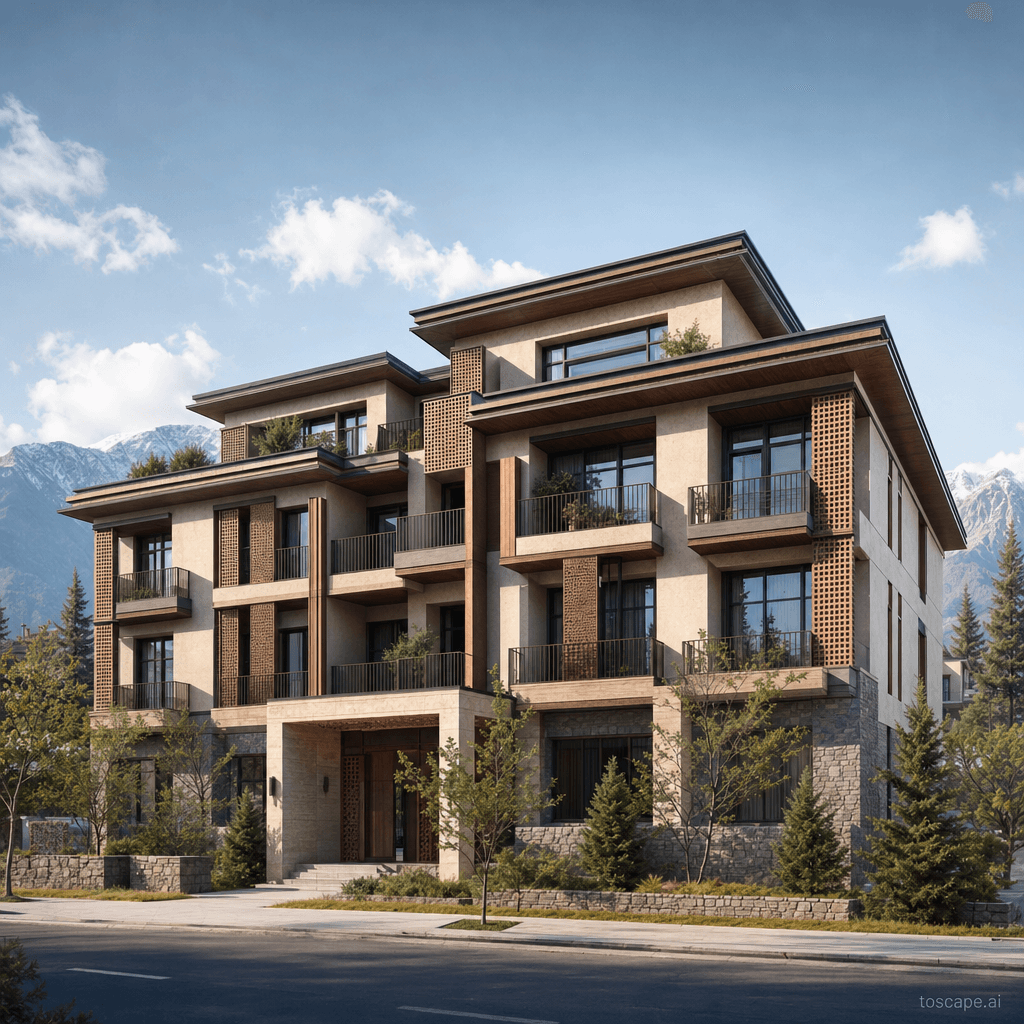
Context Snapshot
The architectural identity of Almaty (Alma-Ata during the Soviet period, renamed 1993), the former capital and largest city of Kazakhstan — founded as the Russian fort of Verny in 1854, the city devel... Almaty has a humid continental climate (Dfa) moderated by its elevation and mountain proximity: (1) The Tien Shan mountains create a dramatic microclimate: the peaks capture moisture from prevailing westerly winds, feedi...
Contemporary Relevance
Almaty Mountain-Steppe City is useful today for residential, hospitality, civic, and place-branding work that needs Kazakhstan-specific character grounded in local massing, material tone, climate response, and settlement logic rather than generic international styling.
Use this style in Toscape
Explore Almaty Mountain-Steppe City directly inside Toscape using the Facade Re-Style and Design Options workflows.
Open Almaty Mountain-Steppe City in the gallery