Dutch Amsterdam Canal House
Netherlands · Amsterdam canal house (Grachtenpand) of the 17th-century Dutch Golden Age (Goude...
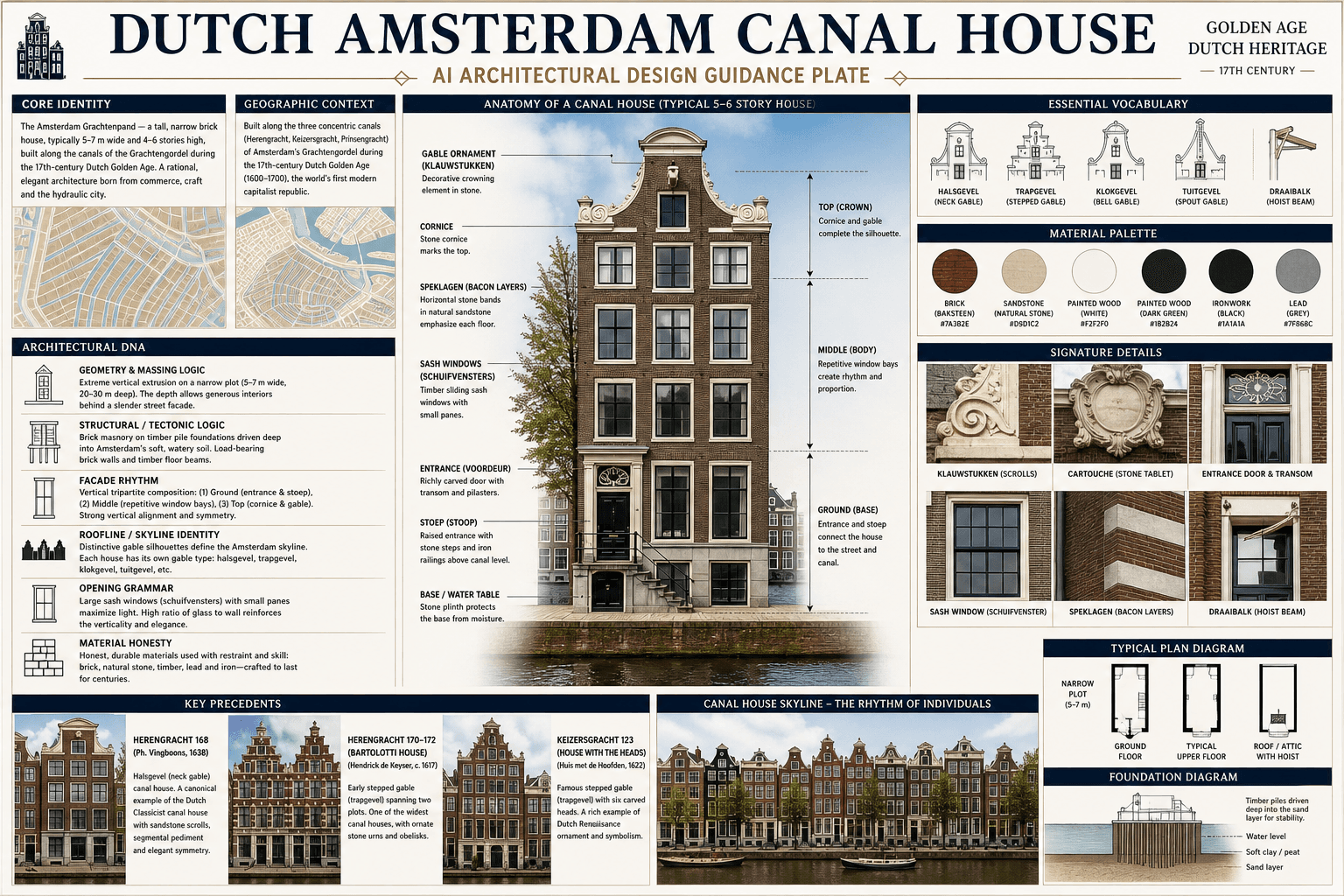
The Amsterdam canal house (Grachtenpand) — the iconic tall narrow brick townhouse of the Dutch Golden Age, lining the concentric canals of Amsterdam with its distinctive neck gable...
Overview
Dutch Amsterdam Canal House is a regional architectural identity in Netherlands. The Amsterdam canal house (Grachtenpand) of the 17th-century Dutch Golden Age (Gouden Eeuw) — the urban architecture of the world's first modern capitalist republic, developed along the three great concentric canals of the Grachtengordel (Herengracht, Keizersgracht, Prinsengracht) during Amsterdam's explosive growth as the center of global trade — the canal house is a tall, extremely narrow brick townhouse (typically...
Visual DNA
Massing & Form
The Amsterdam canal house is an extreme vertical extrusion driven by the narrow plot width (5–7 m) and significant depth (15–30 m). The house is much deeper than it is wide — a "deep house" (diephuis) — with light brought in via the front windows, a narrow side light court, and the rear garden facing the adjacent canal...
Facade Language
The canal house facade is organized as a vertical tripartite stack: (1) Ground floor — the entrance stoop (stoep): a raised stone doorstep (3–5 steps) with wrought-iron handrails, leading to an ornate timber door (voordeur) — the door is typically a double door (boven- en onderdeur — upper and lower halves that open in...
Materials & Texture
The Dutch canal house palette is restrained and dignified: (1) Brick (baksteen) — dark red-brown to deep burgundy (#7A3B2A to #5B2A1A), a small-format brick (the "IJsselsteen," about 18–20 cm long) laid in a fine mortar joint — the brick surface is the dominant visual field. (2) Sandstone (zandsteen) — pale cream to wa...
Color Palette
White, cream, pale sand, warm timber, and shadow-driven dark metal accents define the palette. The facade should stay bright and climate-aware rather than heavy, gray, or over-saturated.
Ornament & Detail
Dutch canal house ornament is concentrated at the gable and the entrance: (1) The gable ornament — the sandstone scrolls (klauwstukken) are the most expressive sculptural elements: large volute scrolls with acanthus leaf carving at the base (the "claw"), flanking the central neck and supporting the pediment — these scr...
Climate Response
Amsterdam occupies a reclaimed delta landscape, the "Low Countries" (Nederland — literally "low land"): (1) Watery soil — the entire city is built on timber piles driven through peat and clay to sand — without pile foundations, buildings would sink — the necessity of pile foundations limited plot widths and encouraged...
Landscape & Ground
The Amsterdam canal house (Grachtenpand) of the 17th-century Dutch Golden Age (Gouden Eeuw) — the urban architecture of the world's first modern capitalist republic, developed along the three great concentric canals of the Grachtengordel (Herengracht, Keizersgracht, Prinsengracht) during Amsterdam's explosive growth as...
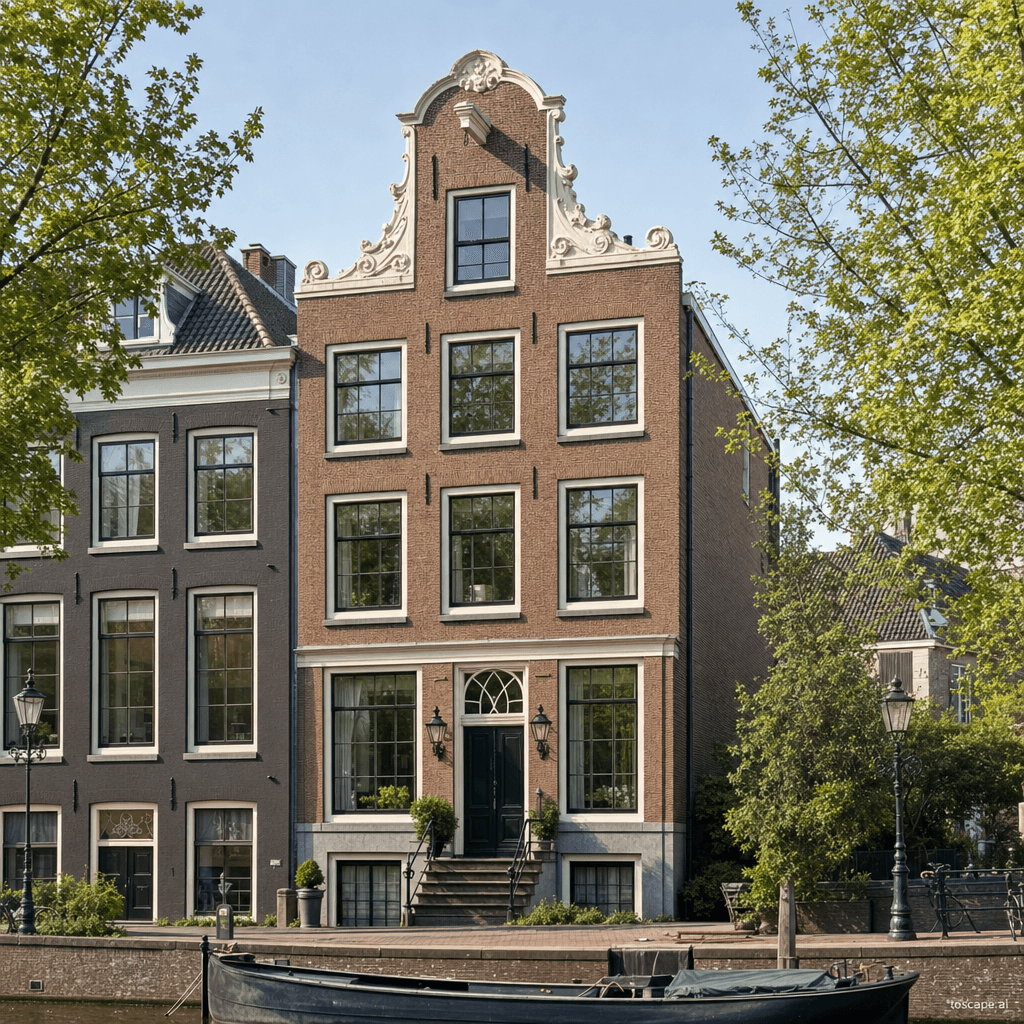
Reference elevation
Dutch Amsterdam Canal House — characteristic facade composition, Amsterdam canal house (Grachtenpand) of the 17th-century Dutch Golden Age (Goude....
Context Snapshot
The Amsterdam canal house (Grachtenpand) of the 17th-century Dutch Golden Age (Gouden Eeuw) — the urban architecture of the world's first modern capitalist republic, developed along the three great co... Amsterdam occupies a reclaimed delta landscape, the "Low Countries" (Nederland — literally "low land"): (1) Watery soil — the entire city is built on timber piles driven through peat and clay to sand — without pile found...
Contemporary Relevance
Dutch Amsterdam Canal House is useful today for residential, hospitality, civic, and place-branding work that needs Netherlands-specific character grounded in local massing, material tone, climate response, and settlement logic rather than generic international styling.
Use this style in Toscape
Explore Dutch Amsterdam Canal House directly inside Toscape using the Facade Re-Style and Design Options workflows.
Open Dutch Amsterdam Canal House in the gallery