Aseer Escarpment Traditional
Saudi Arabia · Aseer Escarpment
Stone tower-house vernacular of the escarpment villages, Asdar region, pre-20th century CE
Overview
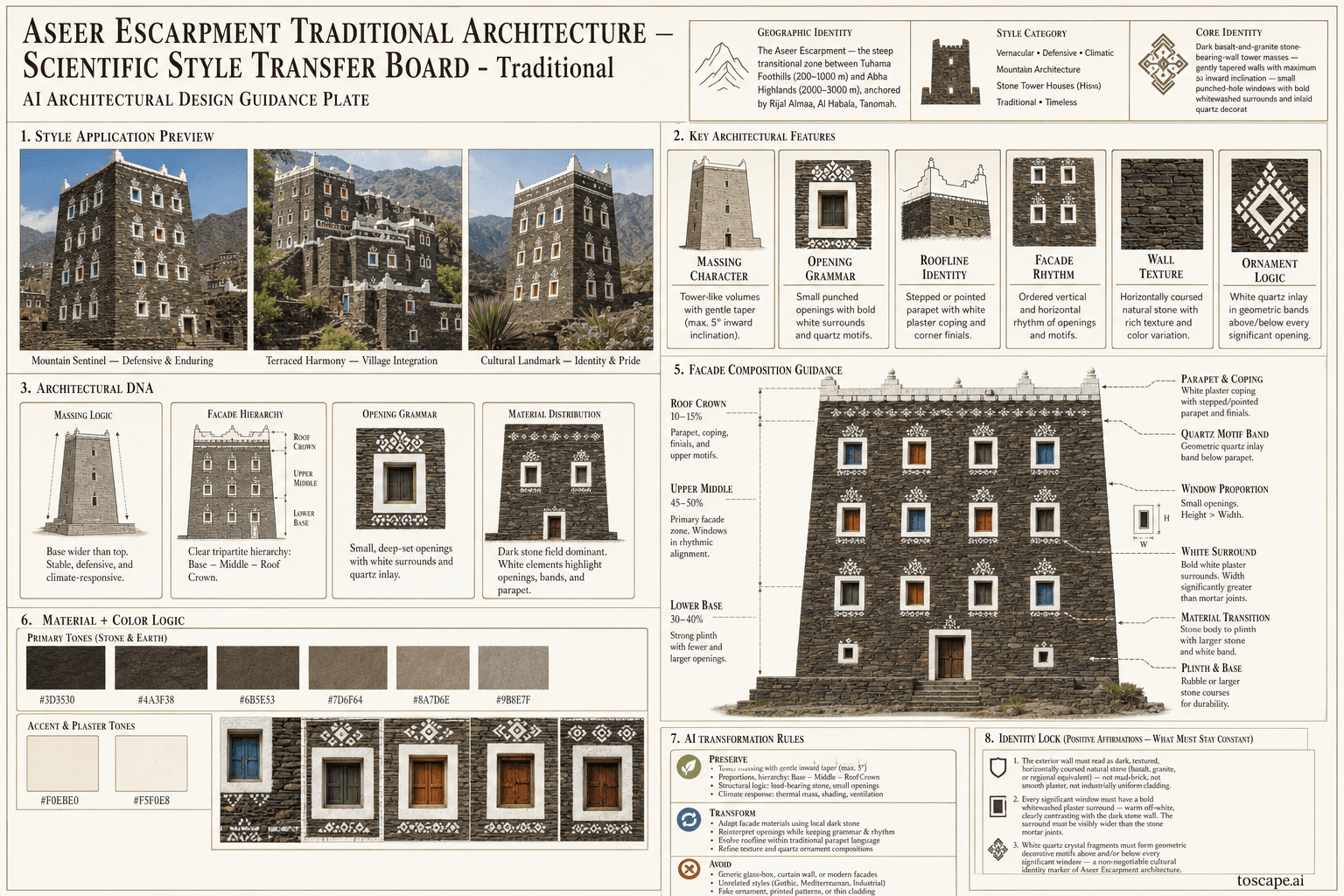
Aseer Escarpment Traditional is a Saudi architectural identity rooted in Aseer Escarpment. Aseer Escarpment Architecture (one of 19 Saudi Architecture Characters Map styles, ADG-07). The Aseer Escarpment — the steep transitional zone between Tuhama Foothills (200–1000 m) and Abha Highlands (2000–3000 m), anchored by Rijal Almaa, Al Majared, and Al Soudah.
Visual DNA
Massing & Form
Traditional Aseer Escarpment buildings are compact, vertical stone tower-houses with documented width-to-height ratios of 1:0.9 to 1:2.5 — the building reads as taller than it is wide in most cases . Buildings range from 2–4 storeys for ordinary dwellings, with tower houses reaching up to 6 storeys (approximately 18–24...
Facade Language
The facade is governed by tripartite articulation: a distinct base, middle, and top . The base (ground floor to approximately first 1–3 storeys) is characterized by minimal openings — small doors recessed from the facade, narrow defensive slits — establishing a solid, grounded, defensive character .
Materials & Texture
All traditional materials are locally sourced from the escarpment's igneous geology and agricultural base. Local stone (basalt, granite, diorite, sandstone): the primary and often sole building material, quarried from the Arabian Shield escarpment, used in horizontal coordinated courses as load-bearing masonry .
Color Palette
Stone greys, lime white, sun-aged timber, and selective mineral accents shape the palette. Highland and escarpment identities can carry stronger painted or stratified contrast, but the wall mass should still feel geologic and rooted in terrain.
Ornament & Detail
Ornament in Aseer Escarpment Traditional architecture is concentrated at specific zones and governed by the Al Qatt Al Asiri artistic tradition — a UNESCO-recognized Intangible Cultural Heritage (2017) practiced by women of the Asir region . Ornamentation zones: (a) White window surrounds with inlaid quartz — whitewash...
Climate Response
The Aseer Escarpment climate is semi-arid highland: summer maximum temperatures reach approximately 32°C, winter lows drop to 9°C, with high precipitation reaching 40 mm in April, relatively low humidity (approximately 1% humidity level), and the area is mostly cloudy from May to October . The escarpment topography — s...
Landscape & Ground
The Aseer Escarpment — the steep transitional zone between Tuhama Foothills (200–1000 m) and Abha Highlands (2000–3000 m), anchored by Rijal Almaa, Al Majared, and Al Soudah. Ridah Escarpment Reserve, approximately 20 km northwest of Abha, on the cliff of the Arabian Shield (igneous rock sediments).
Reference elevation
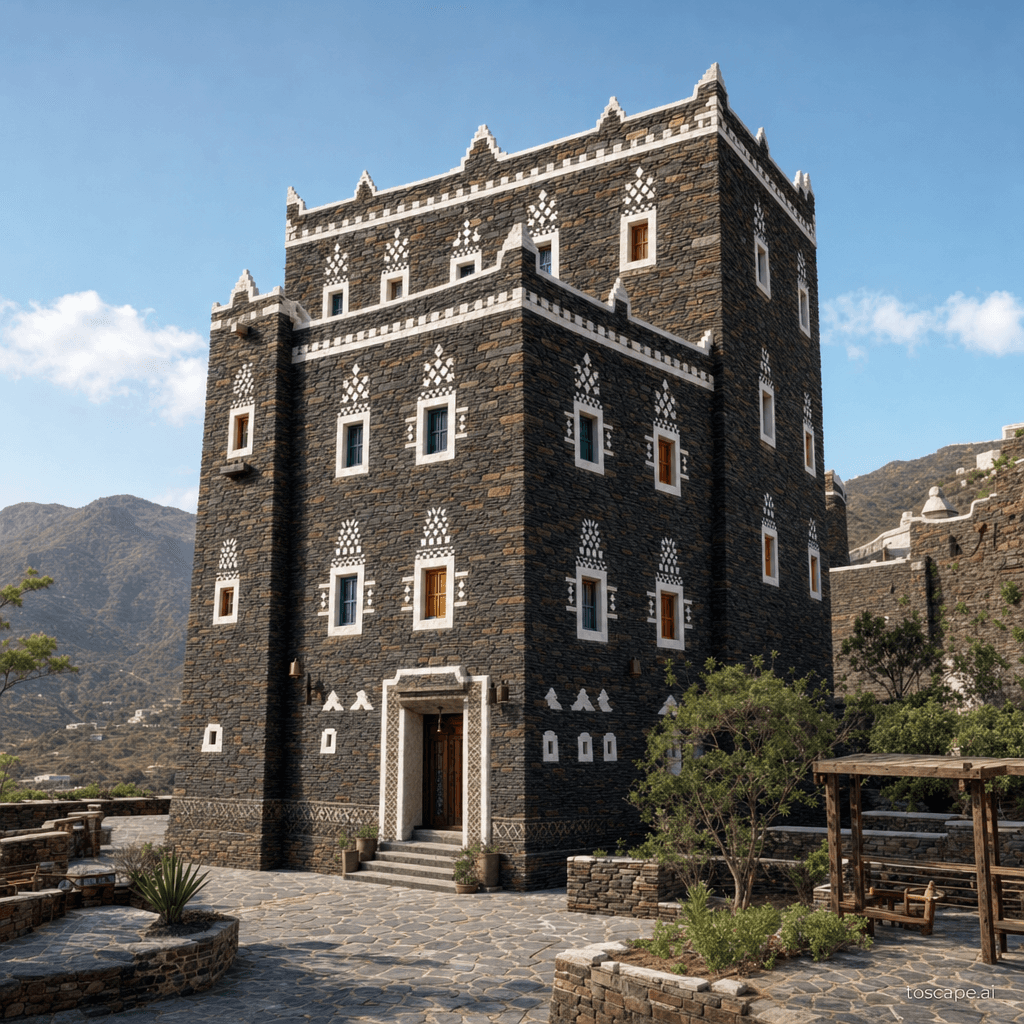
Aseer Escarpment Traditional — characteristic facade composition, Aseer Escarpment.
Context Snapshot
Traditional stone tower-house domestic and village vernacular of the Aseer Escarpment (Asdar sub-region), Traditional sub-style Aseer Escarpment Architecture (one of 19 Saudi Architecture Characters Map styles, ADG-07) The Aseer Escarpment — the steep transitional zone between Tuhama Foothills (200–1000 m) and Abha Highlands (2000–3000 m), anchored by Rijal Almaa, Al Majared, and Al Soudah.
Contemporary Relevance
Aseer Escarpment Traditional operates as the heritage reference layer for Aseer Escarpment and is most useful today in conservation work, cultural tourism districts, and accurate AI rendering direction. Its value in current practice comes from preserving proportion, material hierarchy, and climate logic without flattening them into generic nostalgia.
Use this style in Toscape
Explore Aseer Escarpment Traditional directly inside Toscape using the Facade Re-Style and Design Options workflows.
Open Aseer Escarpment Traditional in the gallery