Bahrain Village Heritage
Bahrain · village architecture of Bahrain's northern agricultural belt and coastal fishing...
The agricultural and fishing village vernacular of Bahrain's islands — date palm groves, freshwater springs, barasti dwellings, and the architectural heritage of Bahrain's rural co...
Overview
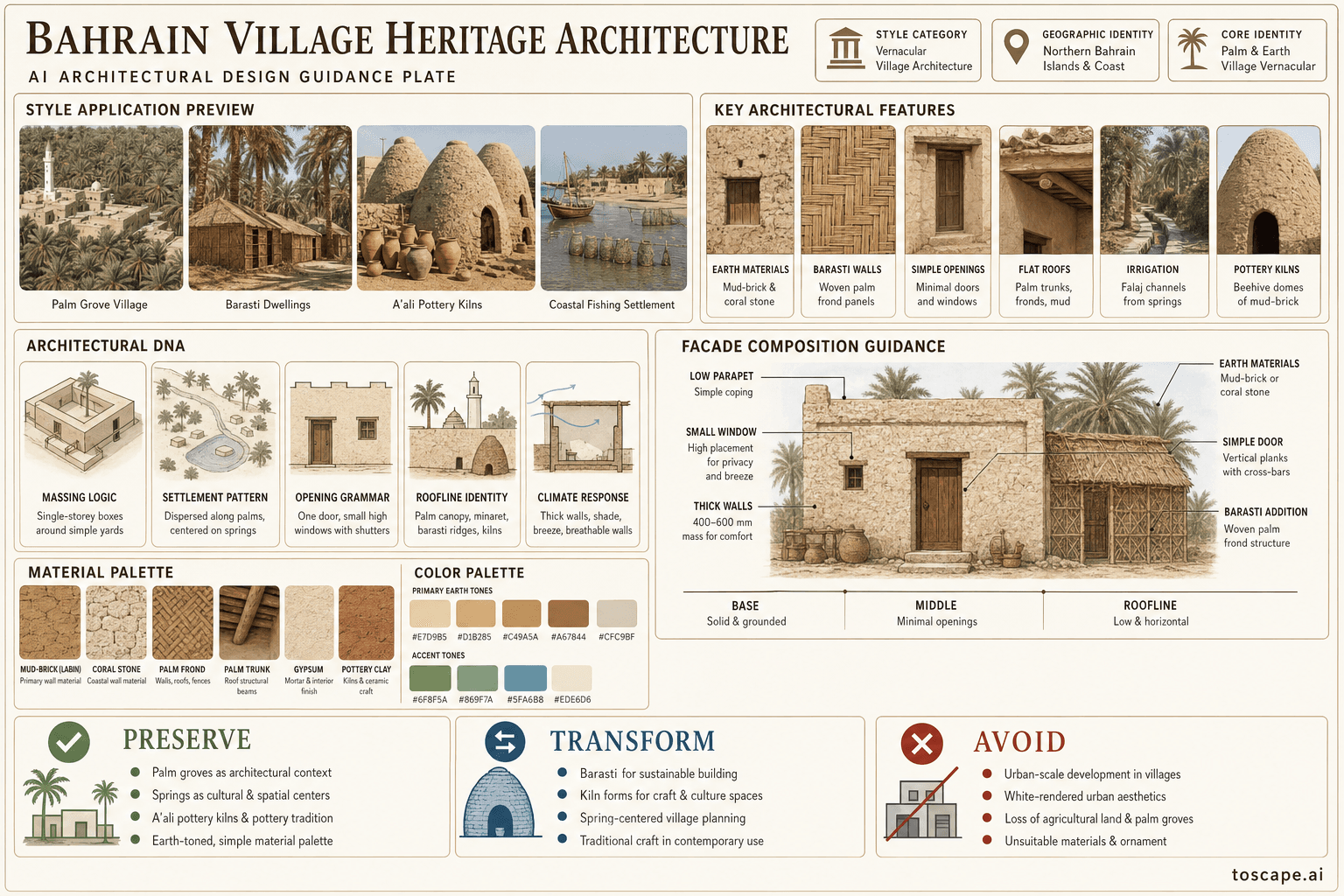
Bahrain Village Heritage is a regional architectural identity in Bahrain. Traditional village architecture of Bahrain's northern agricultural belt and coastal fishing communities — the date palm-cultivating villages of the northern governorates (Buri, A'ali, Barbar, Diraz) and the fishing settlements of the offshore islands. This architectural tradition represents the agricultural and maritime foundations of Bahraini life before the pearling boom concentrated wealth in Manama and Muharraq.
Visual DNA
Massing & Form
Bahraini village buildings are single-storey rectangular volumes — 6–12 m wide × 8–16 m deep — with flat roofs and low parapets. Courtyards are simpler than urban examples — often just a walled open area with a shade tree rather than the elaborate arcaded hosh of merchant houses.
Facade Language
The village facade is defined by functional simplicity: External walls: Mud-brick or coral stone with minimal render. Walls may show exposed stone with mud pointing or a thin mud-plaster coating — earth tones rather than the urban white Openings: Minimal — one entrance door and perhaps a small rectangular window (400–6...
Materials & Texture
Mud-brick (labin) — warm earth tones, golden-ochre to brown — for walls in the agricultural north Coral stone (hajar al-manqabi) — cream-gray — for walls in coastal villages Palm fronds (barusti / khassaf) — woven into wall panels, roof matting, fencing, and shade structures Palm trunks — structural beams for roofs Gyp...
Color Palette
White, cream, pale sand, warm timber, and shadow-driven dark metal accents define the palette. The facade should stay bright and climate-aware rather than heavy, gray, or over-saturated.
Ornament & Detail
Ornament in village architecture is concentrated in craft production rather than building decoration: (1) A'ali pottery — the primary decorative art of Bahrain's villages. Traditional water jars (hibb / jahla), incense burners (mabkhara), and cooking vessels with incised geometric patterns and applied clay decoration.
Climate Response
Village architecture is an agricultural and maritime climate response: (1) Freshwater springs (ain / uyun) — Bahrain's northern belt is blessed with natural artesian springs that emerge from the underlying aquifer. Villages form around these springs — they are the spatial, economic, and spiritual centers.
Landscape & Ground
Traditional village architecture of Bahrain's northern agricultural belt and coastal fishing communities — the date palm-cultivating villages of the northern governorates (Buri, A'ali, Barbar, Diraz) and the fishing settlements of the offshore islands. This architectural tradition represents the agricultural and mariti...
Reference elevation
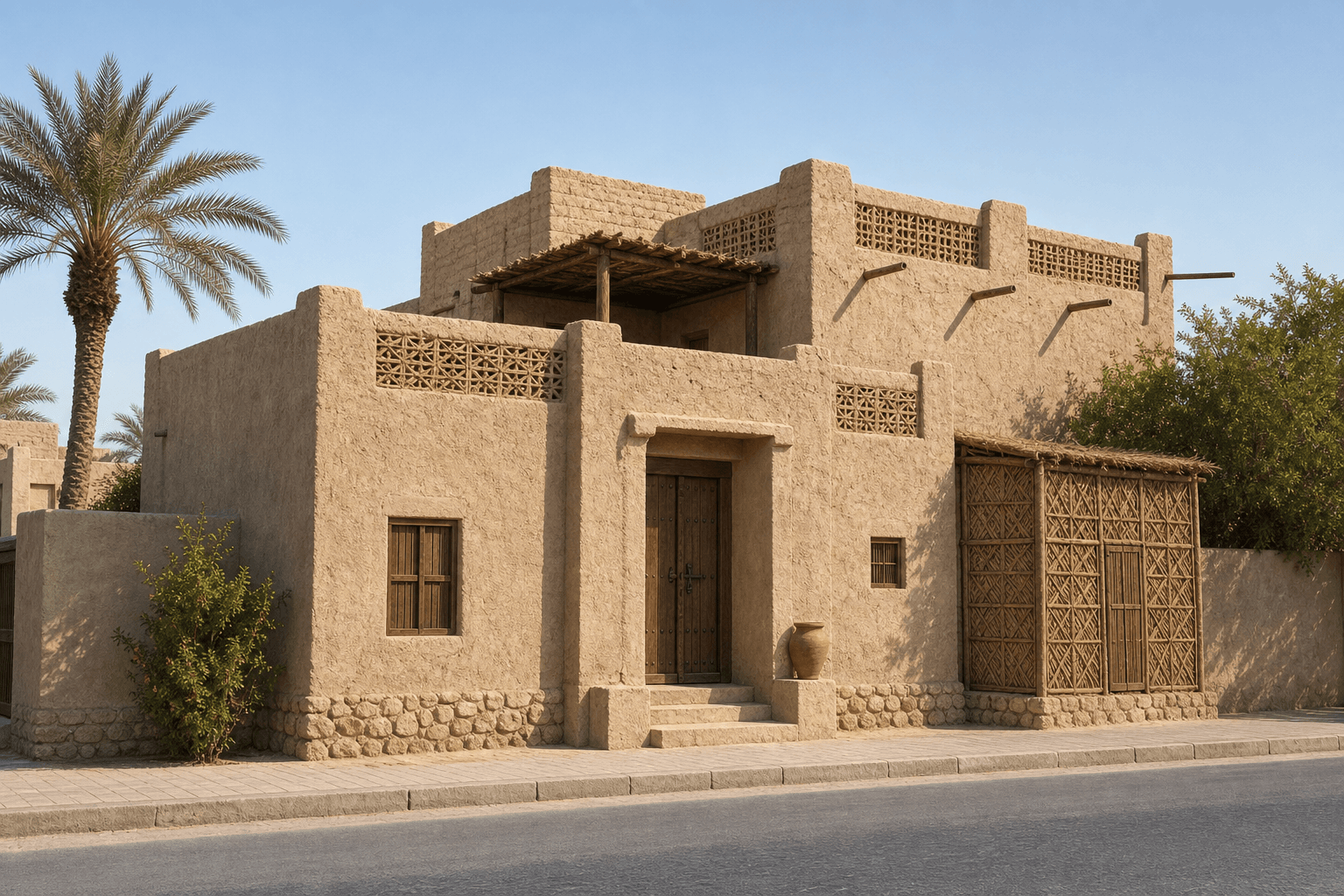
Bahrain Village Heritage — characteristic facade composition, village architecture of Bahrain's northern agricultural belt and coastal fishing....
Context Snapshot
Traditional village architecture of Bahrain's northern agricultural belt and coastal fishing communities — the date palm-cultivating villages of the northern governorates (Buri, A'ali, Barbar, Diraz)... Village architecture is an agricultural and maritime climate response: (1) Freshwater springs (ain / uyun) — Bahrain's northern belt is blessed with natural artesian springs that emerge from the underlying aquifer.
Contemporary Relevance
Bahrain Village Heritage is useful today for residential, hospitality, civic, and place-branding work that needs Bahrain-specific character grounded in local massing, material tone, climate response, and settlement logic rather than generic international styling.
Use this style in Toscape
Explore Bahrain Village Heritage directly inside Toscape using the Facade Re-Style and Design Options workflows.
Open Bahrain Village Heritage in the gallery