Basra Canal
Iraq · Basra
The Venice of the East — canal houses, coral-stone construction, Gulf maritime influences, and the distinctive waterfront architecture of southern Iraq
Overview
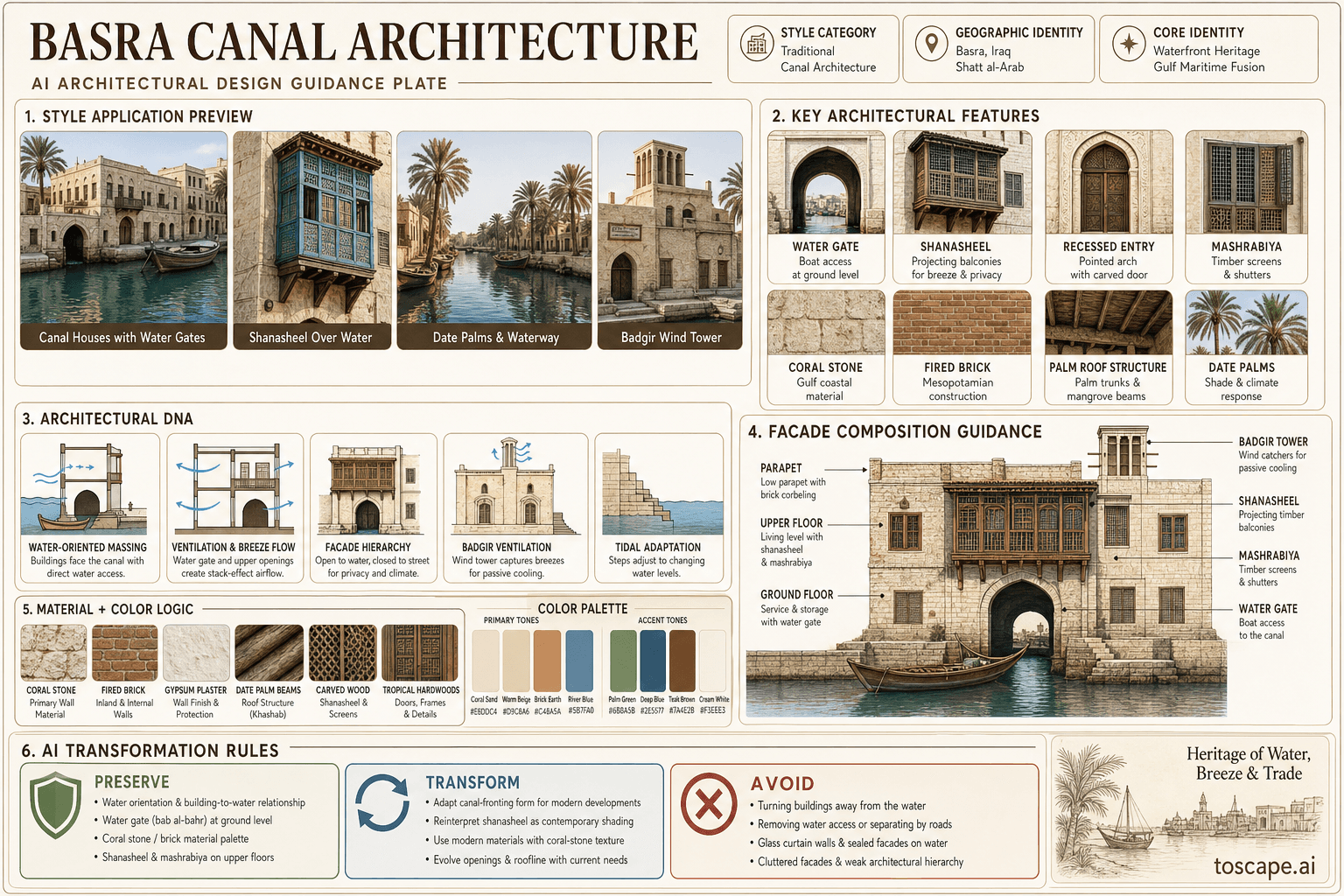
Basra Canal is a regional architectural identity in Iraq. Traditional architecture of Basra — Iraq's historic port city at the Shatt al-Arab waterway, once known as the "Venice of the East" for its network of canals (now largely vanished). Basra's architecture represents a unique fusion of Mesopotamian, Gulf coastal, and Indian Ocean trade influences — distinct from the Baghdadi tradition and reflecting the city's role as the maritime gateway of Iraq.
Visual DNA
Massing & Form
Basra's traditional houses are 1–2 storey rectangular volumes — typically 8–16 m wide × 12–20 m deep — organized either as courtyard houses or, uniquely, as canal-fronting houses with direct water access. The canal houses present their principal facades to the water, with stepped access (daraj) leading from the house t...
Facade Language
The Basrawi facade is distinguished by its water orientation: Canal-facing facade: The primary elevation — more open than the street facade. Ground floor: water gate (bab al-bahr) — a large arched opening giving direct boat access to the ground-floor storage/service area.
Materials & Texture
Coral stone (farrush / hasa bahri) — pale cream to gray-beige, irregular blocks — the Gulf coastal material tradition in canal-front buildings Fired brick (ajur) — golden-brown to reddish — used inland and for internal walls Gypsum-lime plaster — white to cream render Date palm trunk beams (khashab) — for roof construc...
Color Palette
White, cream, pale sand, warm timber, and shadow-driven dark metal accents define the palette. The facade should stay bright and climate-aware rather than heavy, gray, or over-saturated.
Ornament & Detail
Basrawi ornament reflects the city's Indian Ocean cosmopolitanism: (1) Carved wooden doors — geometric paneling with Indian and East African decorative influences — more floral and curvilinear than the austere Baghdadi geometric patterns. (2) Shanasheel lattice — similar turned-wood technique to Baghdad but with differ...
Climate Response
Basra's architecture responds to the hot-humid maritime climate of the northern Gulf: (1) Canal orientation — houses face the water, the most effective orientation for capturing cooling breezes off the Shatt al-Arab and the Gulf. (2) Water gate ventilation — the large canal-facing openings capture breeze at ground leve...
Landscape & Ground
Traditional architecture of Basra — Iraq's historic port city at the Shatt al-Arab waterway, once known as the "Venice of the East" for its network of canals (now largely vanished). Basra's architecture represents a unique fusion of Mesopotamian, Gulf coastal, and Indian Ocean trade influences — distinct from the Baghd...
Reference elevation
Basra Canal — characteristic facade composition, Basra.
Context Snapshot
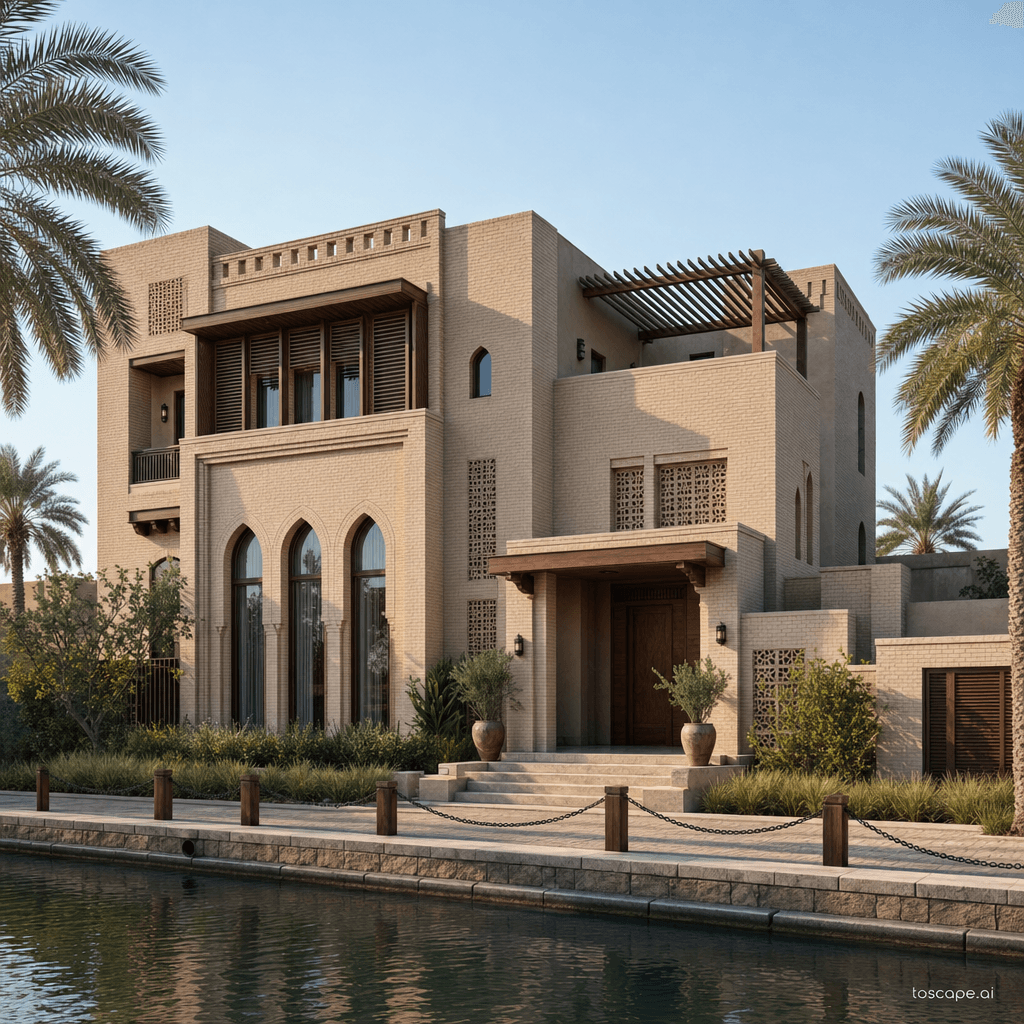
Traditional architecture of Basra — Iraq's historic port city at the Shatt al-Arab waterway, once known as the "Venice of the East" for its network of canals (now largely vanished). Basra's architecture responds to the hot-humid maritime climate of the northern Gulf: (1) Canal orientation — houses face the water, the most effective orientation for capturing cooling breezes off the Shatt al-Arab and...
Contemporary Relevance
Basra Canal is useful today for residential, hospitality, civic, and place-branding work that needs Iraq-specific character grounded in local massing, material tone, climate response, and settlement logic rather than generic international styling.
Use this style in Toscape
Explore Basra Canal directly inside Toscape using the Facade Re-Style and Design Options workflows.
Open Basra Canal in the gallery