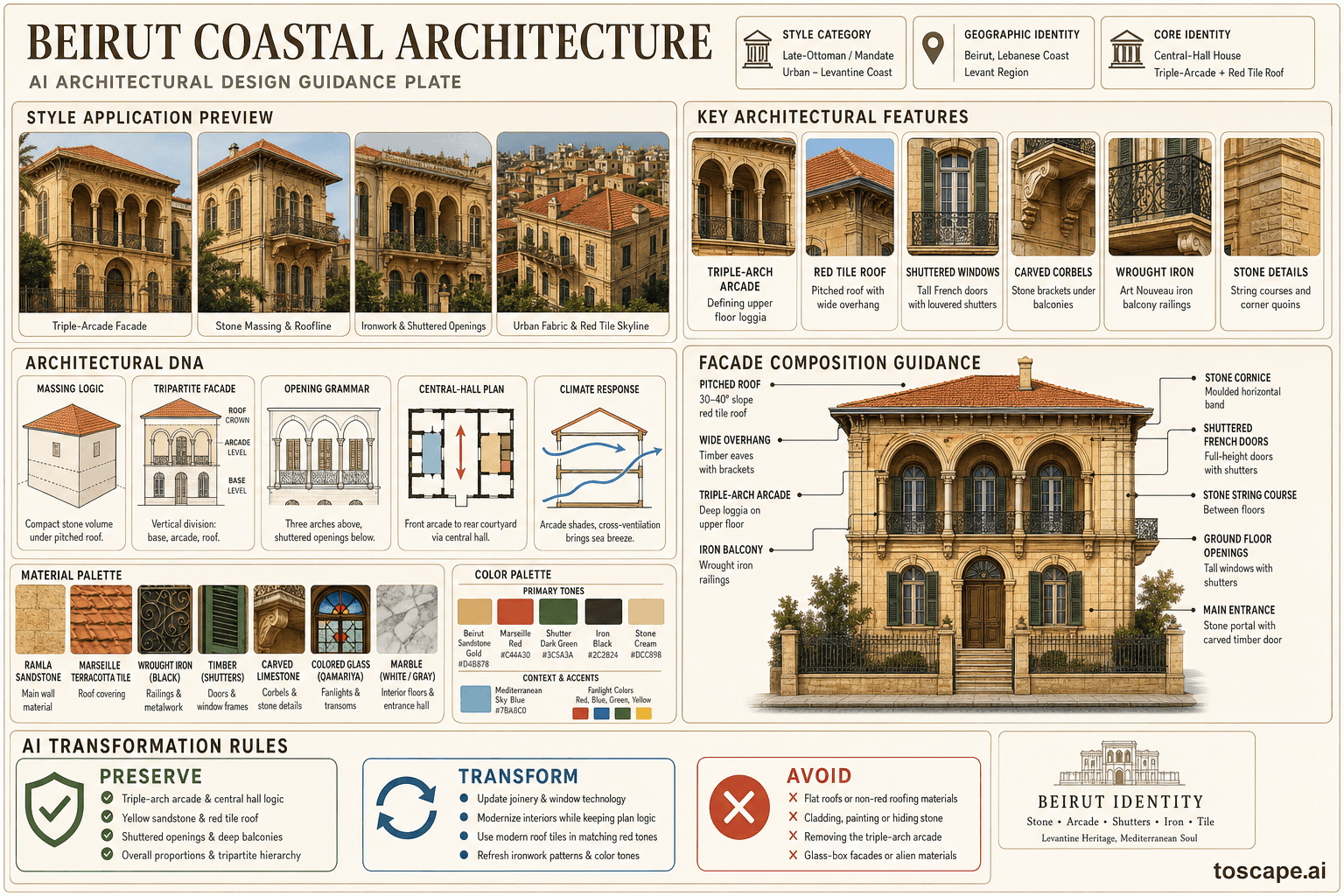
Beirut Coastal
Lebanon · and late-Ottoman domestic architecture of Beirut and the Lebanese coastal strip
The triple-arch and red-tile roof of the Levantine coastal capital — Ottoman-Beirut houses, sandstone façades, arcaded balconies, and the enduring Mediterranean architectural verna...
Overview
Beirut Coastal is a regional architectural identity in Lebanon. Traditional and late-Ottoman domestic architecture of Beirut and the Lebanese coastal strip — the distinctive central-hall house (al-bayt al-markazi) with its triple-arch arcade, red Marseille tile pitched roof, and yellow sandstone construction, defining the architectural identity of the eastern Mediterranean port city from the 1860s through the French Mandate period. The Beirut central-hall house — a rectangular tw...
Visual DNA
Massing & Form
The Beirut central-hall house is a rectangular or nearly-square volume — typically 12–18 m wide × 12–18 m deep — organized around a central reception hall (dar) running the full depth of the building. Two or three storeys with a high-ceiling ground floor (3.5–4.5 m), upper living floor (3.0–3.8 m), and occasional mezza...
Facade Language
The Beirut facade is organized around the triple-arch motif and tripartite vertical division: Triple-arch arcade: The defining Beirut feature — three arches (round, slightly pointed, or segmental) springing from two slender engaged columns or piers, forming a deep loggia on the upper floor. The central arch is slightly...
Materials & Texture
Ramla yellow sandstone — warm honey to golden-beige — the primary façade material, intricately carved for ornament Marseille terracotta roof tile — deep burnt red-orange — the defining roof material, imported from southern France since the 1860s Wrought iron — balcony railings, window grilles, stair balustrades, gate e...
Color Palette
White, cream, pale sand, warm timber, and shadow-driven dark metal accents define the palette. The facade should stay bright and climate-aware rather than heavy, gray, or over-saturated.
Ornament & Detail
Beirut ornament reflects the city's cosmopolitan Levantine position — a fusion of Ottoman, French, Italian, and local traditions: (1) Carved stone corbels — the most expressive element — shaped as scrolls, acanthus leaves, or geometric brackets supporting projecting balconies. (2) Wrought-iron balcony railings — Art No...
Climate Response
Beirut's Mediterranean coastal climate — hot humid summers (28–34°C, high humidity), mild wet winters (12–18°C, 800–900 mm rainfall) — shapes the architecture: (1) The arcaded loggia (liwān) — the primary climate device — deep shade for the upper floor, protected outdoor space capturing the sea breeze. (2) High ceiling...
Landscape & Ground
Traditional and late-Ottoman domestic architecture of Beirut and the Lebanese coastal strip — the distinctive central-hall house (al-bayt al-markazi) with its triple-arch arcade, red Marseille tile pitched roof, and yellow sandstone construction, defining the architectural identity of the eastern Mediterranean port cit...
Reference elevation
Beirut Coastal — characteristic facade composition, and late-Ottoman domestic architecture of Beirut and the Lebanese coastal strip.
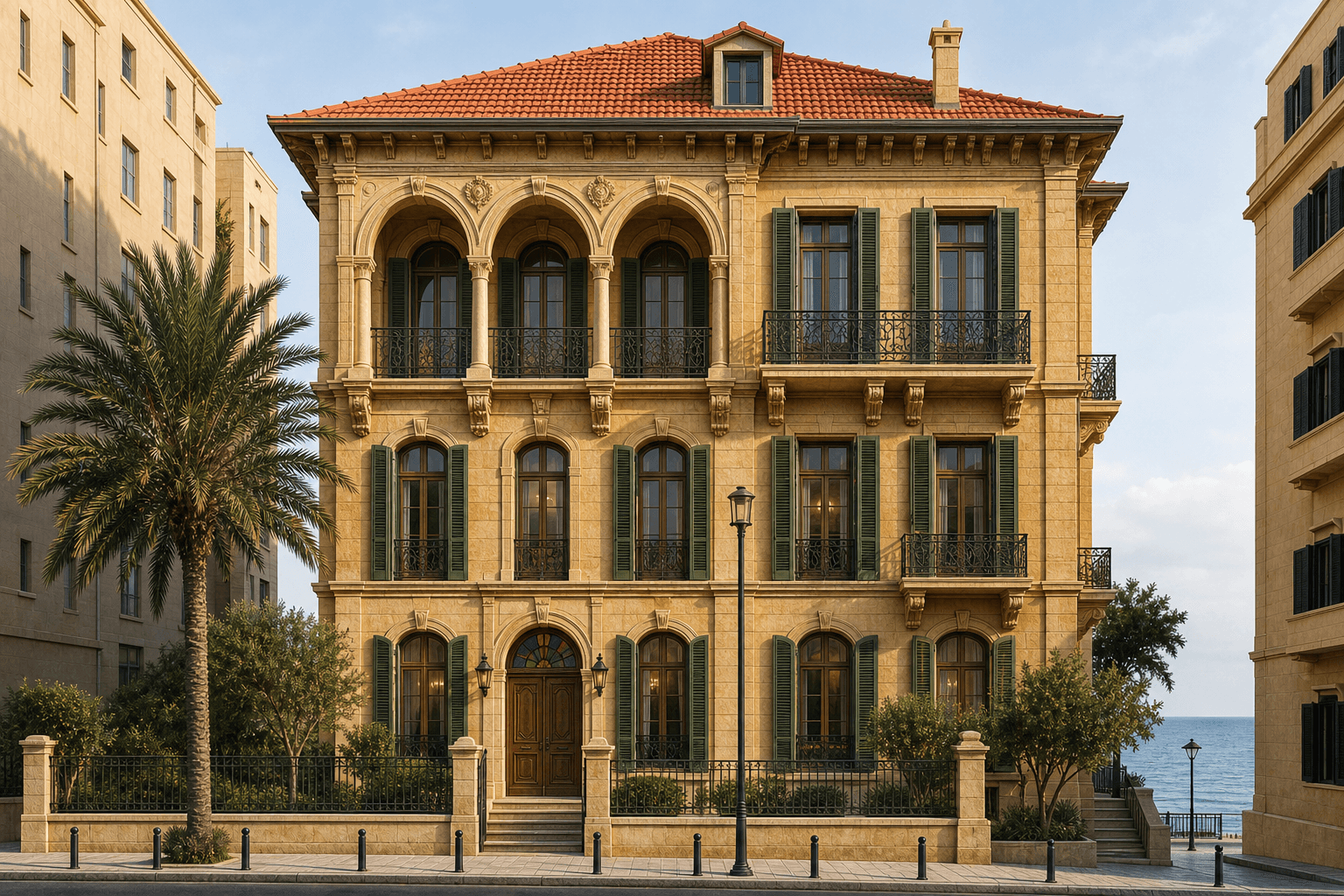
Context Snapshot
Traditional and late-Ottoman domestic architecture of Beirut and the Lebanese coastal strip — the distinctive central-hall house (al-bayt al-markazi) with its triple-arch arcade, red Marseille tile pi... Beirut's Mediterranean coastal climate — hot humid summers (28–34°C, high humidity), mild wet winters (12–18°C, 800–900 mm rainfall) — shapes the architecture: (1) The arcaded loggia (liwān) — the primary climate device...
Contemporary Relevance
Beirut Coastal is useful today for residential, hospitality, civic, and place-branding work that needs Lebanon-specific character grounded in local massing, material tone, climate response, and settlement logic rather than generic international styling.
Use this style in Toscape
Explore Beirut Coastal directly inside Toscape using the Facade Re-Style and Design Options workflows.
Open Beirut Coastal in the gallery