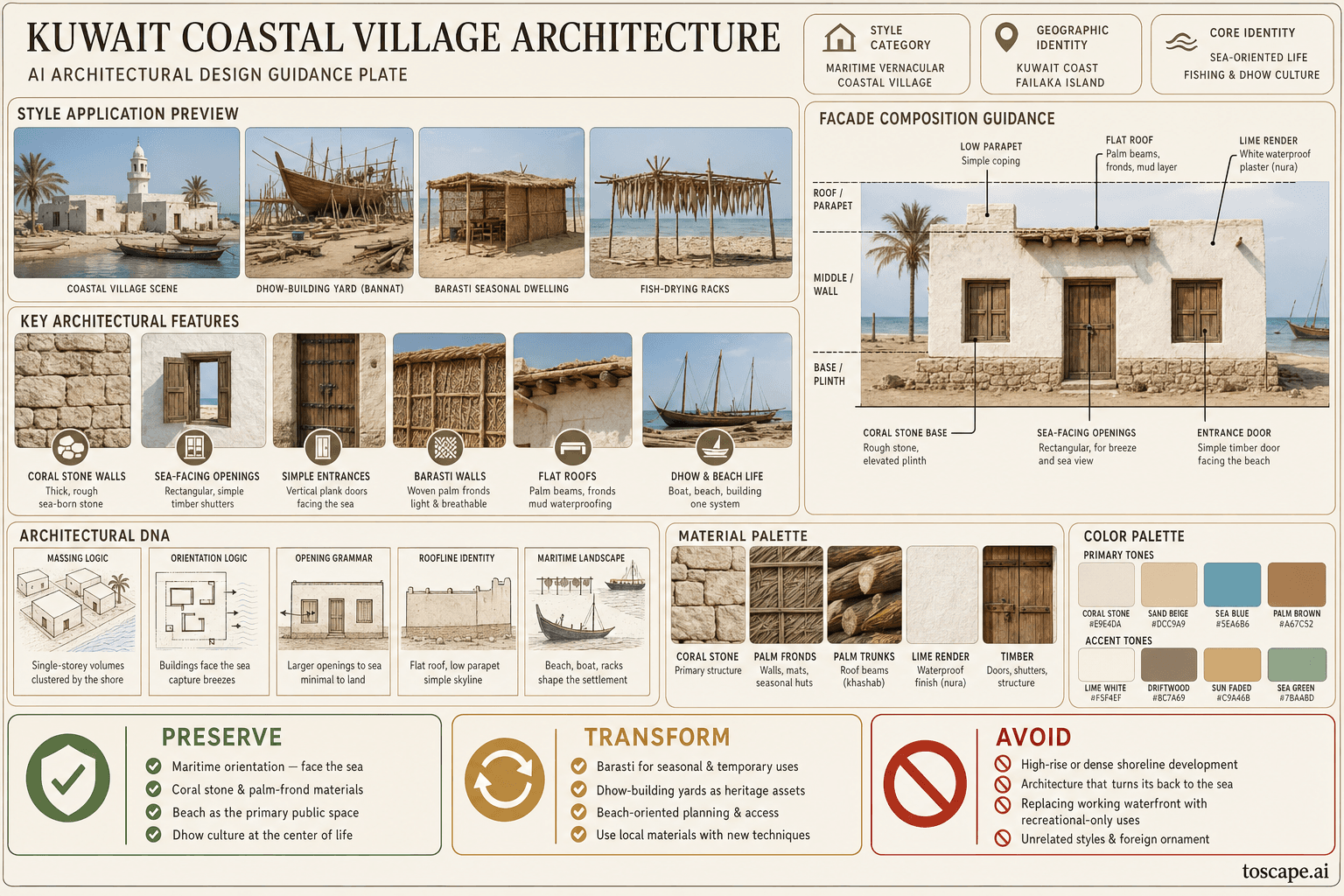
Kuwait Coastal Village
Kuwait · Kuwait's coastal villages and Failaka Island
The maritime vernacular of Kuwait's coastal settlements — Failaka Island, dhow-building villages, fisherfolk architecture, and the sea-dependent building traditions beyond the capi...
Overview
Kuwait Coastal Village is a regional architectural identity in Kuwait. Traditional architecture of Kuwait's coastal villages and Failaka Island — the fishing, pearling, and dhow-building communities that formed the maritime economic foundation of pre-oil Kuwait. These settlements preserve a simpler, more direct relationship between building and sea than the merchant houses of Kuwait City, reflecting the architecture of the bahhar (seafarer) and haddar (coastal dweller) rather than the u...
Visual DNA
Massing & Form
Coastal village buildings are smaller and simpler than their urban counterparts — single-storey rectangular volumes, 6–12 m wide × 8–16 m deep, with flat roofs and low parapets. The massing is dispersed, following the coastline and organized around dhow landing beaches, fish-drying yards, and boat-building areas.
Facade Language
The coastal village facade is defined by functional simplicity: Sea-facing walls: More open than the land-facing walls — windows and doorways face the Gulf to capture breezes and monitor maritime activity. Rectangular openings with simple timber shutters — no mashrabiya, no decorative elaboration Land-facing walls: Min...
Materials & Texture
Coral stone (farrush) — pale cream-gray, irregular blocks set in gypsum or mud mortar Mud-brick (labin) — used in areas away from the immediate coast Palm fronds (barusti / khassaf) — woven into wall panels, roof matting, fish traps, and fencing. The universal coastal material Palm trunks (khashab) — roof beams and str...
Color Palette
White, cream, pale sand, warm timber, and shadow-driven dark metal accents define the palette. The facade should stay bright and climate-aware rather than heavy, gray, or over-saturated.
Ornament & Detail
Ornament in coastal village architecture is concentrated in boat building, not building construction: (1) Dhow decoration — carved prows (boum, sambuk), painted hulls with geometric bands and calligraphic names, decorated transoms — the dhow is the primary vehicle for aesthetic expression. (2) Door decoration — simple...
Climate Response
Coastal village architecture is a pure maritime climate response: (1) Beach orientation — buildings face the sea, positioned to capture offshore breezes and monitor maritime activity. (2) Elevated platforms — buildings raised 300–500 mm above the beach for protection from storm surges and high tides.
Landscape & Ground
Traditional architecture of Kuwait's coastal villages and Failaka Island — the fishing, pearling, and dhow-building communities that formed the maritime economic foundation of pre-oil Kuwait. These settlements preserve a simpler, more direct relationship between building and sea than the merchant houses of Kuwait City...
Reference elevation
Kuwait Coastal Village — characteristic facade composition, Kuwait's coastal villages and Failaka Island.
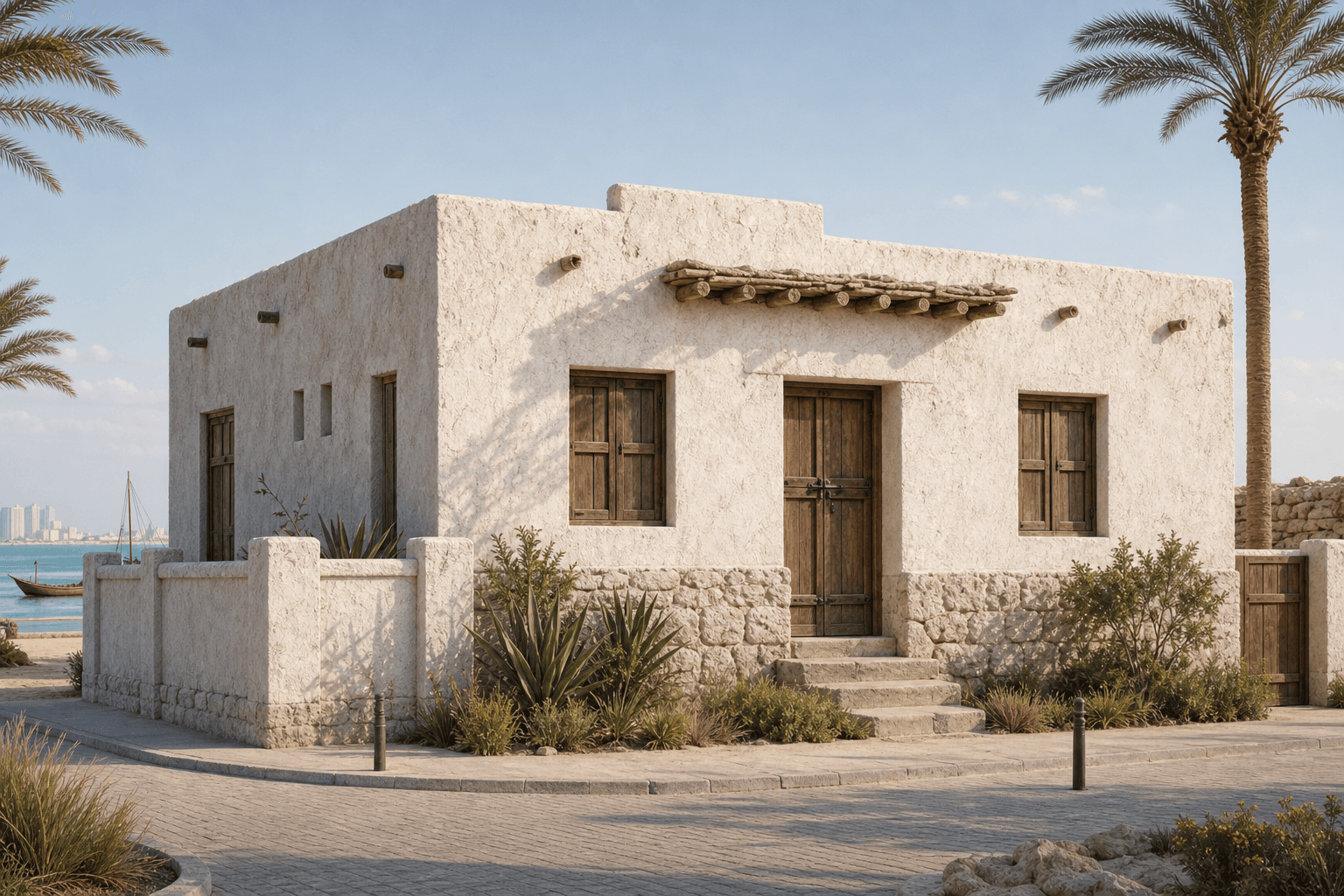
Context Snapshot
Traditional architecture of Kuwait's coastal villages and Failaka Island — the fishing, pearling, and dhow-building communities that formed the maritime economic foundation of pre-oil Kuwait. Coastal village architecture is a pure maritime climate response: (1) Beach orientation — buildings face the sea, positioned to capture offshore breezes and monitor maritime activity.
Contemporary Relevance
Kuwait Coastal Village is useful today for residential, hospitality, civic, and place-branding work that needs Kuwait-specific character grounded in local massing, material tone, climate response, and settlement logic rather than generic international styling.
Use this style in Toscape
Explore Kuwait Coastal Village directly inside Toscape using the Facade Re-Style and Design Options workflows.
Open Kuwait Coastal Village in the gallery