Cordillera
Philippines · Ifugao Province
Ifugao Bale (Fale), Pinoy Timber Hut & Rice Terrace Landscape
Overview
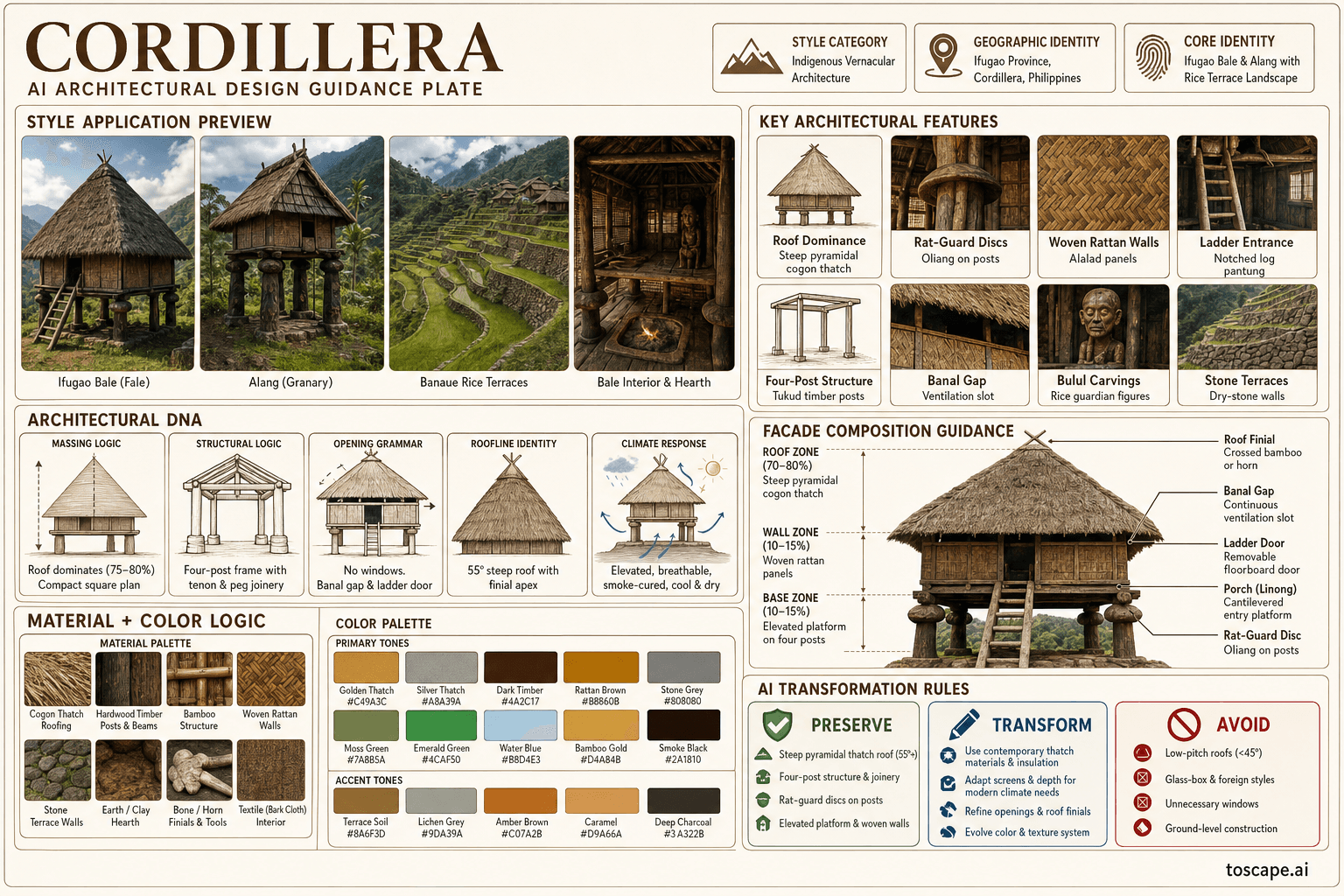
Cordillera is a regional architectural identity in Philippines. Ifugao Province — Banaue and environs, Ifugao indigenous architecture. Bale (or fale) — the Ifugao native house: compact square-plan elevated timber hut on four massive wooden posts (tukud/haligi) with distinctive rat-guard discs (oliang/ha-leb) carved from single hardwood trunks, steep pyramidal cogon grass thatch roof (up to 55° pitch) reaching nearly to ground level — roof envelope dominates the mass, ladder-like...
Visual DNA
Massing & Form
Bale (fale): compact square plan — approximately 3×3 to 4×4 meters. Elevated 1.5-3 meters on four massive round timber posts (tukud).
Facade Language
The bale facade is essentially the roof: steep cogon grass thatch descending from a sharp pyramidal peak, layered in thick courses (30-40cm total thickness), brown to silver-grey with age, held down by bamboo or timber grid (batawil). The low walls beneath appear as a dark recess — woven rattan panels or dark timber bo...
Materials & Texture
Cogon grass (Imperata cylindrica): the most important building material — wild grass harvested from hillsides, layered in thick courses for roof thatch, golden-brown when fresh, weathering to silver-grey. Fire-resistant when tightly layered; exceptionally durable (15-25 years) when smoke-cured from interior hearth.
Color Palette
Warm earth, sandy beige, ochre, clay brown, and sun-softened mineral tones should dominate, with palm green or weathered timber as secondary accents. The palette should read as land-derived rather than polished or urban-generic.
Ornament & Detail
The Ifugao architectural aesthetic is one of refined minimalism — ornament is structural expression, not applied decoration. Rat-guard discs (oliang/ha-leb): the primary decorative element — massive circular discs carved integrally from the post timber, mushroom-shaped, sometimes with concentric rings or scalloped edge...
Climate Response
Tropical highland (Cwb climate) — elevation 700-2,000m, cool temperatures (15-25°C), very high rainfall (3,000-5,000mm annually), frequent mist and cloud immersion, typhoon exposure. The steep pyramidal roof sheds heavy rainfall instantly; thick cogon thatch insulates against cool temperatures while breathing to releas...
Landscape & Ground
Ifugao Province — Banaue and environs, Ifugao indigenous architecture. Tropical highland (Cwb climate) — elevation 700-2,000m, cool temperatures (15-25°C), very high rainfall (3,000-5,000mm annually), frequent mist and cloud immersion, typhoon exposure.
Reference elevation
Cordillera — characteristic facade composition, Ifugao Province.
Context Snapshot
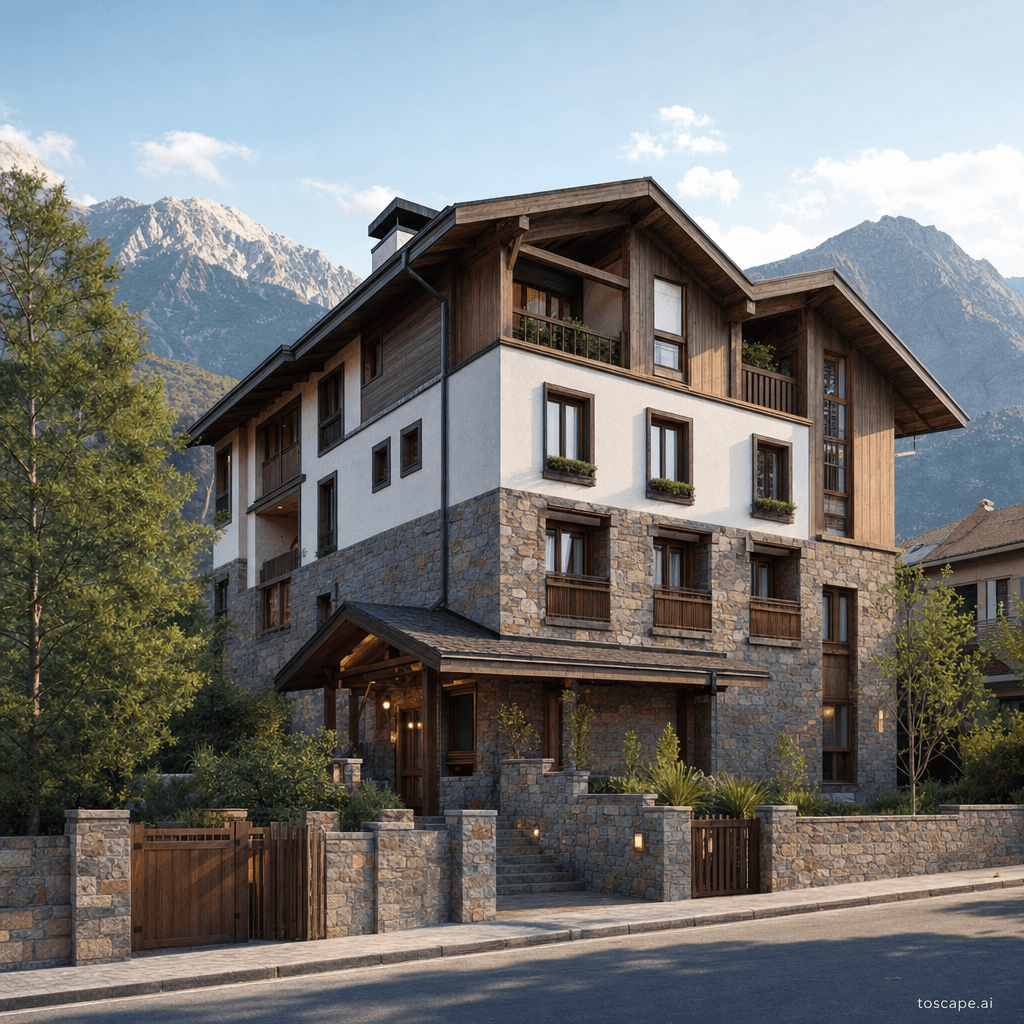
Ifugao Province — Banaue and environs, Ifugao indigenous architecture Tropical highland (Cwb climate) — elevation 700-2,000m, cool temperatures (15-25°C), very high rainfall (3,000-5,000mm annually), frequent mist and cloud immersion, typhoon exposure.
Contemporary Relevance
Cordillera is useful today for residential, hospitality, civic, and place-branding work that needs Philippines-specific character grounded in local massing, material tone, climate response, and settlement logic rather than generic international styling.
Use this style in Toscape
Explore Cordillera directly inside Toscape using the Facade Re-Style and Design Options workflows.
Open Cordillera in the gallery