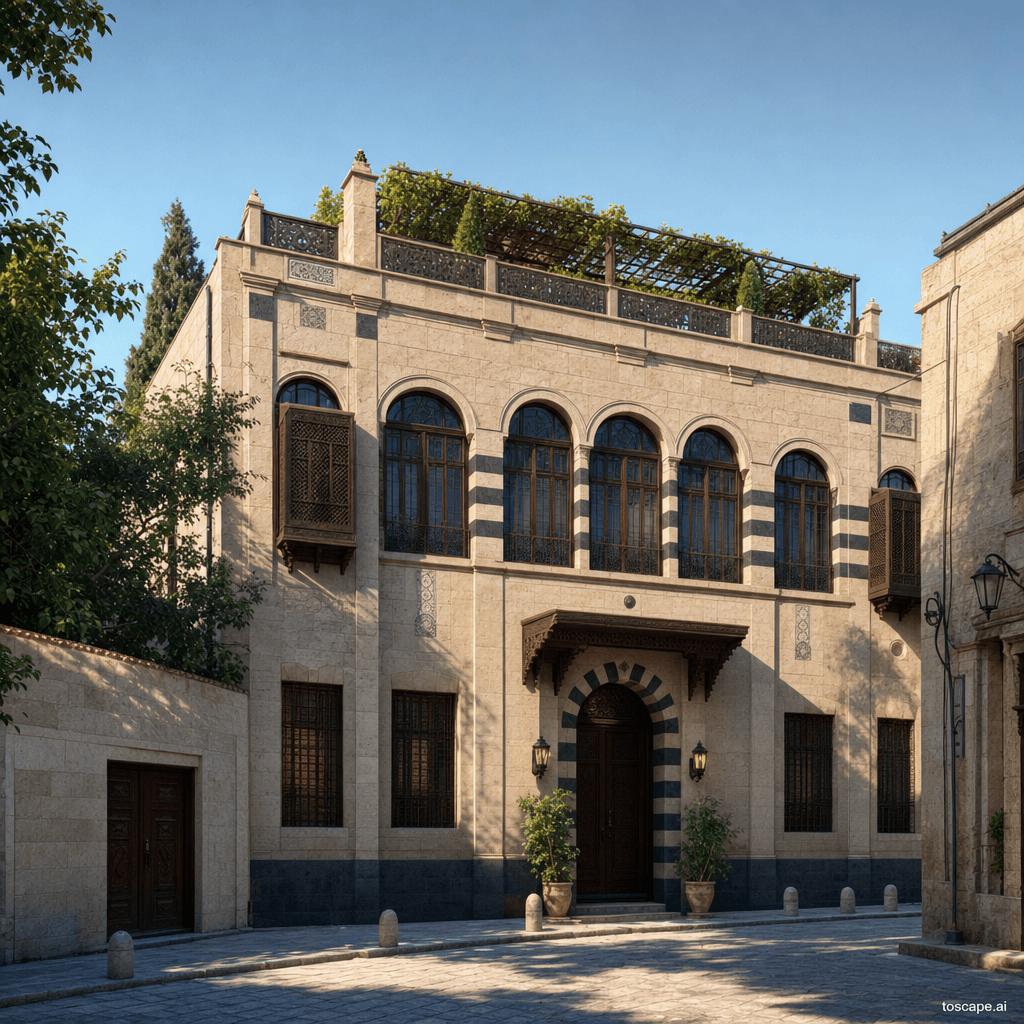
Damascus Courtyard House
Syria · Damascene courtyard house of the late Mamluk and Ottoman periods (15th–19th cent...
The Bayt Dimashqi (Damascene courtyard house) of Old Damascus — organized around a central courtyard (ḥawsh) with a fountain (baḥra), a south-facing open iwan (īwān qiblī), intrica...
Overview
Damascus Courtyard House is a regional architectural identity in Syria. The Damascene courtyard house of the late Mamluk and Ottoman periods (15th–19th centuries) — organized around a rectangular central courtyard (ḥawsh, 8–15 m × 10–20 m) paved with geometric patterns of colored stone — grey limestone and black basalt in the distinctive Syrian ablāq technique (alternating light and dark stone) — with a south-facing īwān qiblī (main reception room, 4–6 m wide, 8–12 m high) open to the co...
Visual DNA
Massing & Form
An inward-facing rectangular volume: a high perimeter wall (8–12 m) encloses the house on all four sides — the exterior is blank except for the entrance door and a few small upper windows. The central courtyard is a rectangular void proportional to the surrounding rooms (1:1.5 to 1:2).
Facade Language
The courtyard elevations are organized around the iwan: the south wall dominated by the great iwan arch, flanked by smaller rooms with mashrabiya above. East and west walls have arcades or rooms with upper mashrabiya windows.
Materials & Texture
Limestone (#F0E8D0 to #E8DCC0, from the Anti-Lebanon) — the white ablāq stone. Basalt (#3A3A3A to #2A2A2A, from Ḥawrān) — the black ablāq stone.
Color Palette
White, cream, pale sand, warm timber, and shadow-driven dark metal accents define the palette. The facade should stay bright and climate-aware rather than heavy, gray, or over-saturated.
Ornament & Detail
Ablāq stonework — alternating white and black stripes creating rhythmic fields. ʿAjamī decoration — raised gesso with floral arabesques (tawrīq), geometric interlace (zakhrafa), and calligraphy (khaṭṭ), painted and gilded.
Climate Response
The courtyard is a thermal regulator: collecting cool night air, providing day cooling through fountain evaporation — creating a microclimate 5–10°C cooler than the street. The south-facing iwan opens to the north, capturing the prevailing summer breeze.
Landscape & Ground
The Damascene courtyard house of the late Mamluk and Ottoman periods (15th–19th centuries) — organized around a rectangular central courtyard (ḥawsh, 8–15 m × 10–20 m) paved with geometric patterns of colored stone — grey limestone and black basalt in the distinctive Syrian ablāq technique (alternating light and dark s...
Reference elevation
Damascus Courtyard House — characteristic facade composition, Damascene courtyard house of the late Mamluk and Ottoman periods (15th–19th cent....
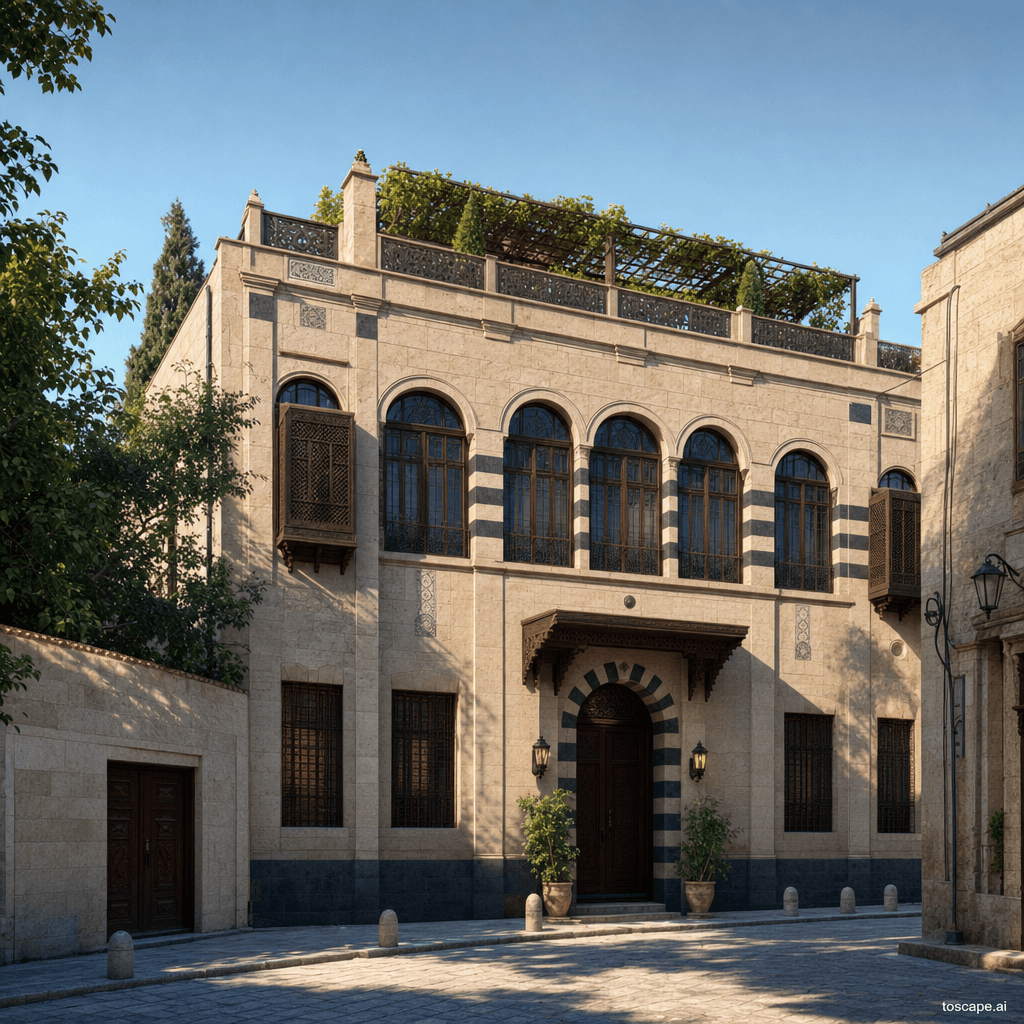
Context Snapshot
The Damascene courtyard house of the late Mamluk and Ottoman periods (15th–19th centuries) — organized around a rectangular central courtyard (ḥawsh, 8–15 m × 10–20 m) paved with geometric patterns of... The courtyard is a thermal regulator: collecting cool night air, providing day cooling through fountain evaporation — creating a microclimate 5–10°C cooler than the street.
Contemporary Relevance
Damascus Courtyard House is useful today for residential, hospitality, civic, and place-branding work that needs Syria-specific character grounded in local massing, material tone, climate response, and settlement logic rather than generic international styling.
Use this style in Toscape
Explore Damascus Courtyard House directly inside Toscape using the Facade Re-Style and Design Options workflows.
Open Damascus Courtyard House in the gallery