Danish Brick Vernacular
Denmark · Danish rural vernacular house
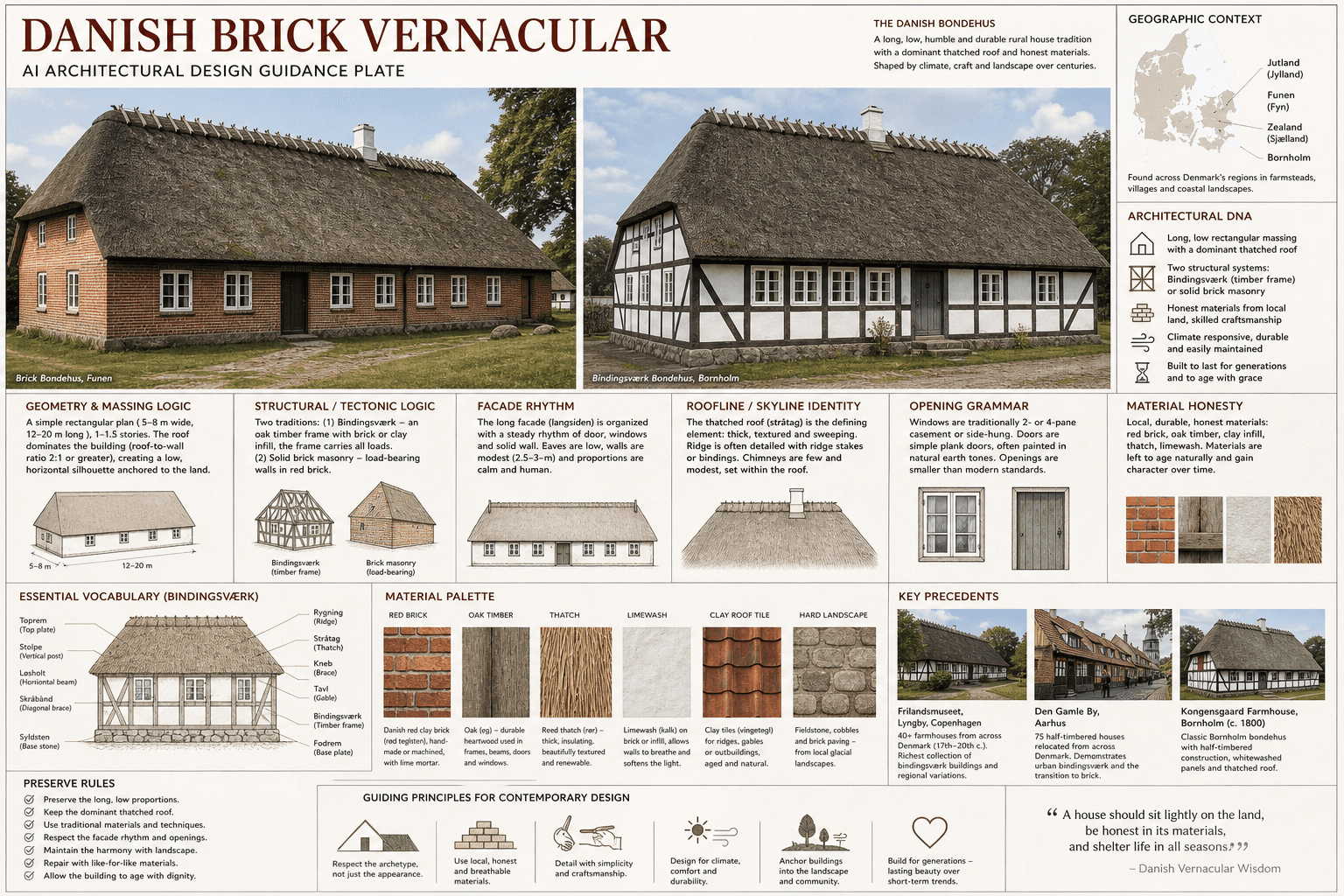
The bindingsværk (half-timbered) farmhouse and brick bondehus of Denmark — a long low rectangular house of red brick (rød tegl) and oak timber frame with whitewashed infill panels...
Overview
Danish Brick Vernacular is a regional architectural identity in Denmark Nordic. The Danish rural vernacular house — the bondehus (farmhouse) and the bindingsværk (half-timbered) tradition of Jutland, Funen, Zealand, and Bornholm — the house is typically a long rectangular block (5–8 m wide, 12–20 m long), one or one-and-a-half stories, with walls of red brick (rød teglsten) or oak half-timbering with brick or wattle-and-daub infill panels painted white or ochre — the roof is steep (45–55° pitch)...
Visual DNA
Massing & Form
The Danish vernacular house is a long rectangular box, typically 1–1.5 stories, with a very dominant roof. The plan is a simple linear arrangement: the dwelling (beboelse) at one end, the stable/barn (stald/lade) at the other, under a continuous roof — this is the langhus (longhouse) typology.
Facade Language
The long facade (langsiden) facing south or the village road is organized as: (1) The low brick or half-timbered wall — the frame grid or brick coursing providing a horizontal and vertical rhythm. (2) The front door — placed centrally or slightly off-center, a solid timber door (fyldingsdør) with a transom window above...
Materials & Texture
Materials are local, durable, and honest: (1) Brick — red clay brick (rød tegl) fired from Danish moraine clay — the brick color ranges from warm red-orange to brownish red, with a soft, slightly irregular surface — brick was the primary building material from the 12th century onward (after the introduction from North...
Color Palette
White, cream, pale sand, warm timber, and shadow-driven dark metal accents define the palette. The facade should stay bright and climate-aware rather than heavy, gray, or over-saturated.
Ornament & Detail
Danish vernacular ornament is restrained: (1) The half-timbered frame itself IS the ornament — the geometry of posts, beams, and braces creates a decorative grid pattern on the facade — the diagonal braces (skråbånd) form distinctive motifs: single diagonal, crossed St. Andrew's crosses (andreas kors), or curved braces...
Climate Response
The Danish house is a response to the maritime temperate climate: (1) Wind — prevailing westerly winds across the flat Danish landscape — the house is oriented with the long facade facing south for sun, the gable end to the west against the wind — the low profile and thick roof resist wind uplift. (2) Rain — frequent r...
Landscape & Ground
The Danish rural vernacular house — the bondehus (farmhouse) and the bindingsværk (half-timbered) tradition of Jutland, Funen, Zealand, and Bornholm — the house is typically a long rectangular block (5–8 m wide, 12–20 m long), one or one-and-a-half stories, with walls of red brick (rød teglsten) or oak half-timbering w...
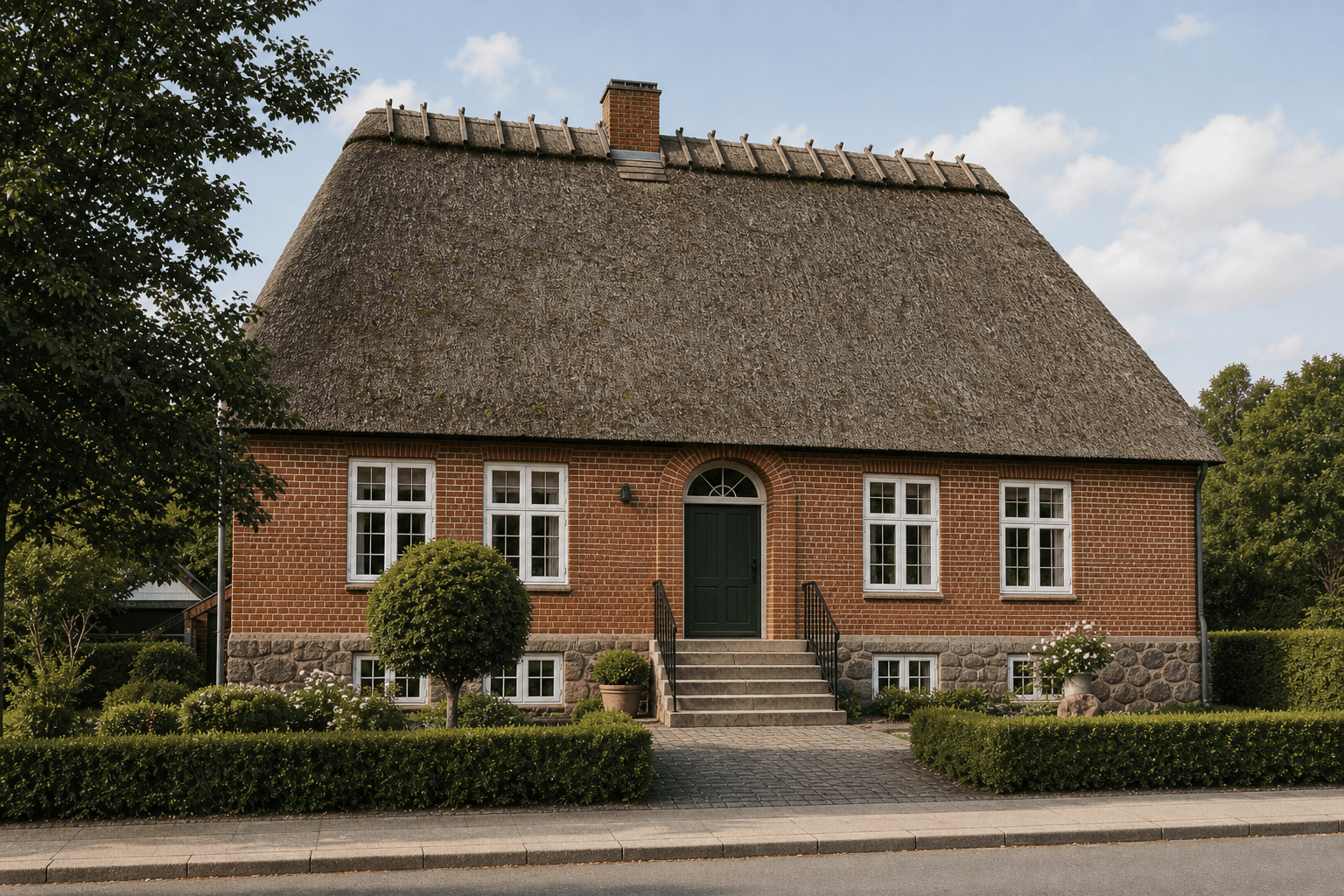
Reference elevation
Danish Brick Vernacular — characteristic facade composition, Danish rural vernacular house.
Context Snapshot
The Danish rural vernacular house — the bondehus (farmhouse) and the bindingsværk (half-timbered) tradition of Jutland, Funen, Zealand, and Bornholm — the house is typically a long rectangular block (... The Danish house is a response to the maritime temperate climate: (1) Wind — prevailing westerly winds across the flat Danish landscape — the house is oriented with the long facade facing south for sun, the gable end to...
Contemporary Relevance
Danish Brick Vernacular is useful today for residential, hospitality, civic, and place-branding work that needs Denmark Nordic-specific character grounded in local massing, material tone, climate response, and settlement logic rather than generic international styling.
Use this style in Toscape
Explore Danish Brick Vernacular directly inside Toscape using the Facade Re-Style and Design Options workflows.
Open Danish Brick Vernacular in the gallery