Eastern Najdi Contemporary
Saudi Arabia · Eastern Najd
The 21st-century reinterpretation of Eastern Najdi identity through organic forms, expanded transparency, and abstracted heritage patterns
Overview
Eastern Najdi Contemporary is a Saudi architectural identity rooted in Eastern Najd. Eastern Najdi Architecture (one of 19 Saudi Architecture Characters Map styles, ADG-05). Eastern stretch between the Najdi plateau and the east coast of KSA — Qaryat Al Ulya, Hafar Al Batin, Rafha, and new development areas within the character zone.
Visual DNA
Massing & Form
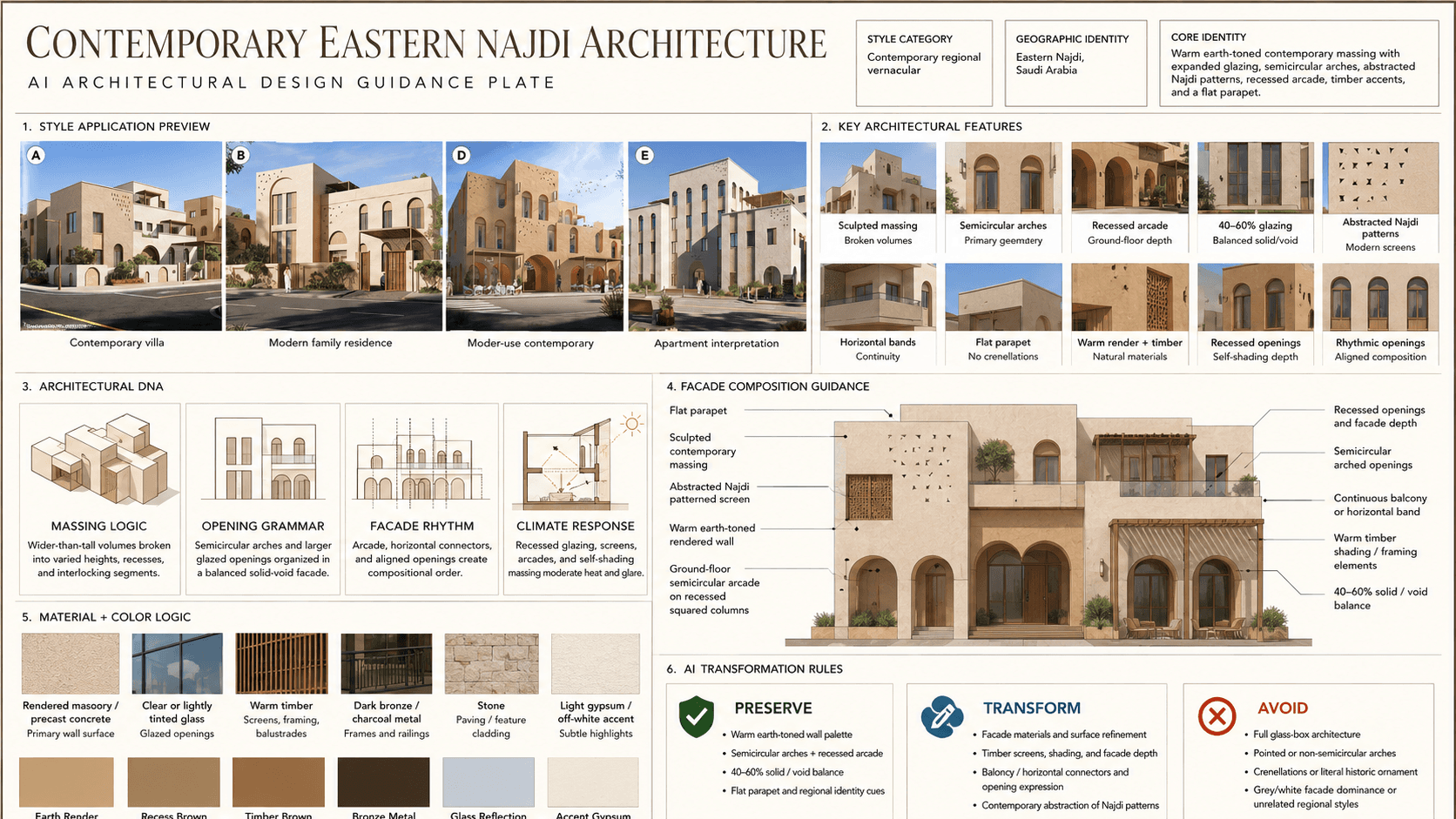
Contemporary Eastern Najdi buildings retain the fundamental horizontal proportion (wider than tall) but introduce organic form-making — "transition to more organic forms with a reinterpretation of arched elements" . The rigid rectangular prism of traditional massing gives way to sculpted volumes — recesses, projections...
Facade Language
The contemporary facade is more open, more varied, and more abstract than either traditional or transitional. The documented window-to-wall ratio is 40–60% — a dramatic increase from traditional (1.4–11.8%) and transitional (15–30%) .
Materials & Texture
The contemporary material palette maintains the earth-tone identity while embracing modern materials and performance requirements. Rendered masonry or precast concrete: the primary wall material, in warm beige-brown earth tones — the surface may be smooth, lightly textured, or panelized, but the colour must remain grou...
Color Palette
The palette should read as sun-baked earth updated for current construction: warm sand, clay beige, chalky off-white, and controlled dark bronze or timber accents. Cool greys and blue-white finishes break the Najdi reading and should be avoided.
Ornament & Detail
Ornament in contemporary Eastern Najdi is abstract, pattern-based, and architecturally integrated — not applied decoration. The primary ornamental device is the re-interpreted Najdi pattern — traditional geometric and botanic motifs abstracted through simplification, scaling, and repetition into contemporary facade scr...
Climate Response
The contemporary style operates in the same hot arid climate but with fundamentally different technological assumptions — mechanical cooling is presumed, allowing higher glazing ratios and more outward-facing compositions. However, the ADG-05 explicitly requires that contemporary architectural elements "should be purpo...
Landscape & Ground
Eastern stretch between the Najdi plateau and the east coast of KSA — Qaryat Al Ulya, Hafar Al Batin, Rafha, and new development areas within the character zone. The contemporary style operates in the same hot arid climate but with fundamentally different technological assumptions — mechanical cooling is presumed, allo...
Reference elevation
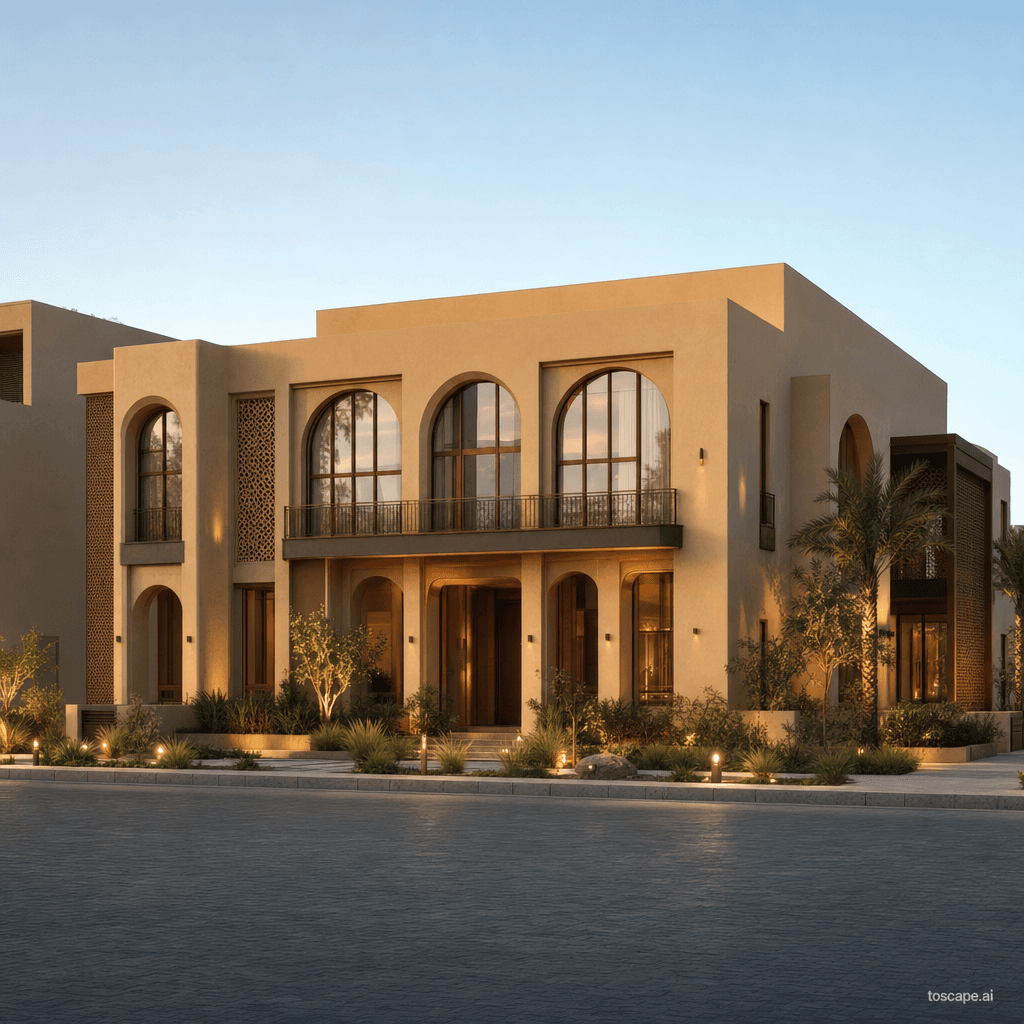
Eastern Najdi Contemporary — characteristic facade composition, Eastern Najd.
Context Snapshot
Contemporary architecture in the Eastern Najdi character area, ca. Eastern Najdi Architecture (one of 19 Saudi Architecture Characters Map styles, ADG-05) Eastern stretch between the Najdi plateau and the east coast of KSA — Qaryat Al Ulya, Hafar Al Batin, Rafha, and new development areas within the character zone
Contemporary Relevance
Eastern Najdi Contemporary aligns naturally with current Saudi practice, where regional identity is carried by proportion, shading depth, material tone, and controlled abstraction rather than direct historic imitation. It suits present-day residential, hospitality, and mixed-use work that needs strong local character inside a modern planning and construction framework.
Use this style in Toscape
Explore Eastern Najdi Contemporary directly inside Toscape using the Facade Re-Style and Design Options workflows.
Open Eastern Najdi Contemporary in the gallery