Farasan Islands Traditional
Saudi Arabia · Farasan Islands / Red Sea
The coral-stone compound vernacular of the Red Sea Farasan archipelago — elaborate gypsum carving, stained glass, and island craft tradition, pre-20th century CE
Overview
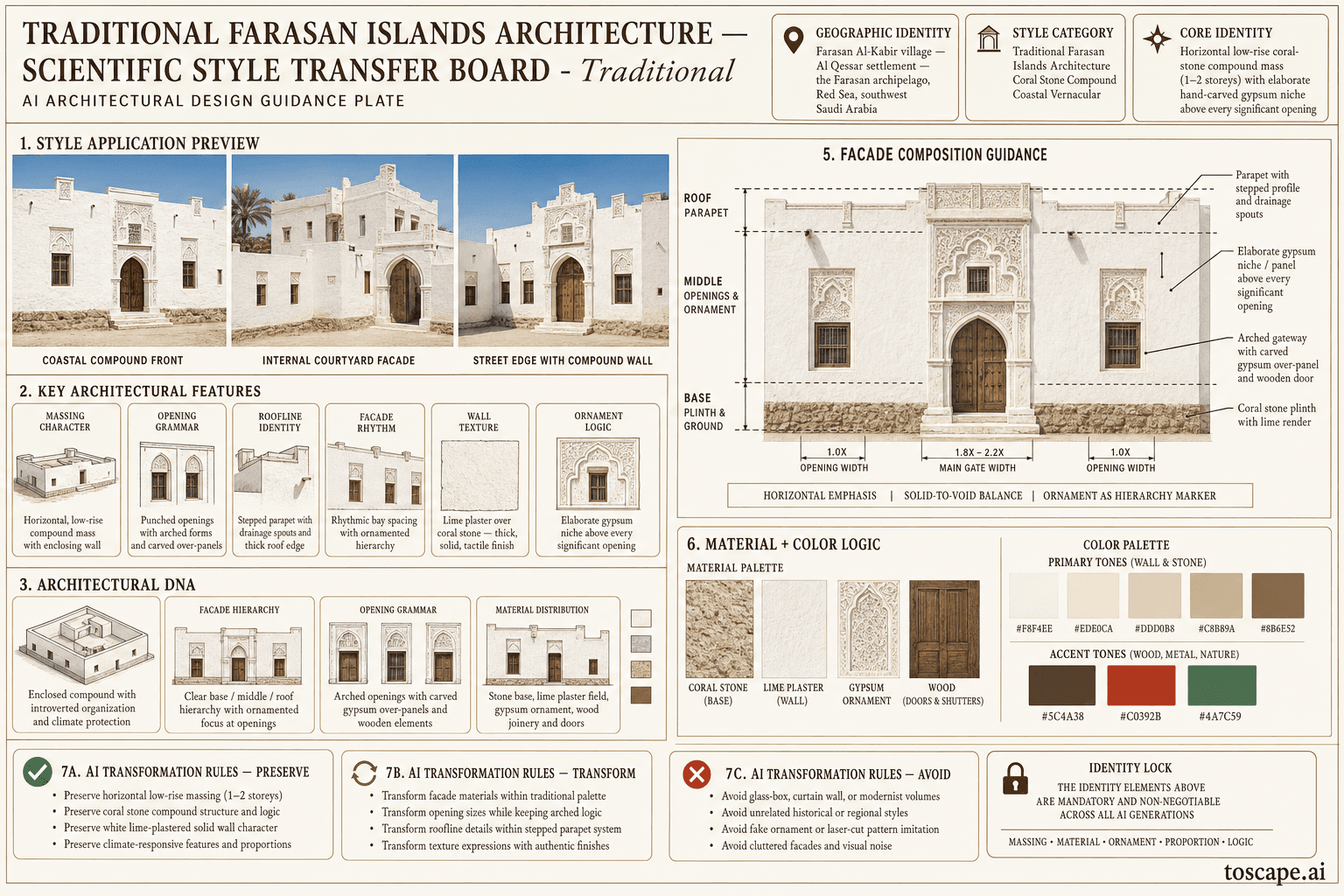
Farasan Islands Traditional is a Saudi architectural identity rooted in Farasan Islands / Red Sea. Farasan Islands Architecture — Red Sea island vernacular, Indian Ocean trade-port craft, Islamic geometric ornament, coral-stone masonry compound settlement. Farasan Al-Kabir village — Al Qessar settlement — the Farasan archipelago, Red Sea, southwest Saudi Arabia.
Visual DNA
Massing & Form
Traditional Farasan buildings are emphatically horizontal, compact, and low. Documented width-to-height ratio: 1:0.4 to 1:0.8 — always wider than tall .
Facade Language
Facade rhythm derives from four interlocking systems: the bipartite division (base openings zone + articulated upper parapet), the symmetrical placement of openings within the base tier, the carved niche over-panels above every significant opening, and the articulated parapet tops with pointed corners, banding, and nic...
Materials & Texture
The traditional material system is fossil coral stone masonry with white lime plaster as the dominant facade surface (≥70% of facade) . Gypsum carving — cut in-situ or applied as relief — is the prestige craft material for niches, over-panels, friezes, and interior Majlis decoration.
Color Palette
Use a light mineral field of sand, shell, coral, and sun-softened white, then introduce timber, bronze, or darker screened shadow as accent. Coastal and oasis palettes should feel bright, breathable, and climate-tempered rather than heavy or monochrome.
Ornament & Detail
Ornament in Traditional Farasan is NOT restrained — it is profuse, elaborate, and central to the architectural identity. Every significant opening has a carved gypsum niche or decorative over-panel above it .
Climate Response
The Farasan Islands have a hot humid climate (30–35°C) with sea breezes from the north and west in summer, south in winter . Traditional architecture responds through: orienting principal windows to the north for breeze capture; creating multiple courtyards to channel sea breezes through the compound; using thick coral...
Landscape & Ground
Farasan Al-Kabir village — Al Qessar settlement — the Farasan archipelago, Red Sea, southwest Saudi Arabia. The Farasan Islands have a hot humid climate (30–35°C) with sea breezes from the north and west in summer, south in winter .
Reference elevation
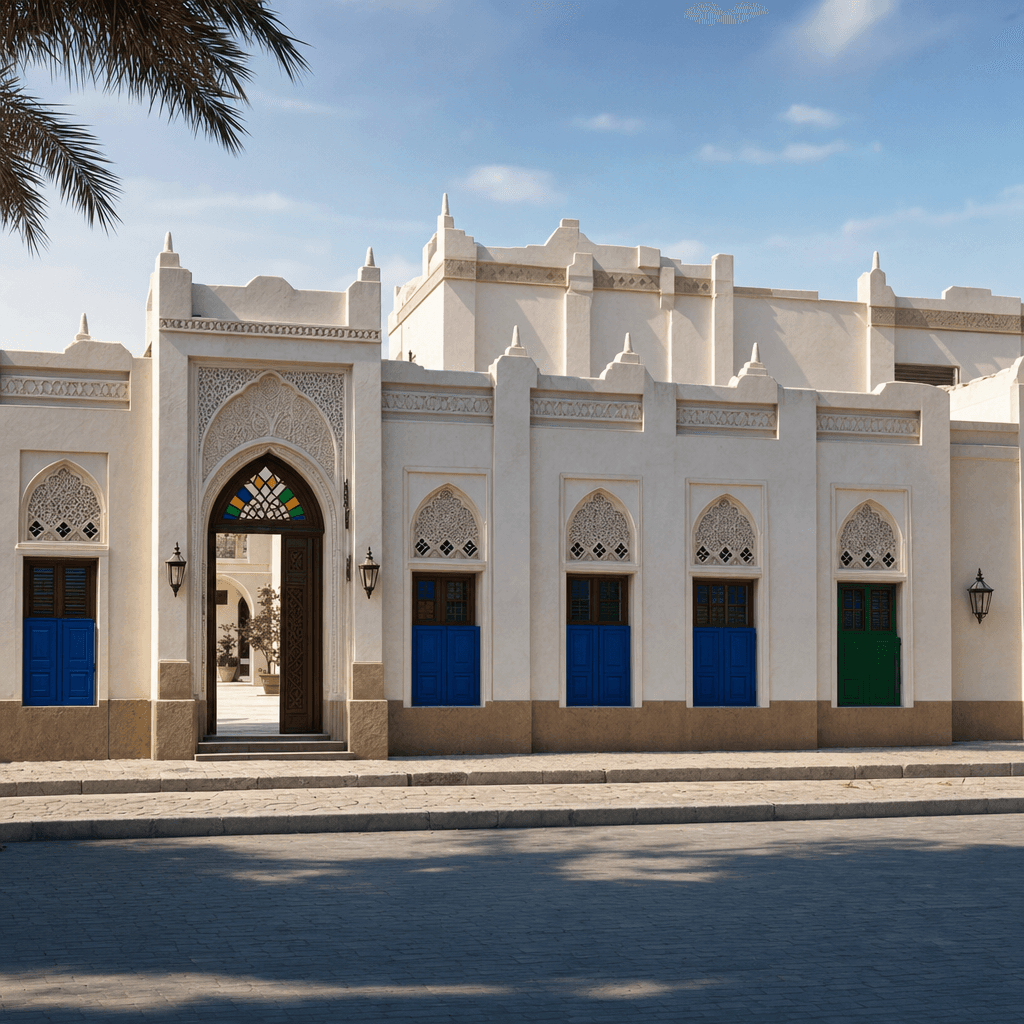
Farasan Islands Traditional — characteristic facade composition, Farasan Islands / Red Sea.
Context Snapshot
Maximum-fidelity translation of Farasan Islands coral-stone compound architecture — the most ornamentally elaborate, craft-dense island vernacular in the Saudi Architecture Characters Map Farasan Islands Architecture — Red Sea island vernacular, Indian Ocean trade-port craft, Islamic geometric ornament, coral-stone masonry compound settlement Farasan Al-Kabir village — Al Qessar settlement — the Farasan archipelago, Red Sea, southwest Saudi Arabia
Contemporary Relevance
Farasan Islands Traditional operates as the heritage reference layer for Farasan Islands / Red Sea and is most useful today in conservation work, cultural tourism districts, and accurate AI rendering direction. Its value in current practice comes from preserving proportion, material hierarchy, and climate logic without flattening them into generic nostalgia.
Use this style in Toscape
Explore Farasan Islands Traditional directly inside Toscape using the Facade Re-Style and Design Options workflows.
Open Farasan Islands Traditional in the gallery