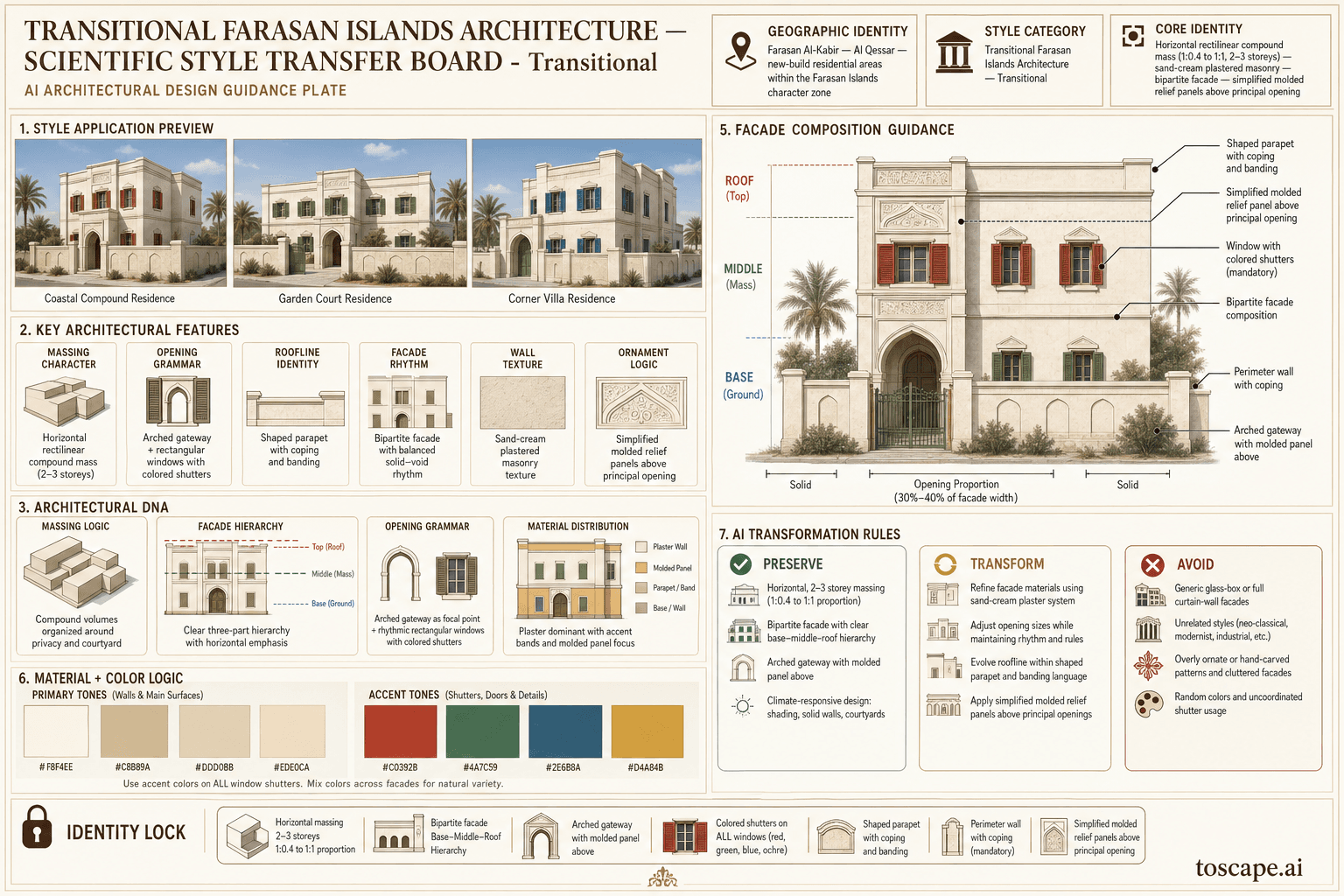
Farasan Islands Transitional
Saudi Arabia · Farasan Islands / Red Sea
The distilled interpretation of Farasan Islands character — sympathetic materials and forms integrating contemporary standards while retaining the essential island identity
Overview
Farasan Islands Transitional is a Saudi architectural identity rooted in Farasan Islands / Red Sea. Farasan Islands Architecture — Red Sea island vernacular as informant, interpreted rather than replicated. Farasan Al-Kabir — Al Qessar — new-build residential areas within the Farasan Islands character zone.
Visual DNA
Massing & Form
Transitional Farasan buildings maintain the horizontal character of the vernacular while integrating contemporary planning needs. Width-to-height ratios remain broadly horizontal at 1:0.4 to 1:1 — buildings may be slightly taller than Traditional but still read as horizontal .
Facade Language
Facade rhythm is maintained as bipartite: base (ground floor windows and principal entrance) + upper (upper floor windows and articulated parapet). Carved niches and gypsum over-panels are retained on principal openings but simplified — molded relief panels replace full hand-carved gypsum at entry doors, gateway, and M...
Materials & Texture
The Transitional material palette is sympathetic contemporary construction with traditional character: plastered or rendered concrete block or natural stone cladding as the facade surface; gypsum or cement-based relief carving for selected opening surrounds; painted or stained timber shutters; colored render or paint f...
Color Palette
Use a light mineral field of sand, shell, coral, and sun-softened white, then introduce timber, bronze, or darker screened shadow as accent. Coastal and oasis palettes should feel bright, breathable, and climate-tempered rather than heavy or monochrome.
Ornament & Detail
Ornament is present but focused, not profuse. The gateway entrance and the principal facade receive the most elaborated treatment.
Climate Response
The climate response remains the same hot humid coastal context but with contemporary building systems. Contemporary buildings can meet thermal needs with improved envelope specification (insulated concrete walls, low-emissivity glass, thermally broken frames) while retaining the horizontal compact massing that reduces...
Landscape & Ground
Farasan Al-Kabir — Al Qessar — new-build residential areas within the Farasan Islands character zone. The climate response remains the same hot humid coastal context but with contemporary building systems.
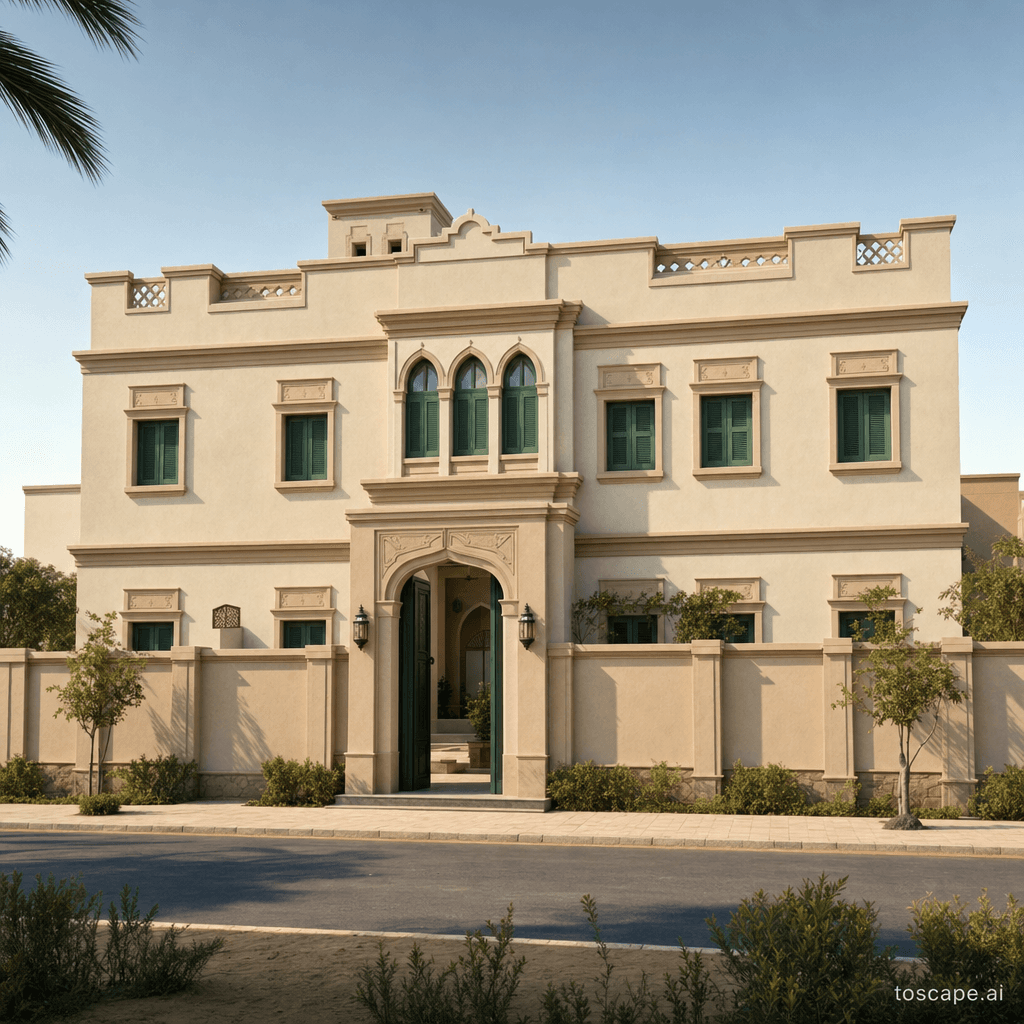
Reference elevation
Farasan Islands Transitional — characteristic facade composition, Farasan Islands / Red Sea.
Context Snapshot
Faithful translation of Farasan Islands identity signals — horizontal compound massing, bipartite facade, carved panel references, arched gateway, colored shutters — in simplified, buildable expressio... Farasan Islands Architecture — Red Sea island vernacular as informant, interpreted rather than replicated Farasan Al-Kabir — Al Qessar — new-build residential areas within the Farasan Islands character zone
Contemporary Relevance
Farasan Islands Transitional is the bridge between conservation and current construction across Farasan Islands / Red Sea, allowing contemporary programs to keep regional identity legible while using modern structure, services, and envelope systems. It is the most practical mode for streetscapes that need to feel rooted without becoming literal replicas.
Use this style in Toscape
Explore Farasan Islands Transitional directly inside Toscape using the Facade Re-Style and Design Options workflows.
Open Farasan Islands Transitional in the gallery