Dutch Friesland Farmhouse
Netherlands · Frisian farmhouse (Friese boerderij) of the northern Dutch province of Friesland
The Frisian farmhouse (Friese boerderij / Stelpboerderij / Kop-hals-romp boerderij) — the distinctive farm typology of Friesland in the northern Netherlands, characterized by its "...
Overview
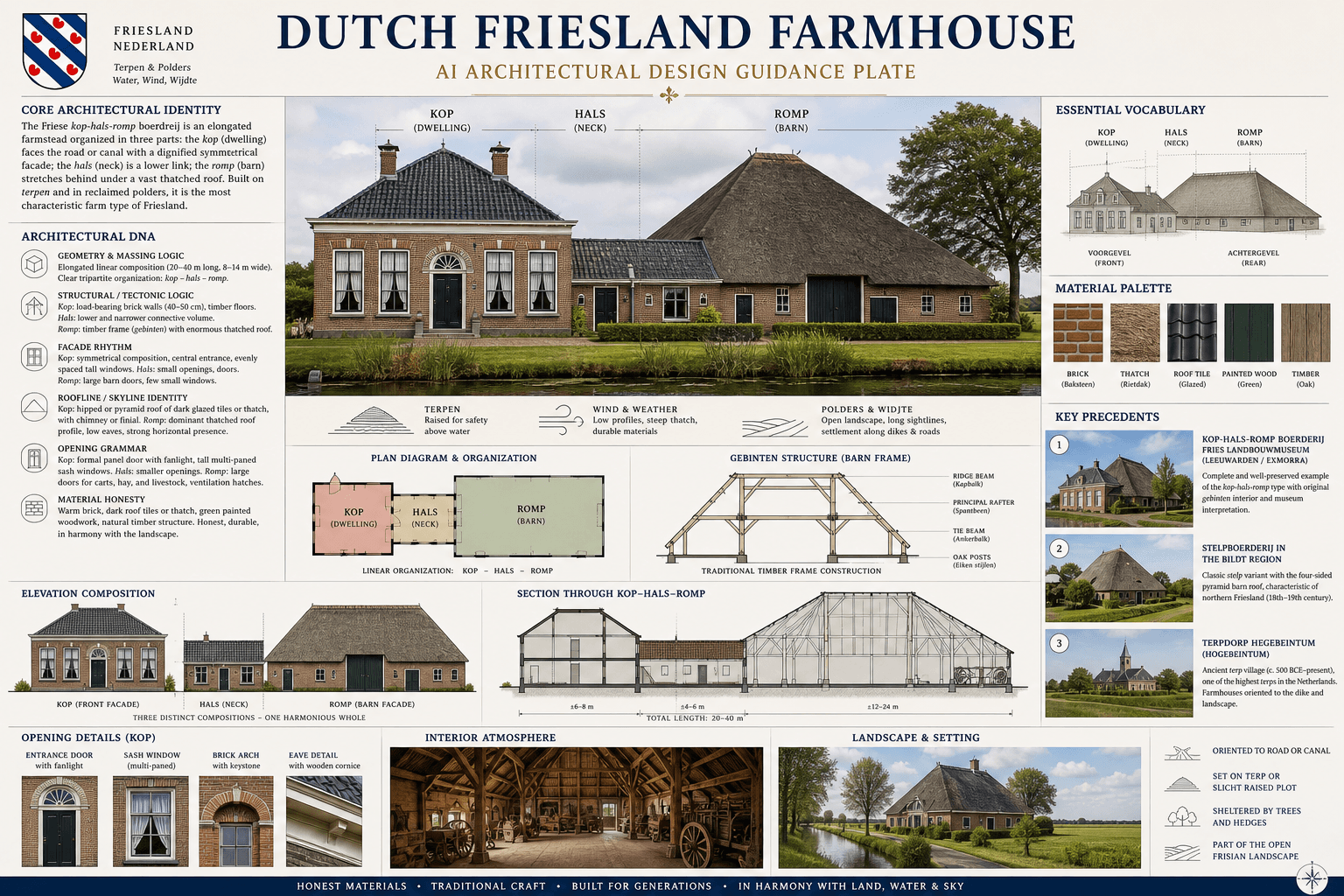
Dutch Friesland Farmhouse is a regional architectural identity in Netherlands. The Frisian farmhouse (Friese boerderij) of the northern Dutch province of Friesland — a distinctive farm typology that evolved on the terpen (singular: terp — artificial dwelling mounds raised above the flood-prone coastal marshland) and the reclaimed polder landscape — the most characteristic type is the kop-hals-romp boerderij ("head-neck-body farm"): a single elongated building (20–40 m long) where the three func...
Visual DNA
Massing & Form
The kop-hals-romp farm is an elongated linear composition (20–40 m long, 8–14 m wide), oriented along the access road or canal. The three functional zones are clearly articulated: (1) The kop (dwelling) — a compact, formal brick block, 1.5–2 stories, 8–12 m wide, with a hipped or pyramid roof — the kop presents a digni...
Facade Language
The facade is read as three distinct compositions: (1) The kop facade (front) — a formal symmetrical composition: central entrance door with paneled timber and a fanlight, flanked by tall multi-paned sash windows (similar to the Amsterdam canal house) — the facade may have a brick cornice, a decorative gable, or a hipp...
Materials & Texture
The Friesian palette is restrained and works with the flat landscape: (1) Brick (baksteen) — the kop is typically a warm red-brown Friesian brick (#A04030 to #803020), sometimes with yellow brick (Friese geeltjes — small yellow bricks) for decorative bands — the barn uses rougher, darker brick. (2) Thatch (riet) — the...
Color Palette
White, cream, pale sand, warm timber, and shadow-driven dark metal accents define the palette. The facade should stay bright and climate-aware rather than heavy, gray, or over-saturated.
Ornament & Detail
Friesian ornament is restrained and focused: (1) The kop facade — the only decorated zone: symmetrical composition, a fanlight with leaded glass or wrought iron, a gable decoration (a brick pattern, a stone plaque, or a decorative gable shape), and sometimes a date stone (gevelsteen) with the year of construction and t...
Climate Response
Friesland is a coastal province of the Wadden Sea, shaped by the struggle against water: (1) The terpen (dwelling mounds) — for over 2,000 years (from c. 500 BCE), the Frisians built artificial mounds (terpen / wierden) to raise their farms above the highest floods of the Wadden Sea — each farm sits on its own terp, 2–...
Landscape & Ground
The Frisian farmhouse (Friese boerderij) of the northern Dutch province of Friesland — a distinctive farm typology that evolved on the terpen (singular: terp — artificial dwelling mounds raised above the flood-prone coastal marshland) and the reclaimed polder landscape — the most characteristic type is the kop-hals-rom...
Reference elevation
Dutch Friesland Farmhouse — characteristic facade composition, Frisian farmhouse (Friese boerderij) of the northern Dutch province of Friesland.
Context Snapshot
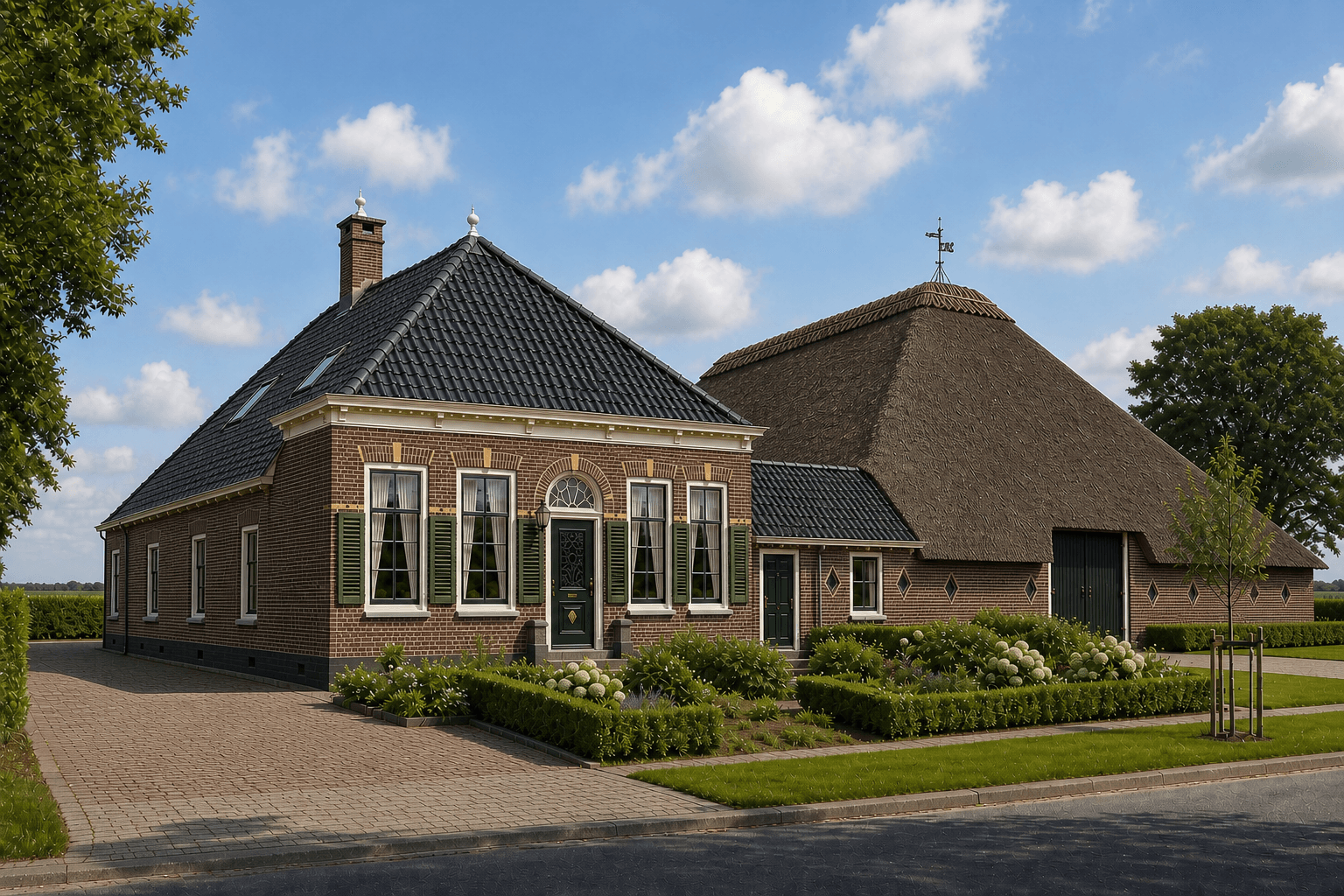
The Frisian farmhouse (Friese boerderij) of the northern Dutch province of Friesland — a distinctive farm typology that evolved on the terpen (singular: terp — artificial dwelling mounds raised above... Friesland is a coastal province of the Wadden Sea, shaped by the struggle against water: (1) The terpen (dwelling mounds) — for over 2,000 years (from c.
Contemporary Relevance
Dutch Friesland Farmhouse is useful today for residential, hospitality, civic, and place-branding work that needs Netherlands-specific character grounded in local massing, material tone, climate response, and settlement logic rather than generic international styling.
Use this style in Toscape
Explore Dutch Friesland Farmhouse directly inside Toscape using the Facade Re-Style and Design Options workflows.
Open Dutch Friesland Farmhouse in the gallery