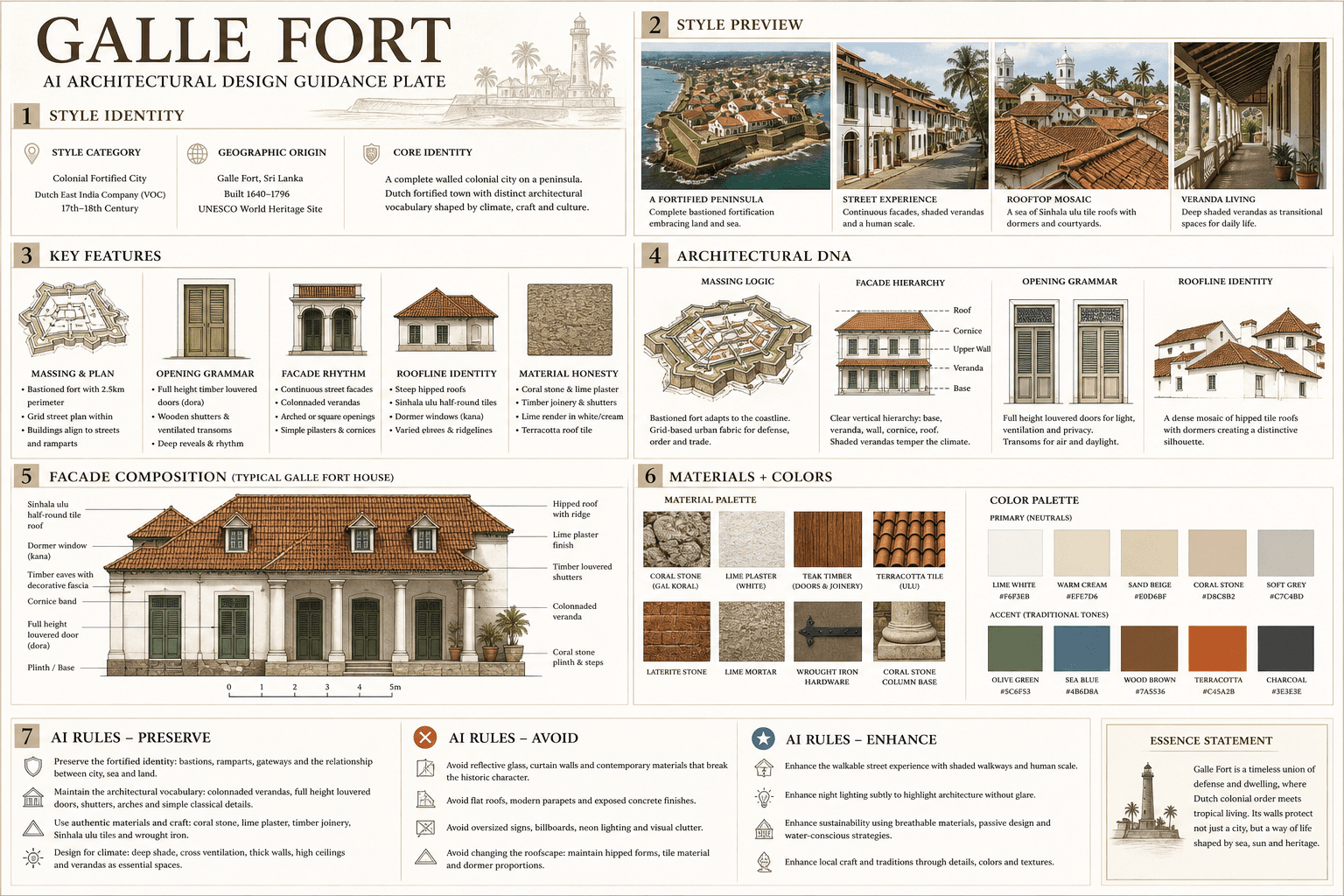
Galle Fort
Sri Lanka · Galle Fort
Dutch Colonial Fort Architecture, Coral-Kabok Walls & Indian Ocean Heritage
Overview
Galle Fort is a regional architectural identity in Sri Lanka. Galle Fort — UNESCO World Heritage Site, Dutch East India Company (VOC) fortified city. Galle Fort (built 1640-1796, expanded by Dutch on earlier Portuguese fort) — a complete walled colonial city on a peninsula: bastioned fortification walls of coral stone and granite, grid street plan within, Dutch-period burgher houses with distinctive architectural vocabulary: coral-limestone (kabok with coral aggregate) or later...
Visual DNA
Massing & Form
Galle Fort: a complete walled city on a peninsula — massive coral-and-granite bastioned ramparts (2.5km perimeter) with 14 bastions (Sun, Moon, Star, Aurora, Akersloot, etc.) enclosing a grid of narrow streets. Domestic architecture: long narrow rectangular house plots (typical 6-8m frontage, 20-30m depth) — the "Dutch...
Facade Language
The Galle Fort street facade is a continuous rhythm of white rendered walls, colonnaded verandas, louvered doors, and fanlights. Deep istopuwa veranda: 2-3m depth, raised 30-60cm above street, with a series of round or square columns (sometimes arches between columns in grander houses).
Materials & Texture
Coral stone (gal koral): the foundational material of the fort — fossilized reef limestone quarried from local waters, buff-cream to honey-brown, embedded with brain coral and shell fossils, massive blocks in fort walls, laid with lime mortar. Kabok (laterite): red-brown, porous, iron-rich — cut into blocks for house w...
Color Palette
White, cream, pale sand, warm timber, and shadow-driven dark metal accents define the palette. The facade should stay bright and climate-aware rather than heavy, gray, or over-saturated.
Ornament & Detail
Galle Fort ornament is a restrained Dutch colonial vocabulary adapted to the tropics. Fanlights (sihala uluassa): the primary decorative element — semi-circular, with timber glazing bars radiating from a central fan motif, sometimes incorporating floral or geometric cutouts in the woodwork.
Climate Response
Tropical monsoon (Af) — hot humid year-round (26-32°C), 2,500mm rainfall, exposed coastal location with salt spray, southwest monsoon directly hits Galle. Fort ramparts: first line of climate defense — breaks storm waves and wind.
Landscape & Ground
Galle Fort — UNESCO World Heritage Site, Dutch East India Company (VOC) fortified city. Tropical monsoon (Af) — hot humid year-round (26-32°C), 2,500mm rainfall, exposed coastal location with salt spray, southwest monsoon directly hits Galle.
Reference elevation
Galle Fort — characteristic facade composition, Galle Fort.
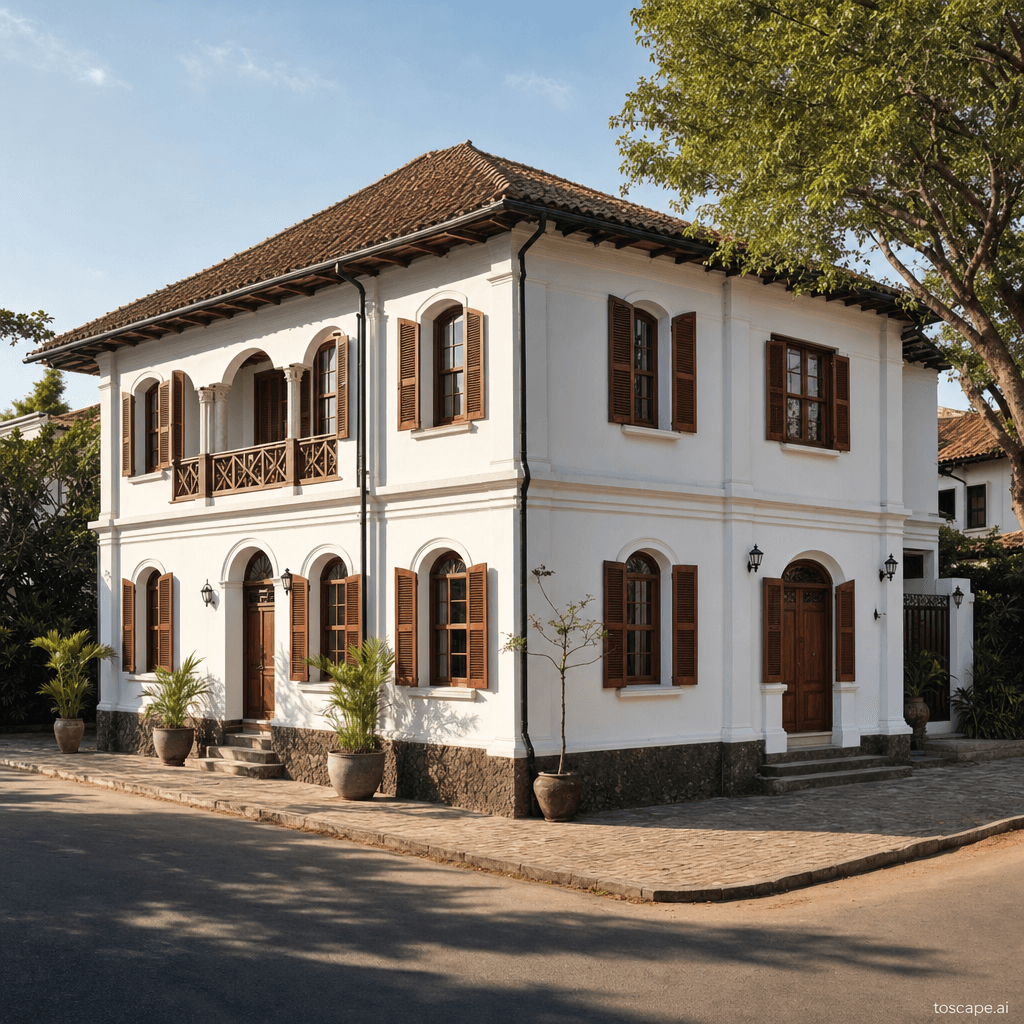
Context Snapshot
Galle Fort — UNESCO World Heritage Site, Dutch East India Company (VOC) fortified city Tropical monsoon (Af) — hot humid year-round (26-32°C), 2,500mm rainfall, exposed coastal location with salt spray, southwest monsoon directly hits Galle.
Contemporary Relevance
Galle Fort is useful today for residential, hospitality, civic, and place-branding work that needs Sri Lanka-specific character grounded in local massing, material tone, climate response, and settlement logic rather than generic international styling.
Use this style in Toscape
Explore Galle Fort directly inside Toscape using the Facade Re-Style and Design Options workflows.
Open Galle Fort in the gallery