Gamo Highlands
Ethiopia · architectural identity of the Gamo Highlands
The bamboo-woven beehive tukul of the Gamo and Dorze people — the tall conical thatch-and-bamboo dwellings of the southern Ethiopian highlands, where houses are woven like baskets...
Overview
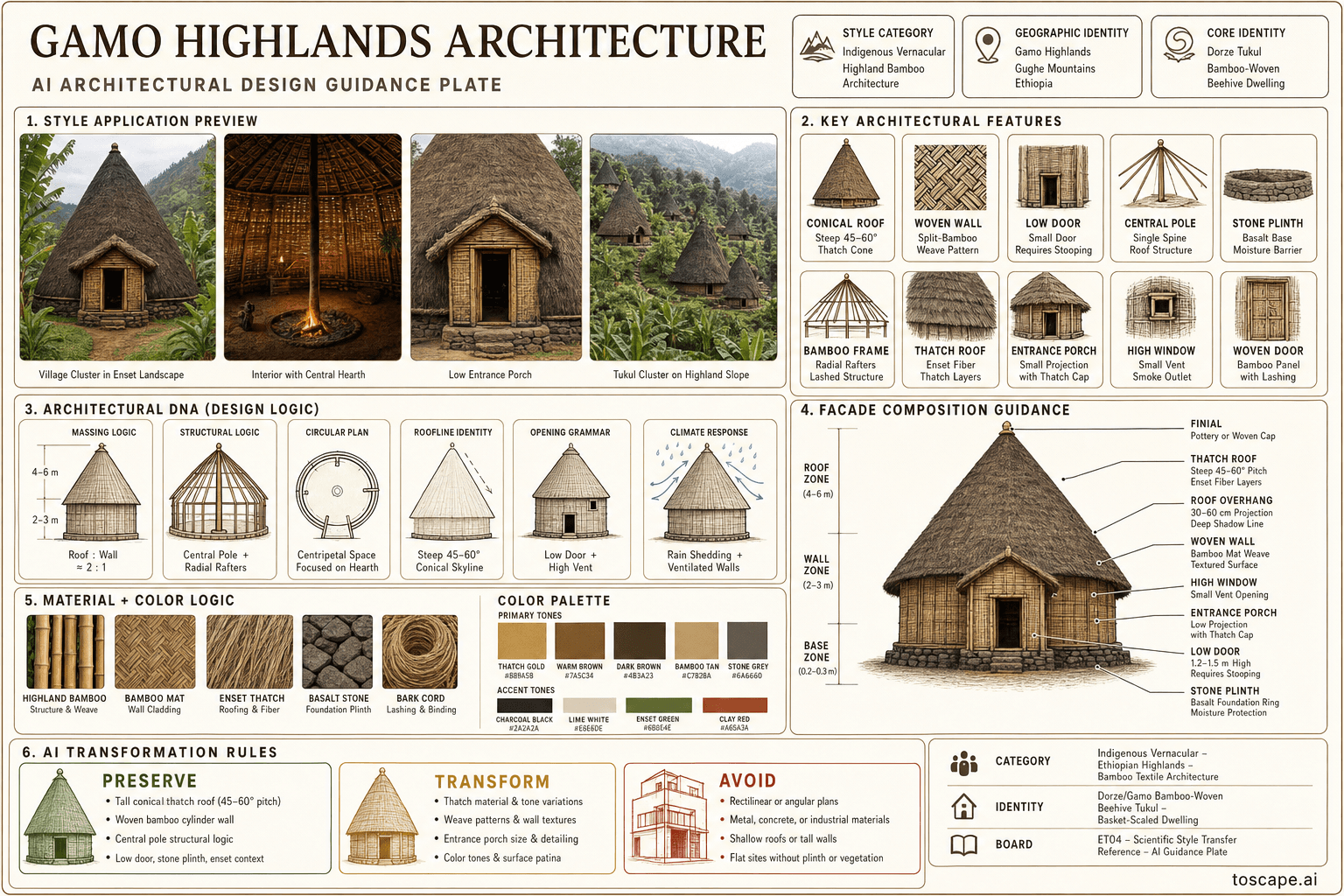
Gamo Highlands is a regional architectural identity in Ethiopia. The architectural identity of the Gamo Highlands — specifically the Dorze tukul (also called a kebele house) of the Gughe Mountains (2,400–3,000 m) — a circular-plan dwelling framed entirely in split bamboo (yushania alpina, the highland bamboo), with walls of woven bamboo matting and a towering conical roof of thatch (false banana — enset — fiber or grass) that extends to within 60–90 cm of the ground — the house as...
Visual DNA
Massing & Form
The tukul is a vertical axis composition — a low woven cylinder capped by a tall steep cone. The proportion is roughly 1:2 (wall height : roof height), creating a distinctly top-heavy silhouette that reads as "roof with walls tucked under." The circular plan (no corners, no hierarchy of direction except the entrance) g...
Facade Language
The facade is the woven bamboo wall surface — a textured, golden-brown to grey-brown mat with visible horizontal and diagonal weave patterns. The wall is interrupted only by the low door opening and occasionally a small high window.
Materials & Texture
The palette is entirely plant-based with a stone foundation: (1) Highland bamboo (yushania alpina) — the primary structural and cladding material, split into poles, woven into mats, lashed with fiber. (2) Enset (false banana, ensete ventricosum) — the leaf fiber used for thatch and coarse rope.
Color Palette
Warm earth, sandy beige, ochre, clay brown, and sun-softened mineral tones should dominate, with palm green or weathered timber as secondary accents. The palette should read as land-derived rather than polished or urban-generic.
Ornament & Detail
Ornament is minimal and woven: (1) The bamboo weave pattern — variations in weave density and direction (diagonal twill, plain weave, herringbone) create the wall's visual texture. (2) The entrance door — sometimes painted with simple geometric motifs in charcoal and lime whitewash (crosses, diamonds).
Climate Response
The Gamo Highlands (2,400–3,000 m) experience a cool, wet climate with heavy rainfall (1,200–1,800 mm/year) concentrated in the kiremt season (June–September) and cooler dry months (December–February, with temperatures occasionally dropping to 5°C at night). The steep thatch roof (45–60°) is engineered for rainfall — w...
Landscape & Ground
The architectural identity of the Gamo Highlands — specifically the Dorze tukul (also called a kebele house) of the Gughe Mountains (2,400–3,000 m) — a circular-plan dwelling framed entirely in split bamboo (yushania alpina, the highland bamboo), with walls of woven bamboo matting and a towering conical roof of thatch...
Reference elevation
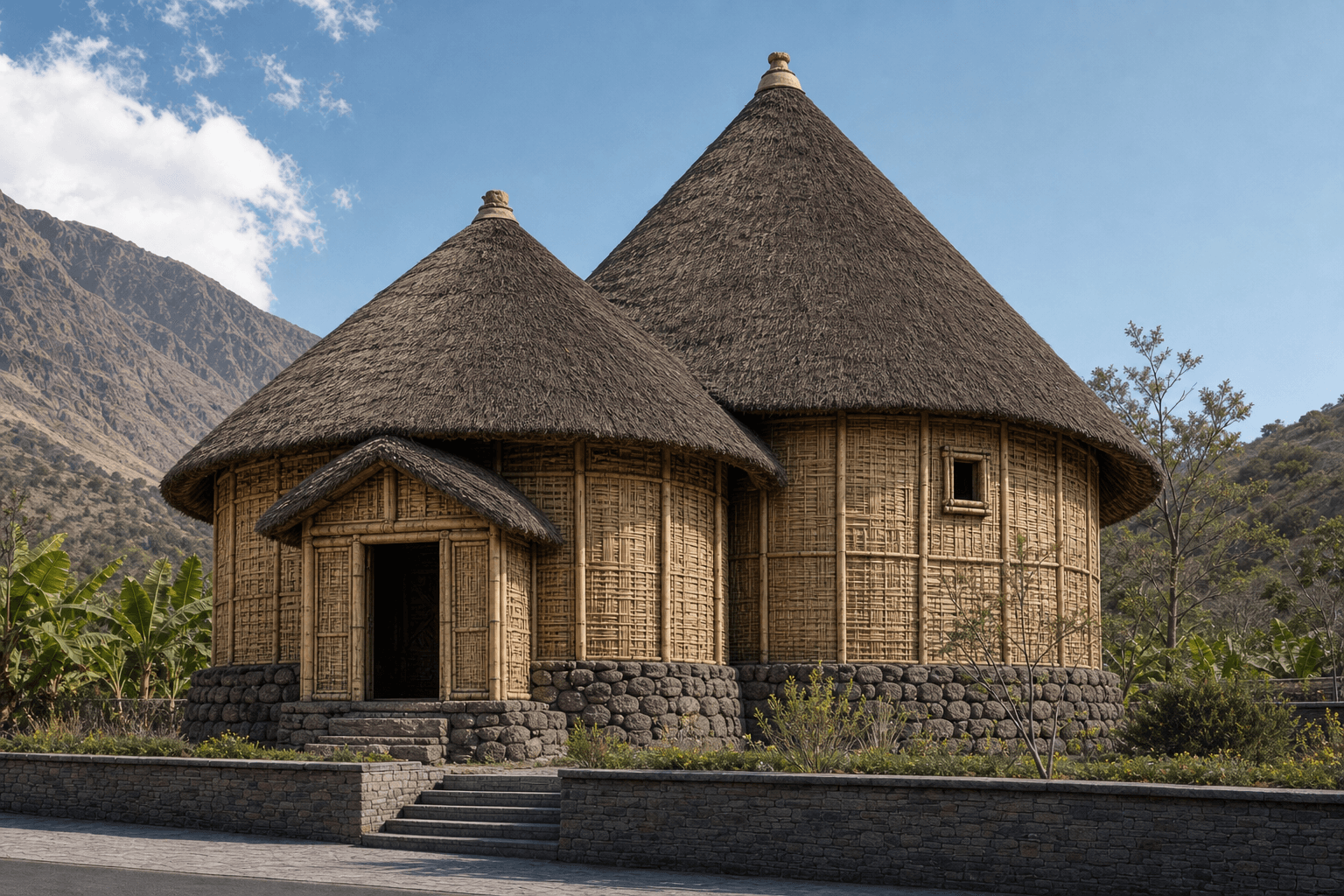
Gamo Highlands — characteristic facade composition, architectural identity of the Gamo Highlands.
Context Snapshot
The architectural identity of the Gamo Highlands — specifically the Dorze tukul (also called a kebele house) of the Gughe Mountains (2,400–3,000 m) — a circular-plan dwelling framed entirely in split... The Gamo Highlands (2,400–3,000 m) experience a cool, wet climate with heavy rainfall (1,200–1,800 mm/year) concentrated in the kiremt season (June–September) and cooler dry months (December–February, with temperatures o...
Contemporary Relevance
Gamo Highlands is useful today for residential, hospitality, civic, and place-branding work that needs Ethiopia-specific character grounded in local massing, material tone, climate response, and settlement logic rather than generic international styling.
Use this style in Toscape
Explore Gamo Highlands directly inside Toscape using the Facade Re-Style and Design Options workflows.
Open Gamo Highlands in the gallery