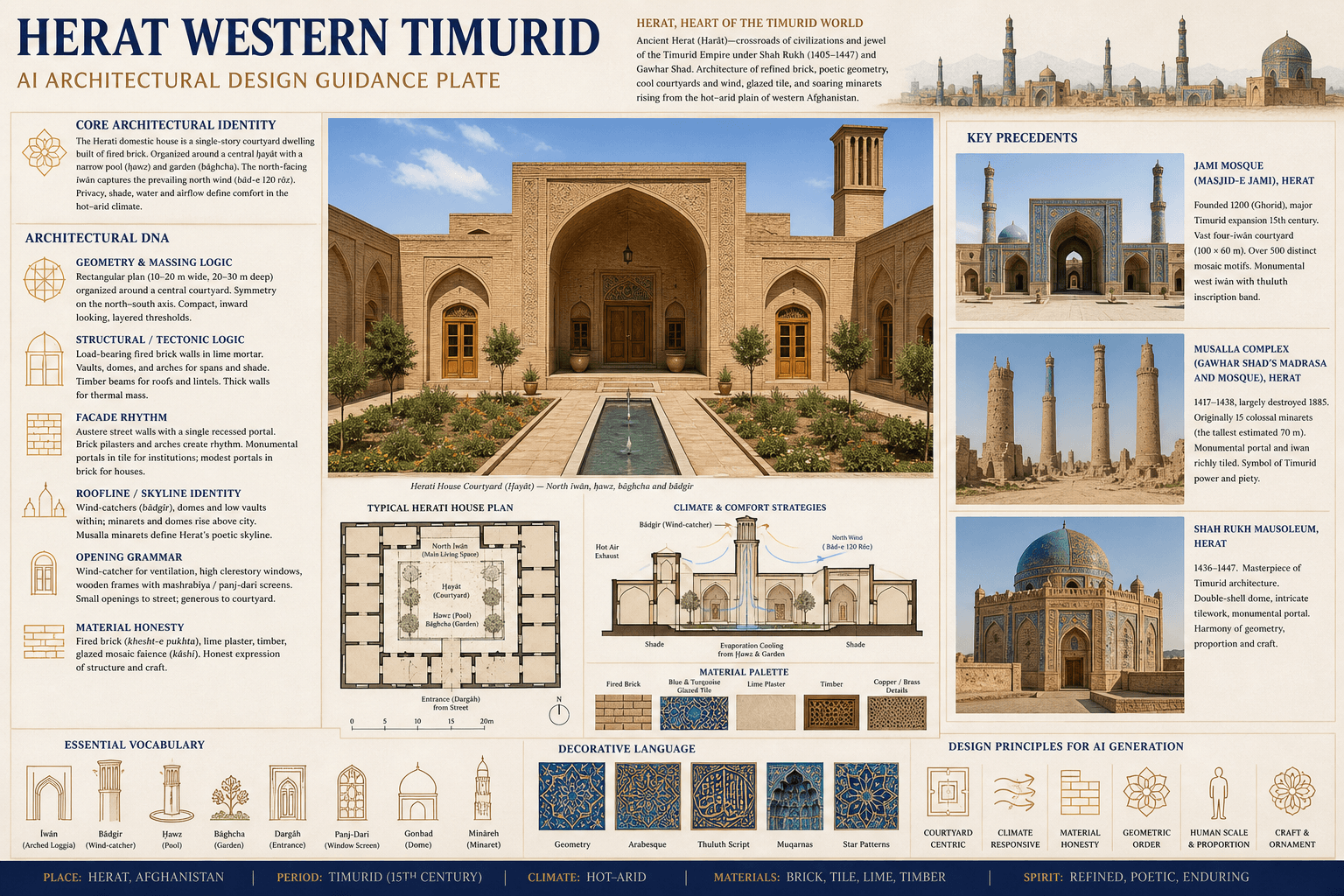
Herat Western Timurid
Afghanistan · architecture of Herat (Harāt)
The "Pearl of Khorasan" — the ancient city of Herat on the Hari Rud river, the cultural capital of the Timurid Renaissance, where the soaring blue-tiled minarets of the Musalla Com...
Overview
Herat Western Timurid is a regional architectural identity in Afghanistan. The architecture of Herat (Harāt) — one of the oldest continuously inhabited cities in Central Asia, flourishing as the capital of the Timurid Empire under Shah Rukh (1405–1447) and his wife, the patron-queen Gawhar Shad — the Timurid period (15th century) represents the golden age of Herati architecture, producing some of the finest examples of Islamic decorative arts: the Musalla Complex with its fifteen monumental...
Visual DNA
Massing & Form
The Herati house is a compact rectangular courtyard dwelling: (1) The house plan is typically rectangular (10–20 m wide, 15–30 m deep), with the courtyard at the center — the courtyard is smaller than in humid climates (4–8 m per side for a typical house) — the rooms are arranged on all four sides, with the summer room...
Facade Language
Herati facades range from the austere domestic wall to the richly decorative monumental portal: (1) The street facade — a high blank brick wall, unrendered, with the brick courses visible — the only opening is the entrance door (darwāza), a heavy timber door set within a shallow brick arch — the brickwork of the street...
Materials & Texture
Herati materials are fired brick and glazed ceramic: (1) Fired brick (khesht-e pukhta) — the universal material: bricks of uniform size (22 × 11 × 5 cm typical) fired in kilns — the brick is a warm buff-beige (#C4A880 to #B09870) — brick is used for walls, domes, minarets, and the bādgīr — the brickwork often includes...
Color Palette
White, cream, pale sand, warm timber, and shadow-driven dark metal accents define the palette. The facade should stay bright and climate-aware rather than heavy, gray, or over-saturated.
Ornament & Detail
Herati ornament is the pinnacle of Timurid decorative art: (1) Mosaic faience (kāshī mu'arraq) — the supreme decorative technique: individual glazed tiles are cut into precise shapes and assembled like a jigsaw puzzle on a plaster bed — the technique allows the most complex patterns: the Friday Mosque's tilework includ...
Climate Response
Herat has a cold semi-arid climate (BSk) with scorching summers: (1) Summer: 35–42°C during the day, 18–25°C at night — the "120-day wind" (bād-e sad-o-bīst rūz) blows from the north-west from June to September, a persistent strong wind that is both a climatic challenge and a resource — the bādgīr captures this wind fo...
Landscape & Ground
The architecture of Herat (Harāt) — one of the oldest continuously inhabited cities in Central Asia, flourishing as the capital of the Timurid Empire under Shah Rukh (1405–1447) and his wife, the patron-queen Gawhar Shad — the Timurid period (15th century) represents the golden age of Herati architecture, producing som...
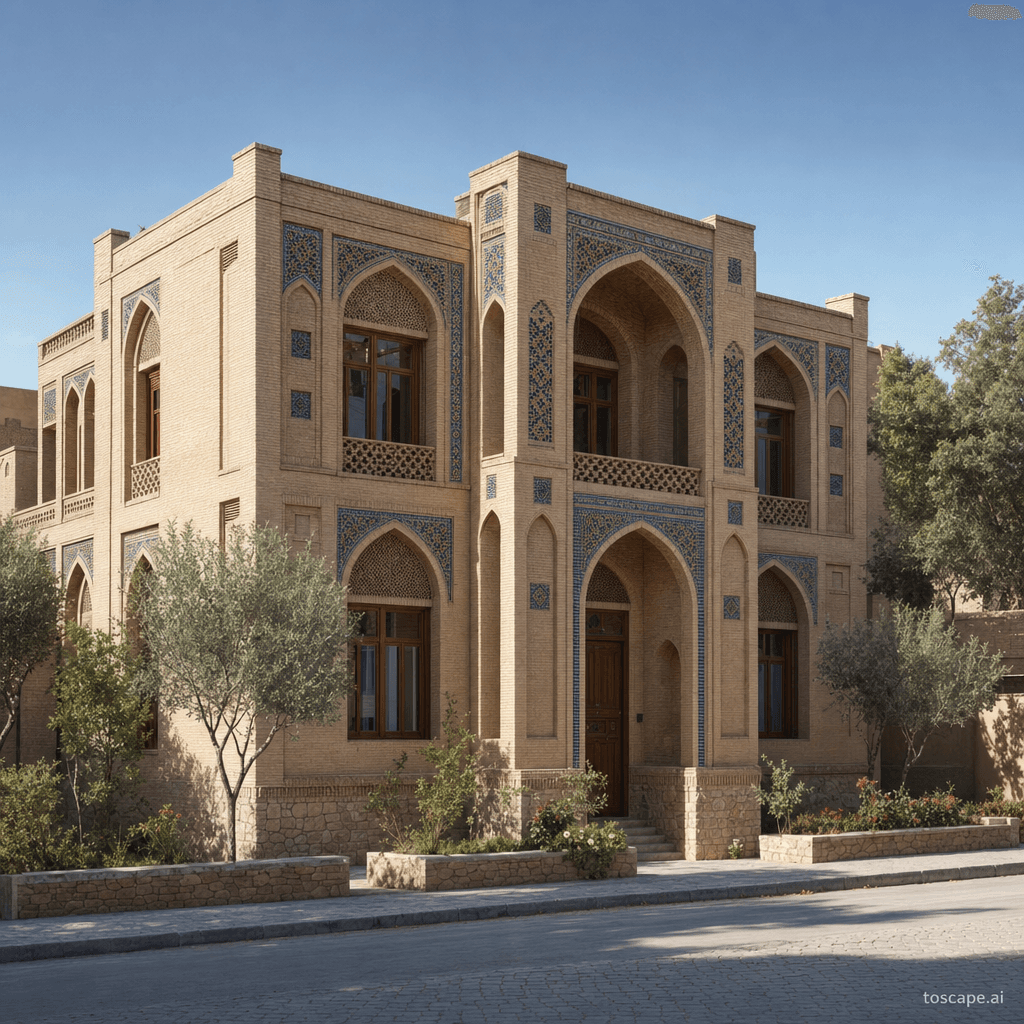
Reference elevation
Herat Western Timurid — characteristic facade composition, architecture of Herat (Harāt).
Context Snapshot
The architecture of Herat (Harāt) — one of the oldest continuously inhabited cities in Central Asia, flourishing as the capital of the Timurid Empire under Shah Rukh (1405–1447) and his wife, the patr... Herat has a cold semi-arid climate (BSk) with scorching summers: (1) Summer: 35–42°C during the day, 18–25°C at night — the "120-day wind" (bād-e sad-o-bīst rūz) blows from the north-west from June to September, a persis...
Contemporary Relevance
Herat Western Timurid is useful today for residential, hospitality, civic, and place-branding work that needs Afghanistan-specific character grounded in local massing, material tone, climate response, and settlement logic rather than generic international styling.
Use this style in Toscape
Explore Herat Western Timurid directly inside Toscape using the Facade Re-Style and Design Options workflows.
Open Herat Western Timurid in the gallery