Icelandic Turf House
Denmark · Icelandic torfbær
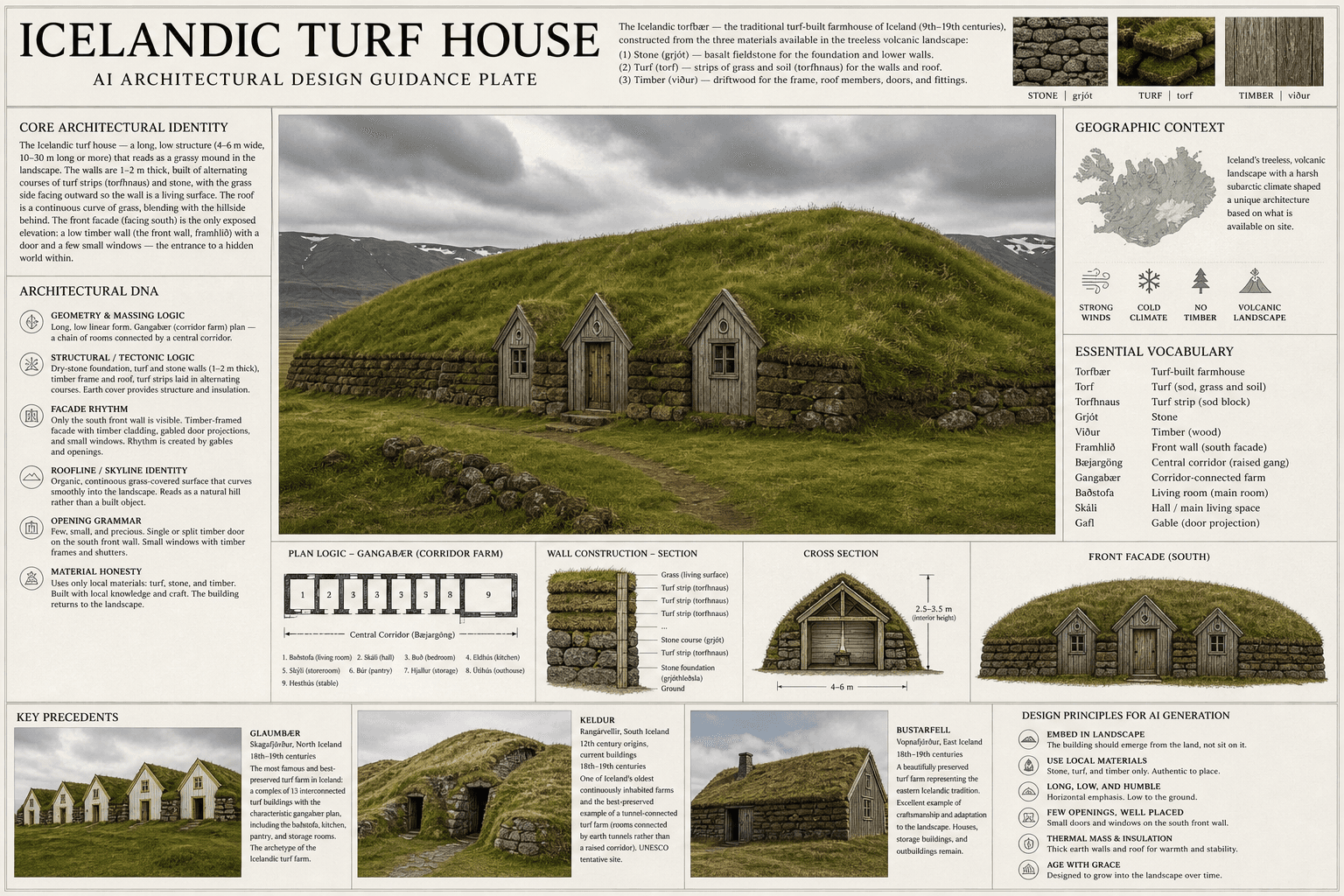
The torfbær (turf house) of Iceland — the ancient vernacular dwelling built of stone, timber, and living turf (grass and soil), with thick grass-covered walls and a grass roof (tor...
Overview
Icelandic Turf House is a regional architectural identity in Denmark Nordic. The Icelandic torfbær — the traditional turf-built farmhouse of Iceland (9th–19th centuries), constructed from the three materials available in the treeless volcanic landscape: (1) Stone (grjót) — basalt fieldstone for the foundation and lower walls. (2) Turf (torf) — strips of grass and soil (about 15–20 cm thick, cut from the surrounding land), laid in a herringbone pattern (klömbruhnaus) or alternating strip patte...
Visual DNA
Massing & Form
The turf house is a long, low mound: (1) A linear chain of rooms connected by a central corridor (bæjargöng) — the plan is a series of rooms strung along the corridor like beads on a string — the main room (baðstofa — living/sleeping/working room) is the largest, at the end of the chain. (2) The massing is a single con...
Facade Language
Only the south-facing front wall (framhlið) is visible as architecture: (1) The front wall is a timber-framed wall, the only exposed timber on the building — it is clad in vertical or horizontal boards, often painted (red, ochre, or white in later centuries). (2) The front wall is set back slightly from the line of the...
Materials & Texture
The turf house uses only the materials of the Icelandic landscape: (1) Turf (torf) — grass and soil cut from the surrounding land — the grass species are native Icelandic grasses (Festuca, Poa, Deschampsia) and moss — the turf is a living material: it continues to grow after construction (the grass may need cutting), i...
Color Palette
White, cream, pale sand, warm timber, and shadow-driven dark metal accents define the palette. The facade should stay bright and climate-aware rather than heavy, gray, or over-saturated.
Ornament & Detail
Icelandic turf house ornament is minimal and arises from necessity: (1) The turf pattern is ornamental — the herringbone (klömbruhnaus) or alternating-strip (rifflað torf) patterns of turf laying create a textured geometric surface — the construction pattern IS the ornament. (2) The carved timber — door frames, gable b...
Climate Response
The turf house is a response to the extreme Icelandic environment: (1) No trees — Iceland has virtually no native forest (the original birch woodland was largely cleared by the first settlers within a century) — the turf house is an architecture born of material scarcity: the earth itself becomes the building. (2) Extr...
Landscape & Ground
The Icelandic torfbær — the traditional turf-built farmhouse of Iceland (9th–19th centuries), constructed from the three materials available in the treeless volcanic landscape: (1) Stone (grjót) — basalt fieldstone for the foundation and lower walls. (2) Turf (torf) — strips of grass and soil (about 15–20 cm thick, cut...
Reference elevation
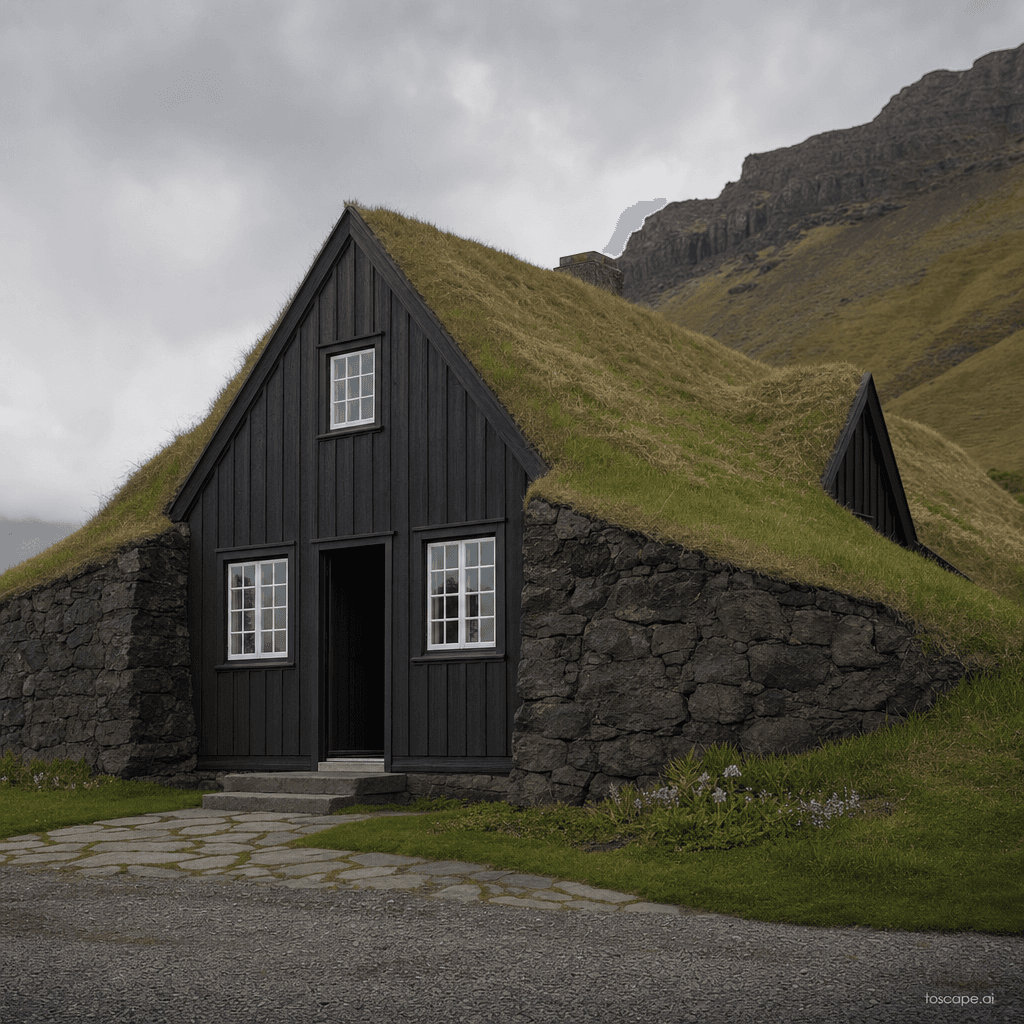
Icelandic Turf House — characteristic facade composition, Icelandic torfbær.
Context Snapshot
The Icelandic torfbær — the traditional turf-built farmhouse of Iceland (9th–19th centuries), constructed from the three materials available in the treeless volcanic landscape: (1) Stone (grjót) — bas... The turf house is a response to the extreme Icelandic environment: (1) No trees — Iceland has virtually no native forest (the original birch woodland was largely cleared by the first settlers within a century) — the turf...
Contemporary Relevance
Icelandic Turf House is useful today for residential, hospitality, civic, and place-branding work that needs Denmark Nordic-specific character grounded in local massing, material tone, climate response, and settlement logic rather than generic international styling.
Use this style in Toscape
Explore Icelandic Turf House directly inside Toscape using the Facade Re-Style and Design Options workflows.
Open Icelandic Turf House in the gallery