Inner Madinah Traditional
Saudi Arabia · Inner Madinah
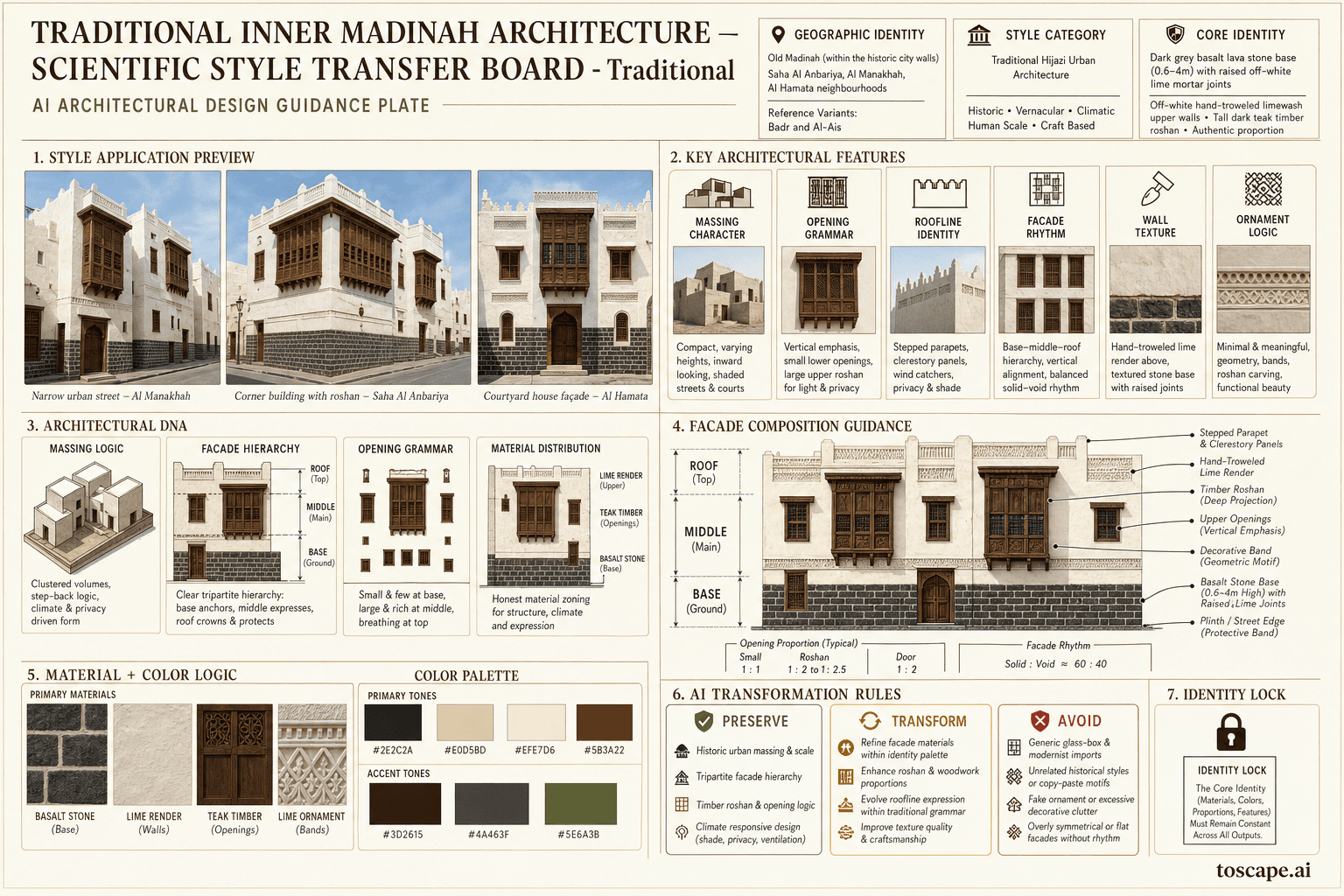
The basalt-and-limewash townhouse vernacular of historic Al-Madinah Al-Munawwarah — projecting timber roshans, arched stone entrances, and tripartite urban facades within the old c...
Overview
Inner Madinah Traditional is a Saudi architectural identity rooted in Inner Madinah. Inner Madinah Architecture — the historic walled-city vernacular of Al-Madinah Al-Munawwarah, a distinct urban branch of Hejazi architecture absorbing pilgrimage and trade influences. Old Madinah (within the historic city walls) — Saha Al Anbariya, Al Manakhah, Al Hamata neighbourhoods — with reference variants at Badr and Al-Ais in Al Madinah Province.
Visual DNA
Massing & Form
Traditional Inner Madinah buildings are compact conjoined townhouses of 2–4 storeys with broadly square to slightly upright proportions — width-to-height ratios typically 1:1.18 to 1:1.91 . Massing reads as tight rectilinear blocks sharing party walls with neighbours along narrow alleyways.
Facade Language
The facade is organized into clearly legible vertical bays of uniform width, each bay running from ground to parapet and centred on a stacked sequence of door/window/roshan/shaburah opening . Bays read as a frame of solid masonry surrounding large rectangular timber-screened infill panels — the facade reads as a masonr...
Materials & Texture
Materials are exactly four: (1) dark grey basalt lava stone — cut into rough rectangular blocks for the load-bearing base; (2) off-white lime render — hand-troweled, slightly chalky matte surface, on all upper walls and parapets; (3) dark aged hardwood — typically teak or imported Indian hardwood — for roshans, shutter...
Color Palette
Keep the palette regionally grounded: a dominant mineral wall tone, a lighter plaster or render accent, and a warm timber or bronze detail layer. The building should read as place-specific before any decorative element is noticed.
Ornament & Detail
Ornament is concentrated in three locations: (a) the timber craftsmanship of the roshan — geometric fretwork, turned balusters, carved denticulated eaves; (b) the arched stone or plaster surround of the primary entrance door — the most loaded ornamental element; (c) the projecting white mortar joints of the basalt base...
Climate Response
Buildings respond to very hot, dry continental summers (36–46°C) and minimal rainfall. The dark basalt base anchors the building to the volcanic Harrat ground — absorbing and storing heat.
Landscape & Ground
Old Madinah (within the historic city walls) — Saha Al Anbariya, Al Manakhah, Al Hamata neighbourhoods — with reference variants at Badr and Al-Ais in Al Madinah Province. Buildings respond to very hot, dry continental summers (36–46°C) and minimal rainfall.
Reference elevation
Inner Madinah Traditional — characteristic facade composition, Inner Madinah.
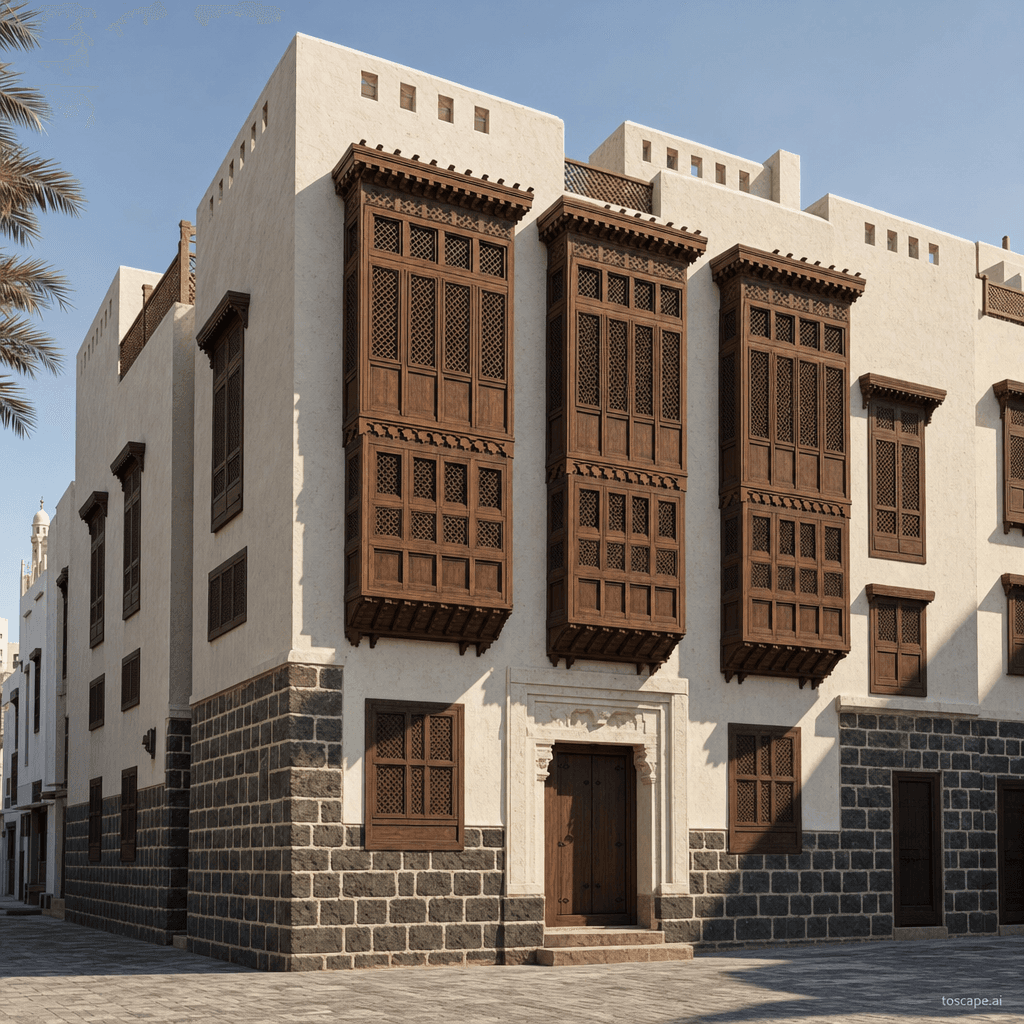
Context Snapshot
Maximum-fidelity translation of Traditional Inner Madinah architecture — the sophisticated urban vernacular of Old Madinah's conjoined townhouses, fusing Hejazi Red Sea roshan culture with the volcani... Inner Madinah Architecture — the historic walled-city vernacular of Al-Madinah Al-Munawwarah, a distinct urban branch of Hejazi architecture absorbing pilgrimage and trade influences Old Madinah (within the historic city walls) — Saha Al Anbariya, Al Manakhah, Al Hamata neighbourhoods — with reference variants at Badr and Al-Ais in Al Madinah Province
Contemporary Relevance
Inner Madinah Traditional operates as the heritage reference layer for Inner Madinah and is most useful today in conservation work, cultural tourism districts, and accurate AI rendering direction. Its value in current practice comes from preserving proportion, material hierarchy, and climate logic without flattening them into generic nostalgia.
Use this style in Toscape
Explore Inner Madinah Traditional directly inside Toscape using the Facade Re-Style and Design Options workflows.
Open Inner Madinah Traditional in the gallery