Isfahan Safavid
Iran · Safavid-era Isfahan (1598-1722)
Blue-Tiled Domes, Iwan Courtyards & Naqsh-e Jahan Square Architecture
Overview
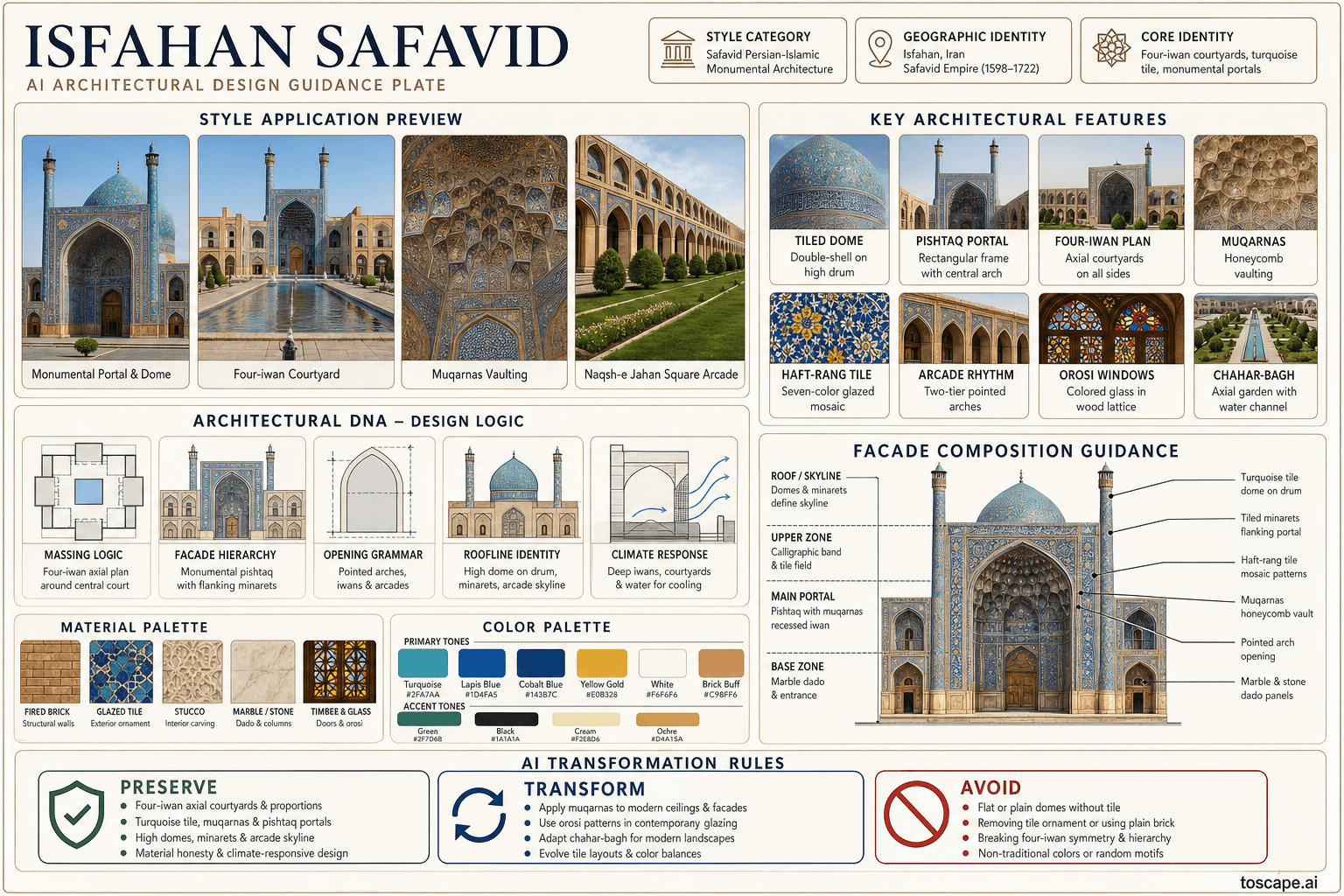
Isfahan Safavid is a regional architectural identity in Iran. Safavid-era Isfahan (1598-1722) — the apogee of Persian-Islamic monumental and urban architecture. Four-iwan mosque typology, turquoise-blue tile mosaic (haft-rang / mo'arraq kashi), monumental arched portals (pishtaq), double-shelled domes on high drums, arcaded bazaar entries, chahar-bagh garden geometry
Visual DNA
Massing & Form
Four-iwan axial plan: central courtyard with four iwan (vaulted halls) on cardinal axes. Shah Mosque (Masjed-e Shah): south-facing iwan leads to domed sanctuary.
Facade Language
Maydan arcade: continuous rhythmic arches in two tiers, each bay with a blind arch niche. Mosque portal (pishtaq): massive iwan — rectangular frame rising to full height, central pointed arch, flanking minarets.
Materials & Texture
Fired brick (ajur) — structural walls. Glazed ceramic tile (kashi) — haft-rang (seven-color cuerda seca tile) and mo'arraq (mosaic tile).
Color Palette
White, cream, pale sand, warm timber, and shadow-driven dark metal accents define the palette. The facade should stay bright and climate-aware rather than heavy, gray, or over-saturated.
Ornament & Detail
Tile mosaic as primary ornamental medium: arabesque floral (eslimi), geometric interlace (girih), and calligraphic (sols/nastaliq scripts) bands. Muqarnas: honeycomb vaulting in iwans and dome transitions.
Climate Response
Hot arid plateau (1570m), cold winters. Courtyard orientation to catch prevailing breezes.
Landscape & Ground
Safavid-era Isfahan (1598-1722) — the apogee of Persian-Islamic monumental and urban architecture. Hot arid plateau (1570m), cold winters.
Reference elevation
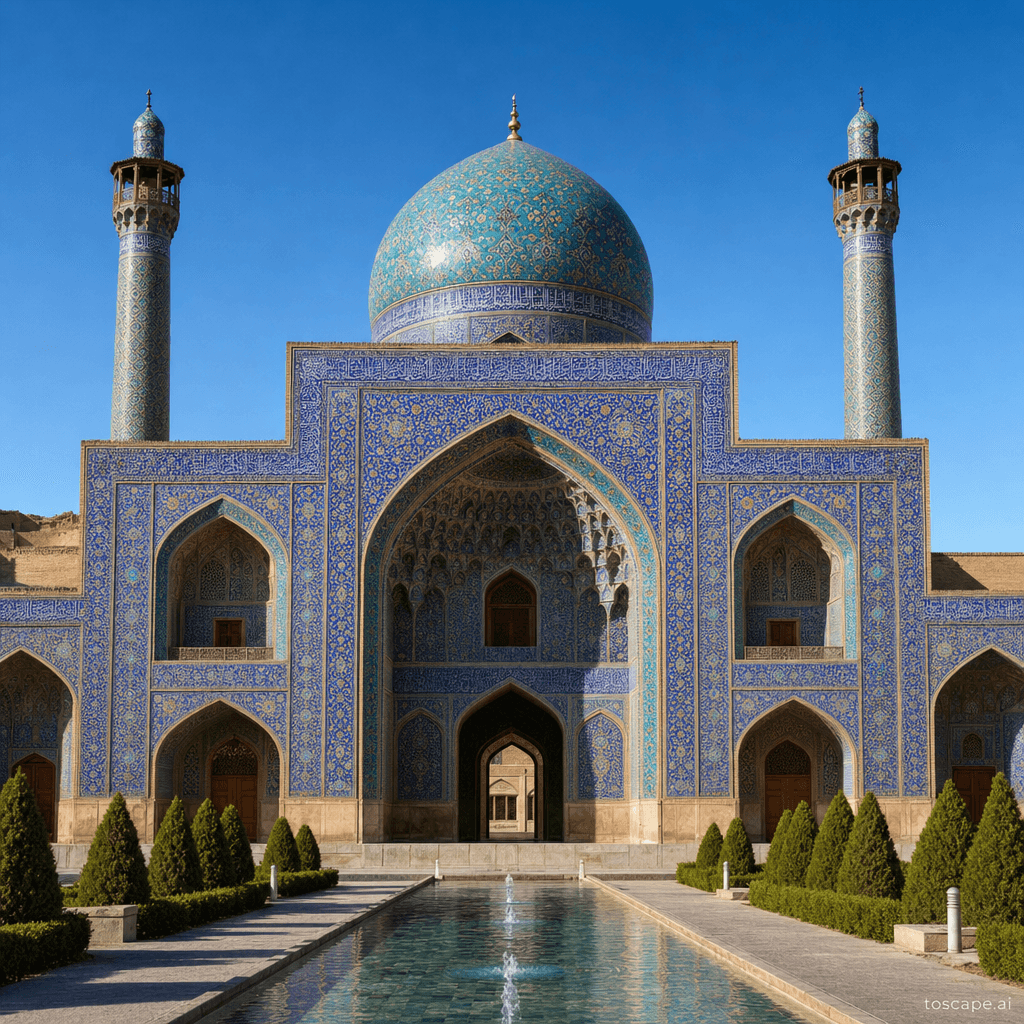
Isfahan Safavid — characteristic facade composition, Safavid-era Isfahan (1598-1722).
Context Snapshot
Safavid-era Isfahan (1598-1722) — the apogee of Persian-Islamic monumental and urban architecture Hot arid plateau (1570m), cold winters.
Contemporary Relevance
Isfahan Safavid is useful today for residential, hospitality, civic, and place-branding work that needs Iran-specific character grounded in local massing, material tone, climate response, and settlement logic rather than generic international styling.
Use this style in Toscape
Explore Isfahan Safavid directly inside Toscape using the Facade Re-Style and Design Options workflows.
Open Isfahan Safavid in the gallery