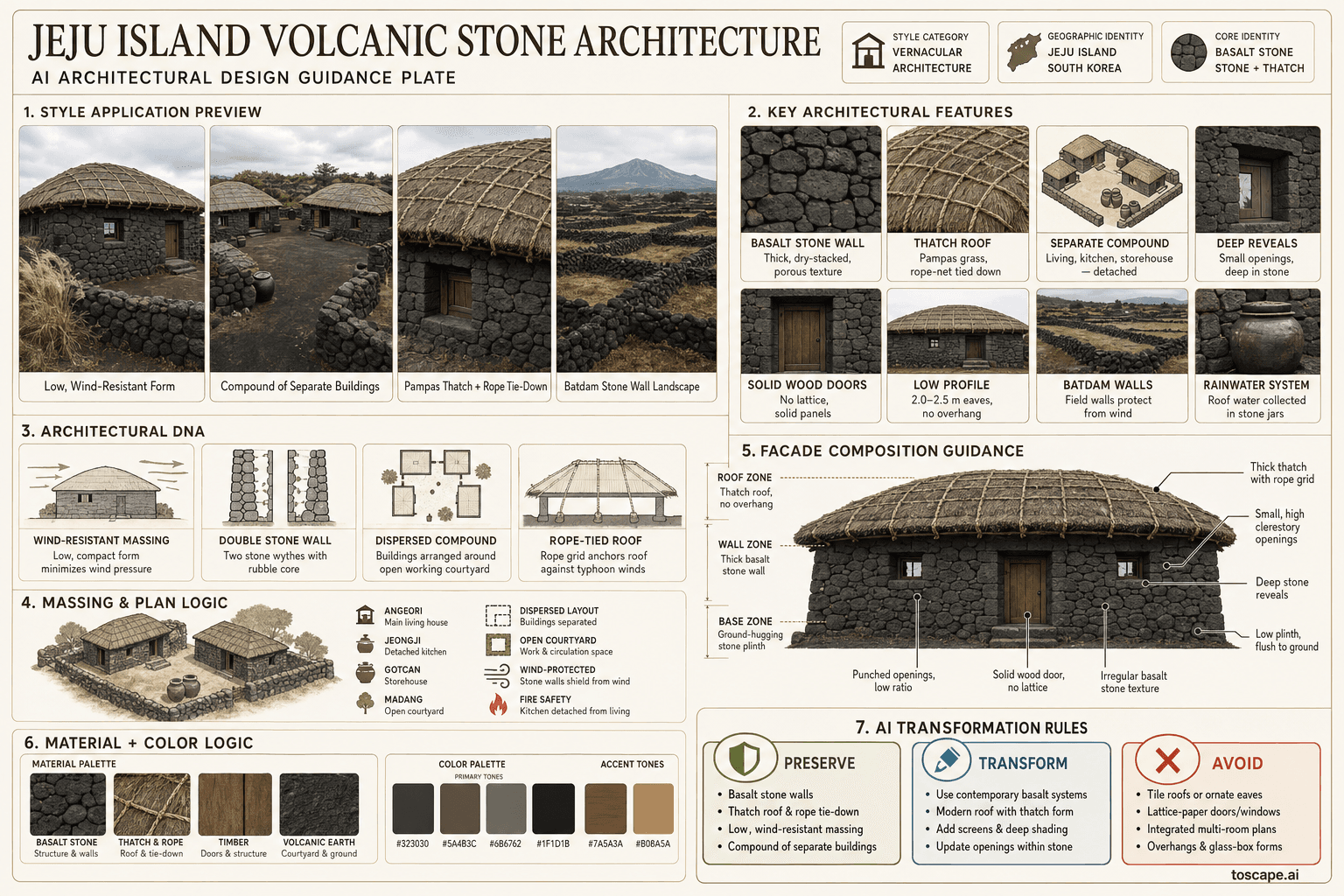
Jeju Island Volcanic Stone
South Korea · domestic architecture of Jeju Island (Jeju Special Self-Governing Province)
The unique stone-and-thatch architecture of Korea's subtropical volcanic island
Overview
Jeju Island Volcanic Stone is a regional architectural identity in South Korea. Traditional domestic architecture of Jeju Island (Jeju Special Self-Governing Province) — the most climatically, geologically, and culturally distinct region of Korea. A volcanic island 80 km south of the Korean mainland with a subtropical climate fundamentally different from the peninsula.
Visual DNA
Massing & Form
Jeju traditional houses are the lowest, most grounded, and most wind-resistant of all Korean domestic architectures. The driving design forces are wind resistance (typhoons and year-round oceanic winds) and material availability (volcanic basalt, pampas grass, limited timber).
Facade Language
The Jeju facade is dominated by the black basalt stone wall — the timber frame is secondary or hidden: Stone wall surface: The facade reads primarily as a textured black-grey stone surface — irregular basalt blocks in dry-stacked courses, with small gaps and variations creating a rich, organic texture. The stone wall e...
Materials & Texture
The Jeju material palette is the most materially unified of all Korean regions — essentially a two-material architecture: Black porous basalt stone — walls, foundations, field boundaries, enclosure walls — the omnipresent material. Color ranges from dark grey (RGB ~60,55,55) to true black (RGB ~40,38,38) depending on q...
Color Palette
Warm earth, sandy beige, ochre, clay brown, and sun-softened mineral tones should dominate, with palm green or weathered timber as secondary accents. The palette should read as land-derived rather than polished or urban-generic.
Ornament & Detail
Jeju ornament is essentially non-existent — the aesthetic is one of pure functional expression: No dancheong — no painted decoration of any kind No carved brackets — the timber frame is too minimal to support bracket development No lattice patterns — solid doors, no sal muni The rope-net grid IS the ornament: The thatc...
Climate Response
Jeju's climate response is dominated by wind: Wind resistance (primary driver): The low profile, thick stone walls, flush eaves, rope-tied roof, solid doors, and compound layout all respond to the year-round oceanic winds and periodic typhoons. Jeju architecture is fundamentally "wind architecture" — the wind shapes ev...
Landscape & Ground
Traditional domestic architecture of Jeju Island (Jeju Special Self-Governing Province) — the most climatically, geologically, and culturally distinct region of Korea. A volcanic island 80 km south of the Korean mainland with a subtropical climate fundamentally different from the peninsula.
Reference elevation
Jeju Island Volcanic Stone — characteristic facade composition, domestic architecture of Jeju Island (Jeju Special Self-Governing Province).
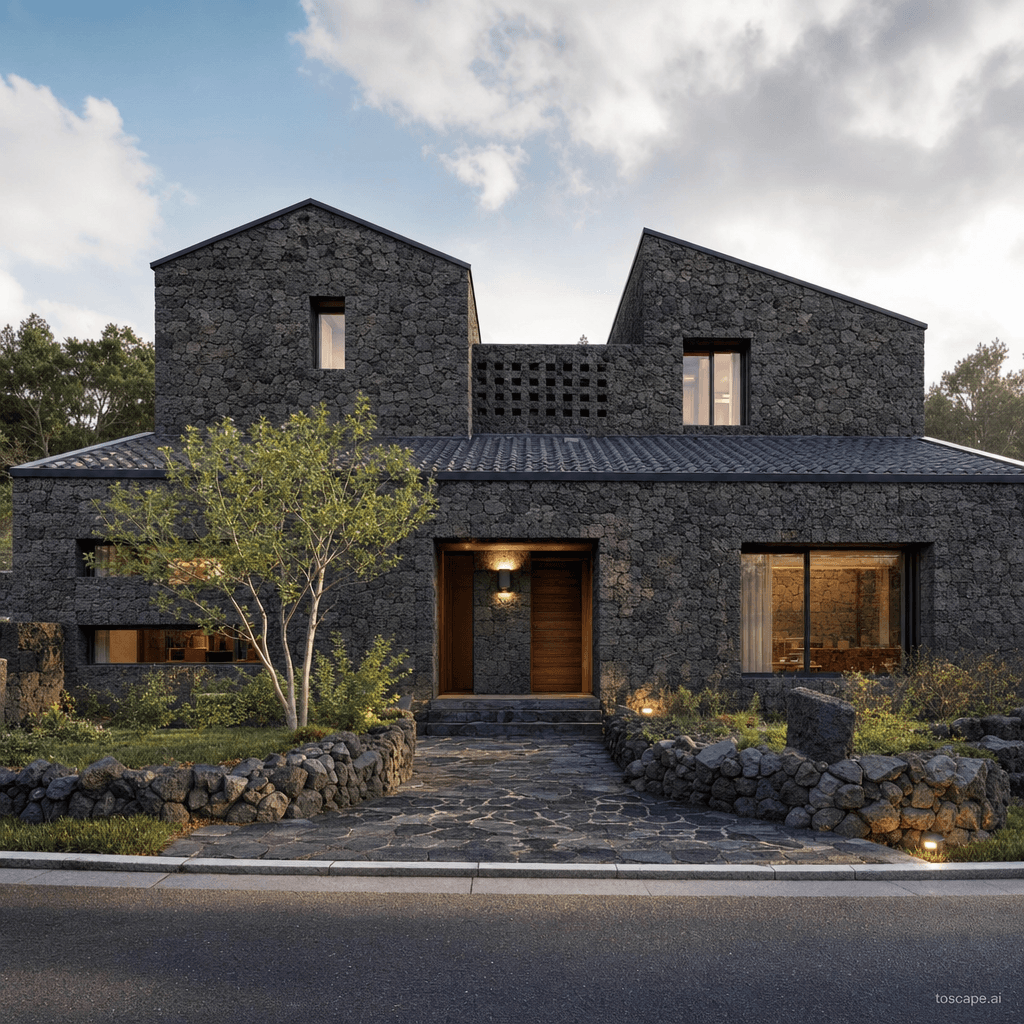
Context Snapshot
Traditional domestic architecture of Jeju Island (Jeju Special Self-Governing Province) — the most climatically, geologically, and culturally distinct region of Korea. Jeju's climate response is dominated by wind: Wind resistance (primary driver): The low profile, thick stone walls, flush eaves, rope-tied roof, solid doors, and compound layout all respond to the year-round oceanic wind...
Contemporary Relevance
Jeju Island Volcanic Stone is useful today for residential, hospitality, civic, and place-branding work that needs South Korea-specific character grounded in local massing, material tone, climate response, and settlement logic rather than generic international styling.
Use this style in Toscape
Explore Jeju Island Volcanic Stone directly inside Toscape using the Facade Re-Style and Design Options workflows.
Open Jeju Island Volcanic Stone in the gallery