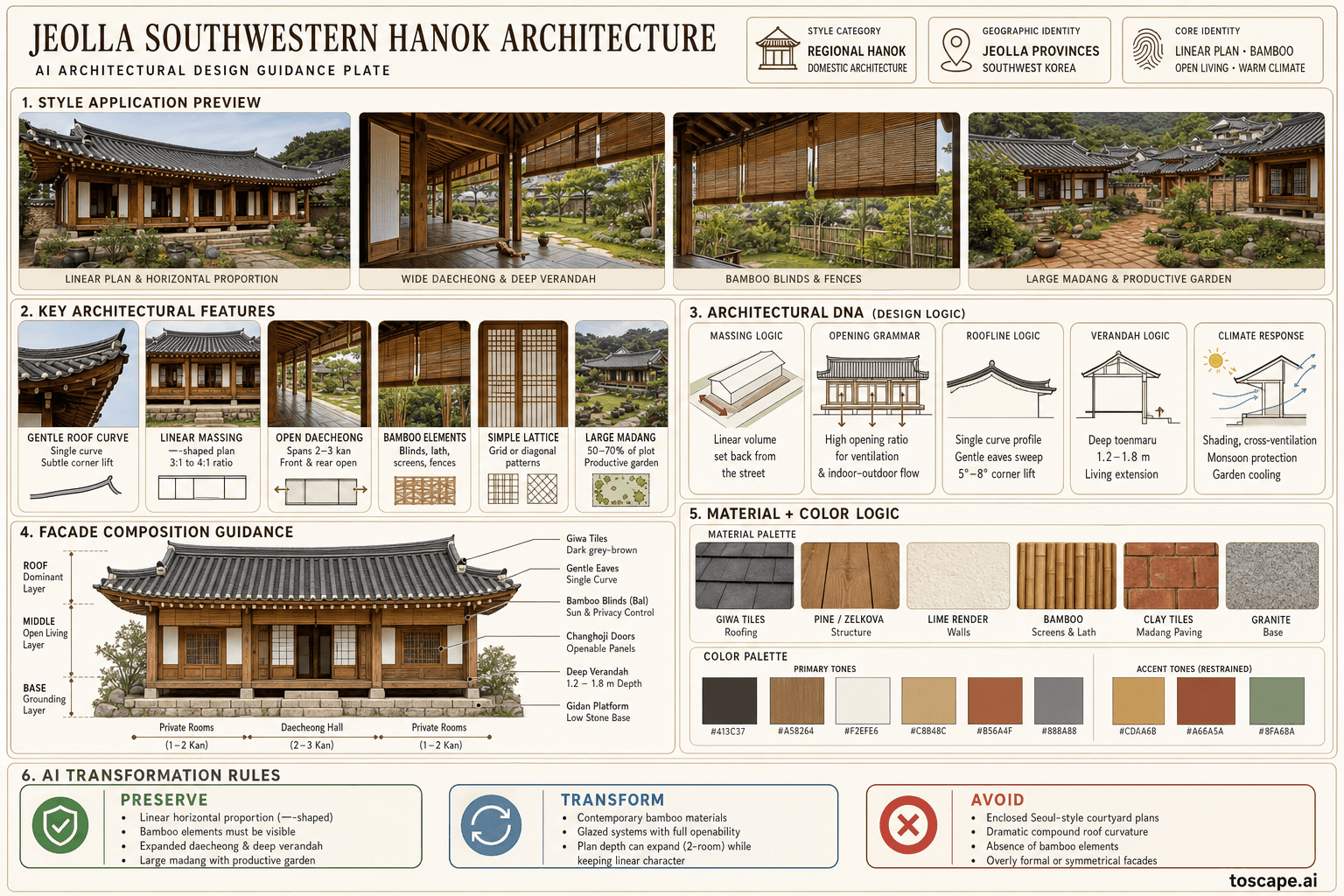
Jeolla Southwestern Hanok
South Korea · hanok domestic architecture of the Jeolla provinces (Jeollabuk-do and Jeollanam...
The warmer-climate regional hanok typology of Korea's southwestern provinces
Overview
Jeolla Southwestern Hanok is a regional architectural identity in South Korea. Regional hanok domestic architecture of the Jeolla provinces (Jeollabuk-do and Jeollanam-do), including the historic city of Jeonju — the warmest and most agriculturally rich region of the Korean peninsula. Single-wing linear plan (一-shaped, ilja-jip) predominating over enclosed courtyard forms — larger, more open madang — less enclosed, more outward-facing elevation — lighter, more open timber treatment — wider toen...
Visual DNA
Massing & Form
Jeolla hanok are predominantly single-wing linear plans (一-shaped, ilja-jip) — a single rectangular volume with rooms arranged in a straight line, opening onto an extended toenmaru verandah that faces the madang. The 一-shaped plan is the most common rural and small-town typology in Jeolla, contrasting with the enclosed...
Facade Language
The Jeolla hanok facade is characterized by greater openness and informality compared to Seoul: Opening ratio: The courtyard-facing opening ratio is 70–80% — higher than Seoul's 60–70% — reflecting the warmer climate that favors indoor-outdoor connection. The daecheong-maru (open hall) typically extends across 2–3 kan...
Materials & Texture
The Jeolla material palette adds bamboo and warmer-toned timber to the basic Seoul triad: Dark grey-brown giwa tiles (warmer tone than Seoul) Natural honey-brown pine and zelkova timber Warm off-white lime render Grey granite plinth Golden bamboo — as structural lath, ceiling lattice, blinds, fences, and decorative scr...
Color Palette
White, cream, pale sand, warm timber, and shadow-driven dark metal accents define the palette. The facade should stay bright and climate-aware rather than heavy, gray, or over-saturated.
Ornament & Detail
Jeolla ornament is distinctly more vernacular and less formal than Seoul: (a) Simpler gongpo brackets: Ikgong (wing-bracket) style — fewer tiers, simpler carving. The bracket zone is less visually dominant than in Seoul hanok.
Climate Response
Jeolla's warmer, wetter climate drives key adaptations: Expanded ventilation: The wider daecheong, deeper toenmaru, and higher opening ratio all serve maximum cross-ventilation for the long, humid summer. Monsoon protection: The extended eaves (similar projection to Seoul: 0.9–1.2 m) protect the paper doors and wooden...
Landscape & Ground
Regional hanok domestic architecture of the Jeolla provinces (Jeollabuk-do and Jeollanam-do), including the historic city of Jeonju — the warmest and most agriculturally rich region of the Korean peninsula. Jeolla's warmer, wetter climate drives key adaptations: Expanded ventilation: The wider daecheong, deeper toenmar...
Reference elevation
Jeolla Southwestern Hanok — characteristic facade composition, hanok domestic architecture of the Jeolla provinces (Jeollabuk-do and Jeollanam....
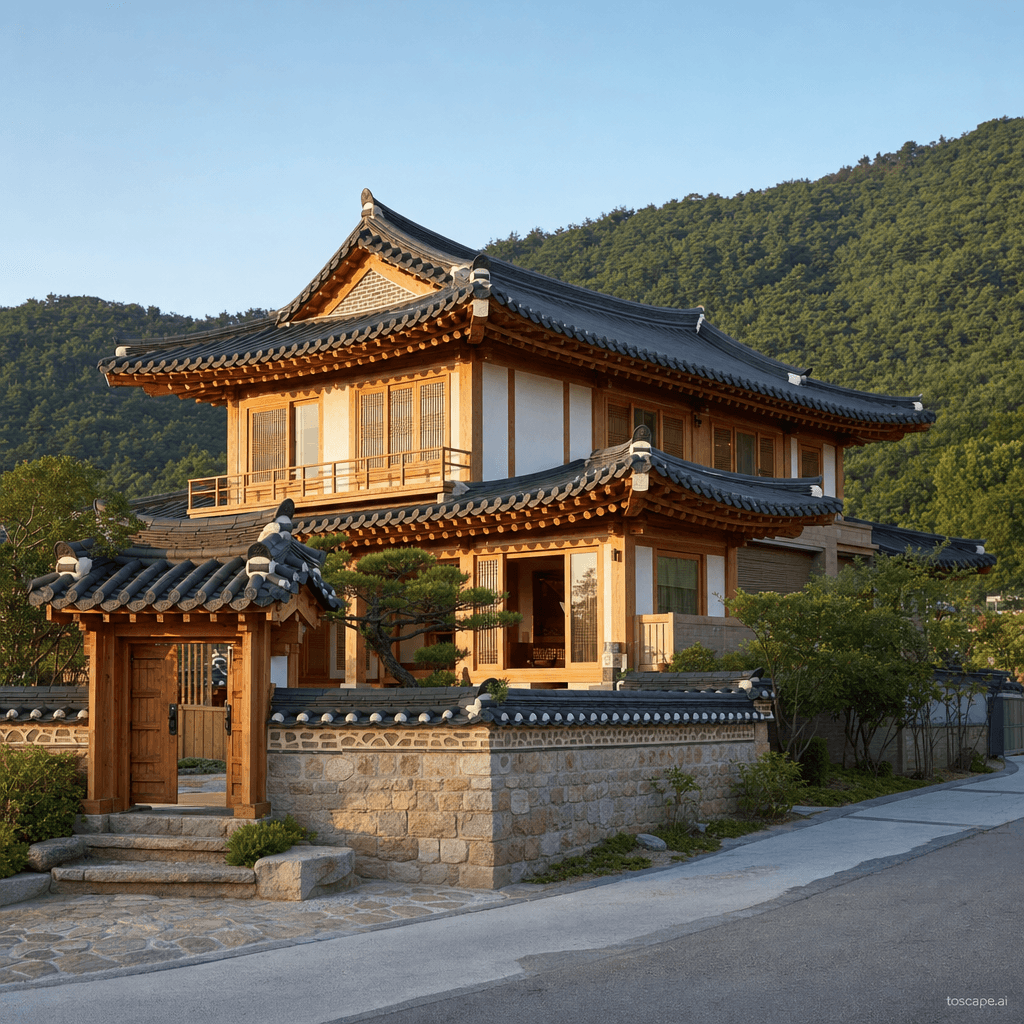
Context Snapshot
Regional hanok domestic architecture of the Jeolla provinces (Jeollabuk-do and Jeollanam-do), including the historic city of Jeonju — the warmest and most agriculturally rich region of the Korean peni... Jeolla's warmer, wetter climate drives key adaptations: Expanded ventilation: The wider daecheong, deeper toenmaru, and higher opening ratio all serve maximum cross-ventilation for the long, humid summer.
Contemporary Relevance
Jeolla Southwestern Hanok is useful today for residential, hospitality, civic, and place-branding work that needs South Korea-specific character grounded in local massing, material tone, climate response, and settlement logic rather than generic international styling.
Use this style in Toscape
Explore Jeolla Southwestern Hanok directly inside Toscape using the Facade Re-Style and Design Options workflows.
Open Jeolla Southwestern Hanok in the gallery