Jordan Valley
Jordan · vernacular architecture of the Jordan Valley (Al-Ghor)
The mud-brick and reed dwellings of the Ghor — subtropical oasis architecture along the Dead Sea Rift, where earth, water, and palm define the built environment
Overview
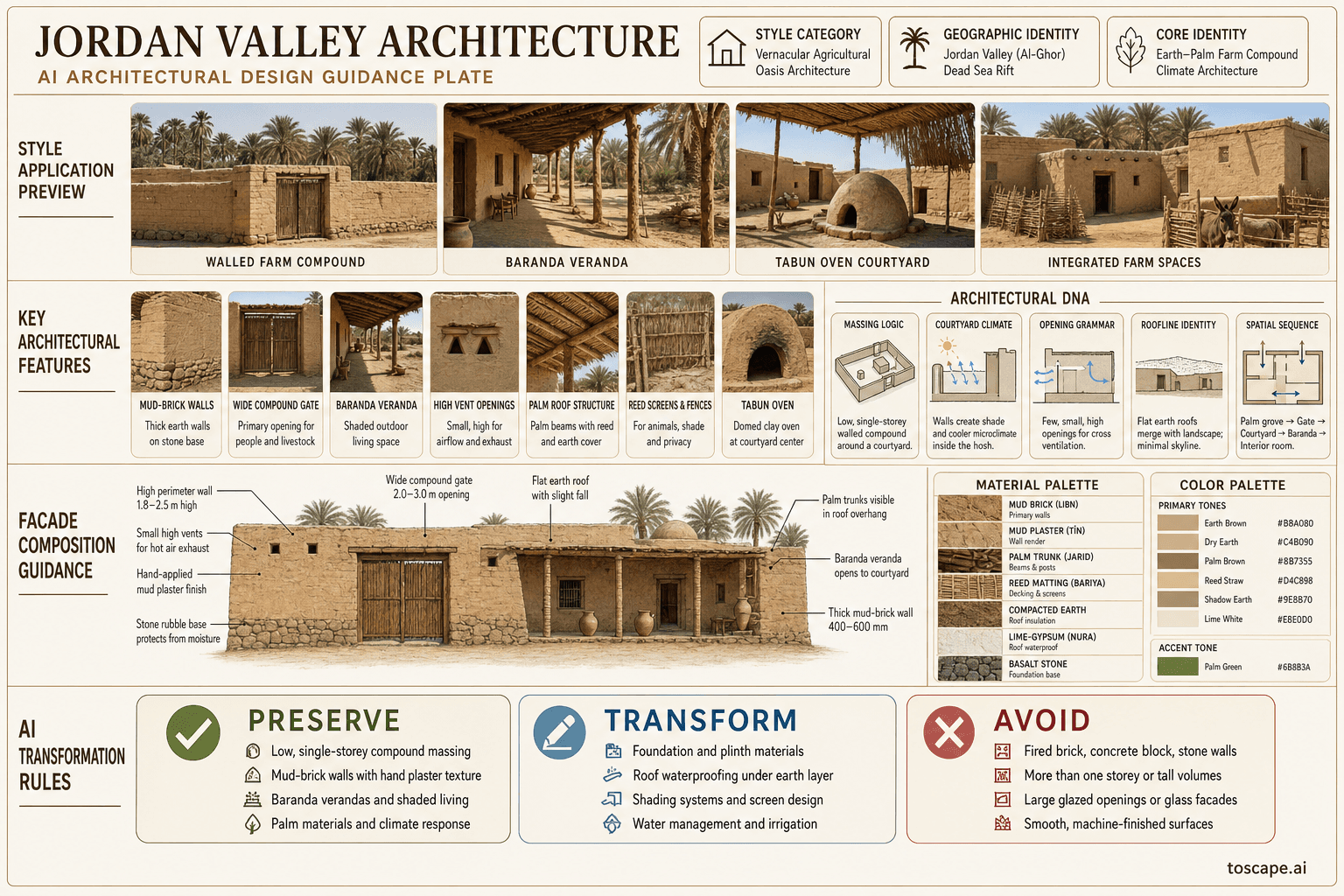
Jordan Valley is a regional architectural identity in Jordan. Traditional vernacular architecture of the Jordan Valley (Al-Ghor) — the subtropical depression extending from the Sea of Galilee to the Dead Sea at 200–400 m below sea level. A distinct architectural ecology defined by mud-brick (libn) construction, palm-frond roofing, courtyard farm compounds, and the adaptation of Levantine vernacular to one of the hottest inhabited places on Earth (summer maxima 40–48°C).
Visual DNA
Massing & Form
The Jordan Valley dwelling is a single-storey, horizontally-spread compound — typically 15–30 m wide × 20–40 m deep — organized as a walled enclosure containing multiple small rectilinear volumes. Individual rooms are small (3–5 m × 3–5 m) and arranged around or adjacent to the central work courtyard.
Facade Language
The Jordan Valley compound presents a deliberately blank exterior: Perimeter wall: Continuous earth-rendered surface, 1.8–2.5 m high, broken only by compound gates and occasional high ventilation slots. Mud plaster (tîn) applied annually after the rainy season — the surface is renewed, not permanent.
Materials & Texture
Sun-dried mud brick (libn) — warm earthy brown to pale tan, depending on the local clay source — the primary wall material Mud plaster (tîn) — external render, reapplied annually — the living surface of the building Palm trunk (jarid) — date palm midribs used as roofing beams — the structural gift of the palm oasis Ree...
Color Palette
White, cream, pale sand, warm timber, and shadow-driven dark metal accents define the palette. The facade should stay bright and climate-aware rather than heavy, gray, or over-saturated.
Ornament & Detail
The architecture of the Jordan Valley is essentially unornamented — beauty derives from material texture, proportional clarity, and the integration with the palm oasis ecology: (1) Mud plaster surface texture — the hand-applied annual render creates subtle undulations and sweeping gestures across the wall surface — an...
Climate Response
The Jordan Valley's extreme climate — among the hottest places on Earth — drives every architectural decision: (1) Thermal mass in walls and roof — thick mud-brick (400–600 mm) and earth roof covering (200–300 mm) provide the only available passive cooling — diurnal temperature amplitude reduced by 10–15°C. (2) Compoun...
Landscape & Ground
Traditional vernacular architecture of the Jordan Valley (Al-Ghor) — the subtropical depression extending from the Sea of Galilee to the Dead Sea at 200–400 m below sea level. A distinct architectural ecology defined by mud-brick (libn) construction, palm-frond roofing, courtyard farm compounds, and the adaptation of L...
Reference elevation
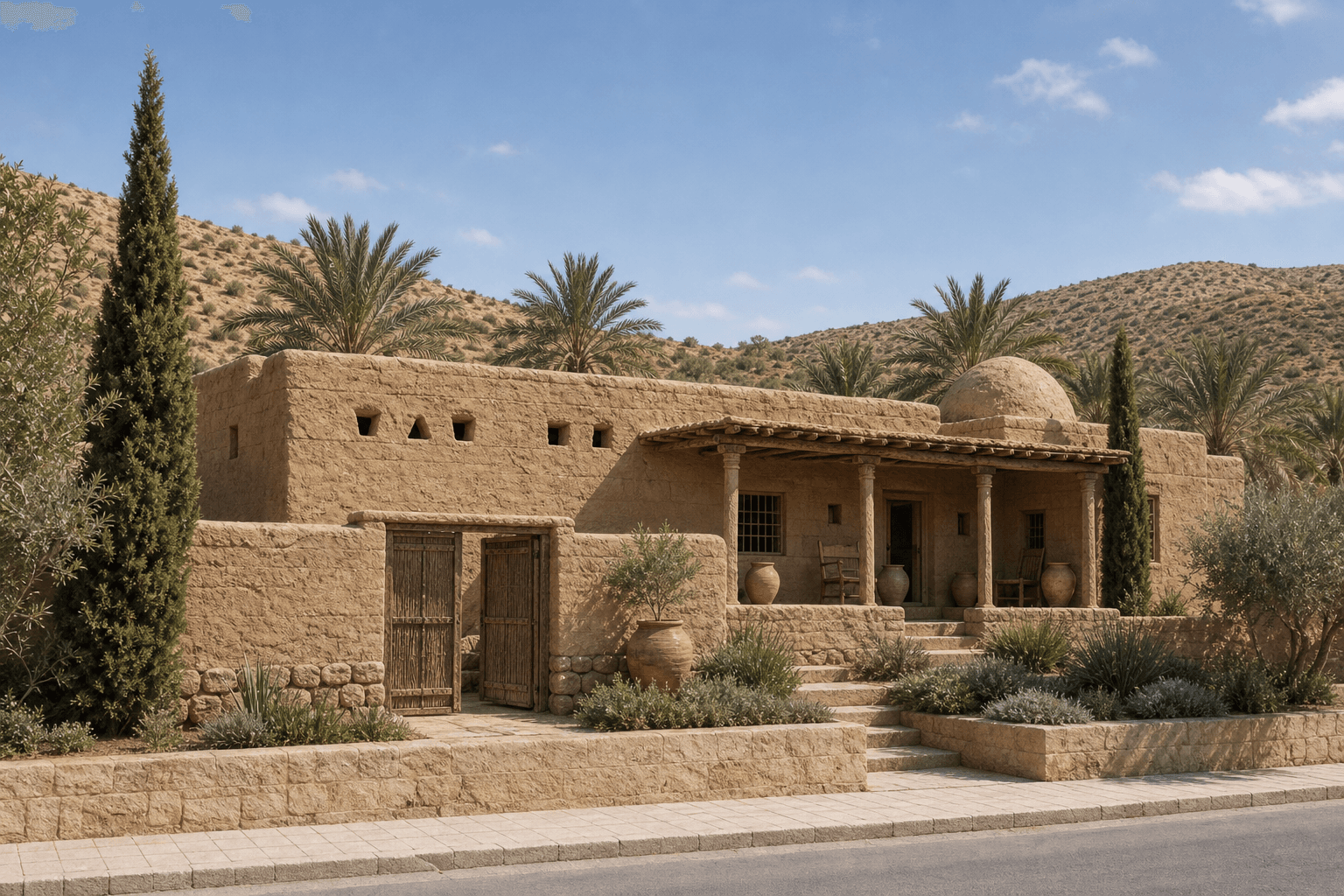
Jordan Valley — characteristic facade composition, vernacular architecture of the Jordan Valley (Al-Ghor).
Context Snapshot
Traditional vernacular architecture of the Jordan Valley (Al-Ghor) — the subtropical depression extending from the Sea of Galilee to the Dead Sea at 200–400 m below sea level. The Jordan Valley's extreme climate — among the hottest places on Earth — drives every architectural decision: (1) Thermal mass in walls and roof — thick mud-brick (400–600 mm) and earth roof covering (200–300 mm) provid...
Contemporary Relevance
Jordan Valley is useful today for residential, hospitality, civic, and place-branding work that needs Jordan-specific character grounded in local massing, material tone, climate response, and settlement logic rather than generic international styling.
Use this style in Toscape
Explore Jordan Valley directly inside Toscape using the Facade Re-Style and Design Options workflows.
Open Jordan Valley in the gallery