Kurdistan Mountain
Iraq · mountain architecture of the Kurdistan Region of Iraq
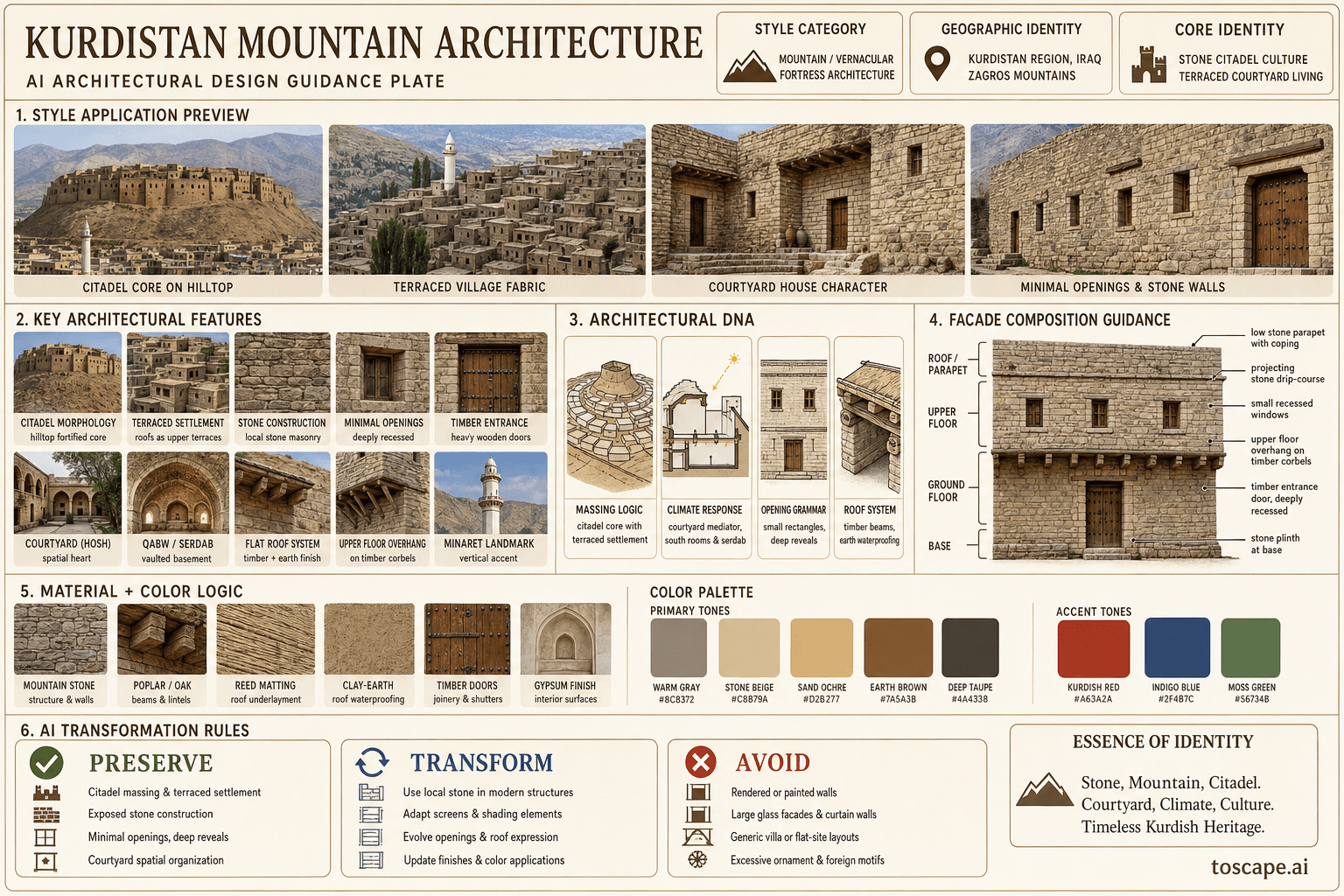
The stone fortress-village architecture of Iraqi Kurdistan — mountain stone construction, flat-roofed terraced settlements, Kurdish citadel typologies, and the distinctive vernacul...
Overview
Kurdistan Mountain is a regional architectural identity in Iraq. Traditional mountain architecture of the Kurdistan Region of Iraq — the rugged Zagros Mountain settlements of Dohuk, Erbil, Sulaymaniyah, and the surrounding valleys. This architecture represents a distinct mountain vernacular within Iraq, characterized by stone construction, fortress-village morphology, and architectural traditions shared with Kurdish communities across Turkey, Iran, and Syria.
Visual DNA
Massing & Form
Kurdish mountain buildings are compact, stone-built, single-storey to two-storey rectangular volumes — typically 6–12 m wide × 8–16 m deep. The massing is dominated by the citadel typology: the settlement clusters organically around a fortified hilltop core, buildings stepping down the slope in concentric or radial pat...
Facade Language
The Kurdish mountain facade is characterized by stone and minimal penetration: Wall surface: Exposed stone masonry — warm gray, brown, and ochre tones depending on local geology. The stone is laid in horizontal courses with projecting stone drip-courses at floor levels.
Materials & Texture
Mountain stone — limestone, dolomite, sandstone in warm gray, brown, and ochre tones. Roughly dressed, split-faced, or occasional smooth-dressed quoins at corners and openings Mud mortar — traditional bedding and pointing material Lime mortar — used in higher-quality construction and for water cisterns Poplar timber (h...
Color Palette
Warm earth, sandy beige, ochre, clay brown, and sun-softened mineral tones should dominate, with palm green or weathered timber as secondary accents. The palette should read as land-derived rather than polished or urban-generic.
Ornament & Detail
Ornament in Kurdish mountain architecture is restrained and tectonic: (1) Stone drip-courses — projecting stone courses at floor levels — both functional (water shedding) and decorative. (2) Entrance door studwork — simple geometric nail-head patterns on timber doors.
Climate Response
Kurdish mountain architecture responds to a harsh continental-mountain climate: (1) Defensive positioning — settlements occupy hilltops and defensible promontories, with the citadel at the highest point. (2) Stone thermal mass — thick stone walls moderate the extreme temperature swings between scorching summers and fre...
Landscape & Ground
Traditional mountain architecture of the Kurdistan Region of Iraq — the rugged Zagros Mountain settlements of Dohuk, Erbil, Sulaymaniyah, and the surrounding valleys. This architecture represents a distinct mountain vernacular within Iraq, characterized by stone construction, fortress-village morphology, and architectu...
Reference elevation
Kurdistan Mountain — characteristic facade composition, mountain architecture of the Kurdistan Region of Iraq.
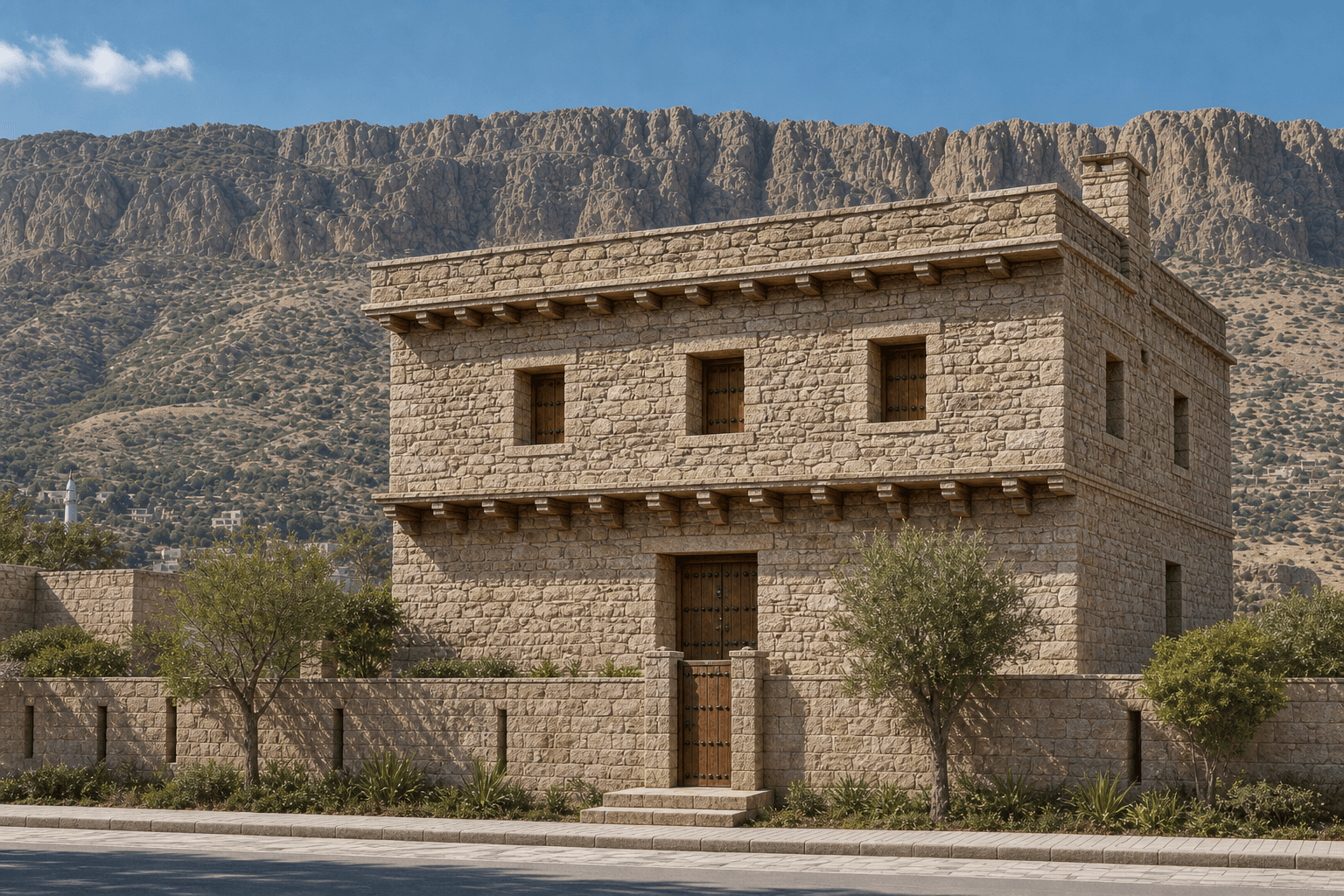
Context Snapshot
Traditional mountain architecture of the Kurdistan Region of Iraq — the rugged Zagros Mountain settlements of Dohuk, Erbil, Sulaymaniyah, and the surrounding valleys. Kurdish mountain architecture responds to a harsh continental-mountain climate: (1) Defensive positioning — settlements occupy hilltops and defensible promontories, with the citadel at the highest point.
Contemporary Relevance
Kurdistan Mountain is useful today for residential, hospitality, civic, and place-branding work that needs Iraq-specific character grounded in local massing, material tone, climate response, and settlement logic rather than generic international styling.
Use this style in Toscape
Explore Kurdistan Mountain directly inside Toscape using the Facade Re-Style and Design Options workflows.
Open Kurdistan Mountain in the gallery