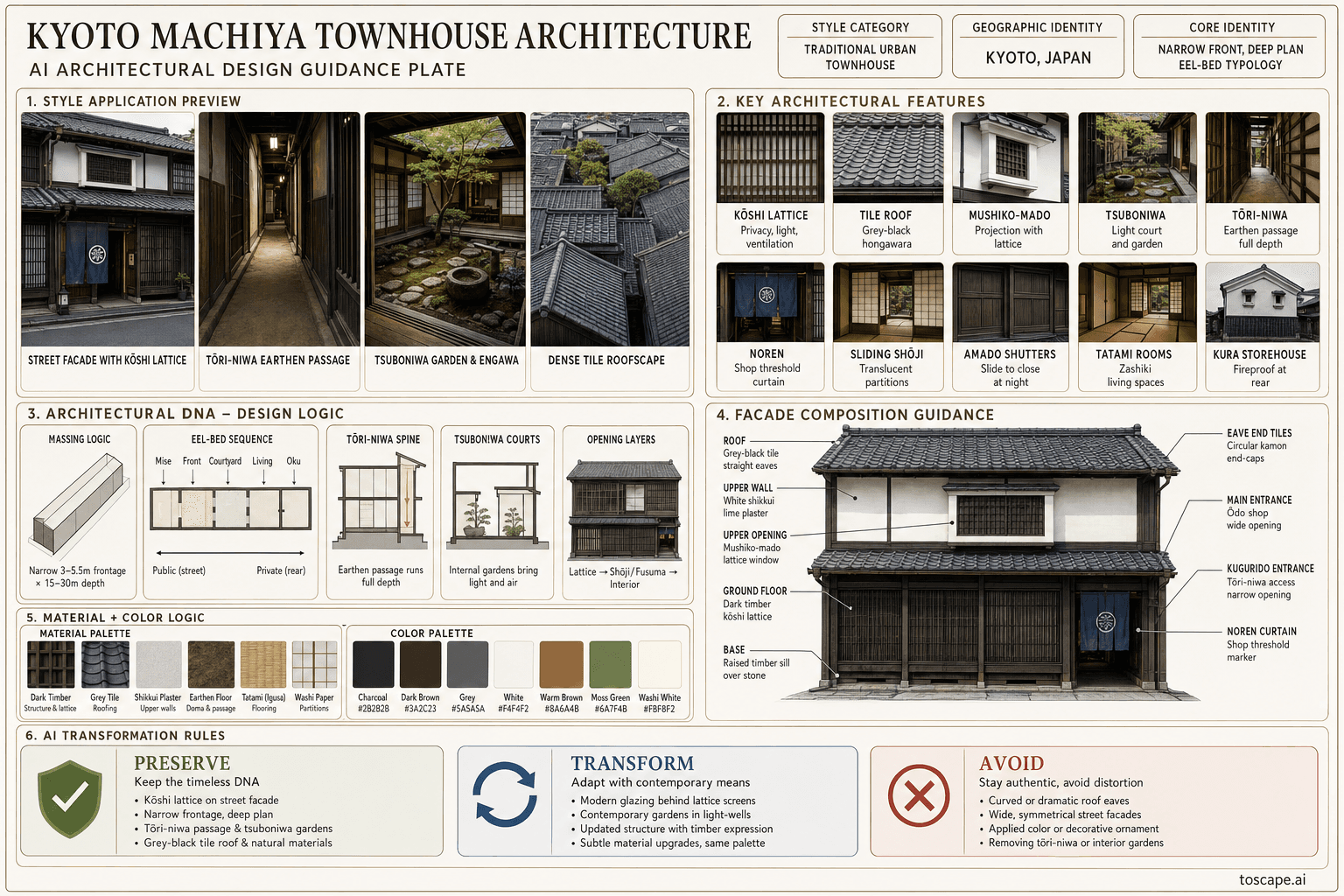
Kyoto Machiya Townhouse
Japan · Kyoto machiya
The urban merchant townhouse of Japan's imperial capital — the narrow-frontage, deep-plan eel-bed typology
Overview
Kyoto Machiya Townhouse is a regional architectural identity in Japan. The Kyoto machiya — the traditional urban townhouse of Kyoto's merchant and artisan classes, a type that reached its mature form during the Edo period (1603–1868) and defines the character of Kyoto's historic streetscapes. Narrow street frontage (3–5.5 m, reflecting Edo-period frontage taxation — "narrow front, deep body") — extremely deep plan (15–30 m, extending from street to rear lane) — the "unagi no nedoko" (ee...
Visual DNA
Massing & Form
The Kyoto machiya is defined by its extreme depth-to-width ratio — a direct product of Edo-period taxation based on street frontage: Frontage: 3–5.5 m (10–18 shaku; 1 ken = 1.82 m) — deliberately narrow to minimize tax liability Depth: 15–30 m — extending the full block depth from street to rear service lane (roji) Hei...
Facade Language
The machiya street facade is the defining element of the Kyoto streetscape: Kōshi lattice (timber grid): The entire ground-floor street frontage is screened by a dark-stained timber lattice (kōshi) — a grid of vertical and horizontal timber members at approximately 100 mm spacing. The lattice provides privacy (interior...
Materials & Texture
The machiya material palette is restrained, natural, and climate-responsive: Dark-stained timber (cypress/pine) — kōshi lattice, structural frame, doors — dark brown to charcoal black White shikkui lime plaster — upper walls (interior and exterior), mushiko-mado plaster cubes — bright white, matte Grey-black hongawara...
Color Palette
White, cream, pale sand, warm timber, and shadow-driven dark metal accents define the palette. The facade should stay bright and climate-aware rather than heavy, gray, or over-saturated.
Ornament & Detail
Machiya ornament is restrained to the point of apparent absence — the aesthetic is one of "quiet beauty" (shibumi): Structural joinery as ornament: The exposed timber post-and-beam frame with its precise joinery (visible beam ends, bracket details, column capitals) IS the ornament. The joinery is not concealed — it is...
Climate Response
Kyoto's climate (hot humid summers 30–38°C, cold winters 0–8°C, high humidity year-round, seasonal typhoon rains) drives the machiya's environmental strategy: Cross-ventilation through the tōri-niwa: The open earthen passage, combined with the lattice facade and the rear opening, creates a continuous airflow path throu...
Landscape & Ground
The Kyoto machiya — the traditional urban townhouse of Kyoto's merchant and artisan classes, a type that reached its mature form during the Edo period (1603–1868) and defines the character of Kyoto's historic streetscapes. Kyoto's climate (hot humid summers 30–38°C, cold winters 0–8°C, high humidity year-round, seasona...
Reference elevation
Kyoto Machiya Townhouse — characteristic facade composition, Kyoto machiya.
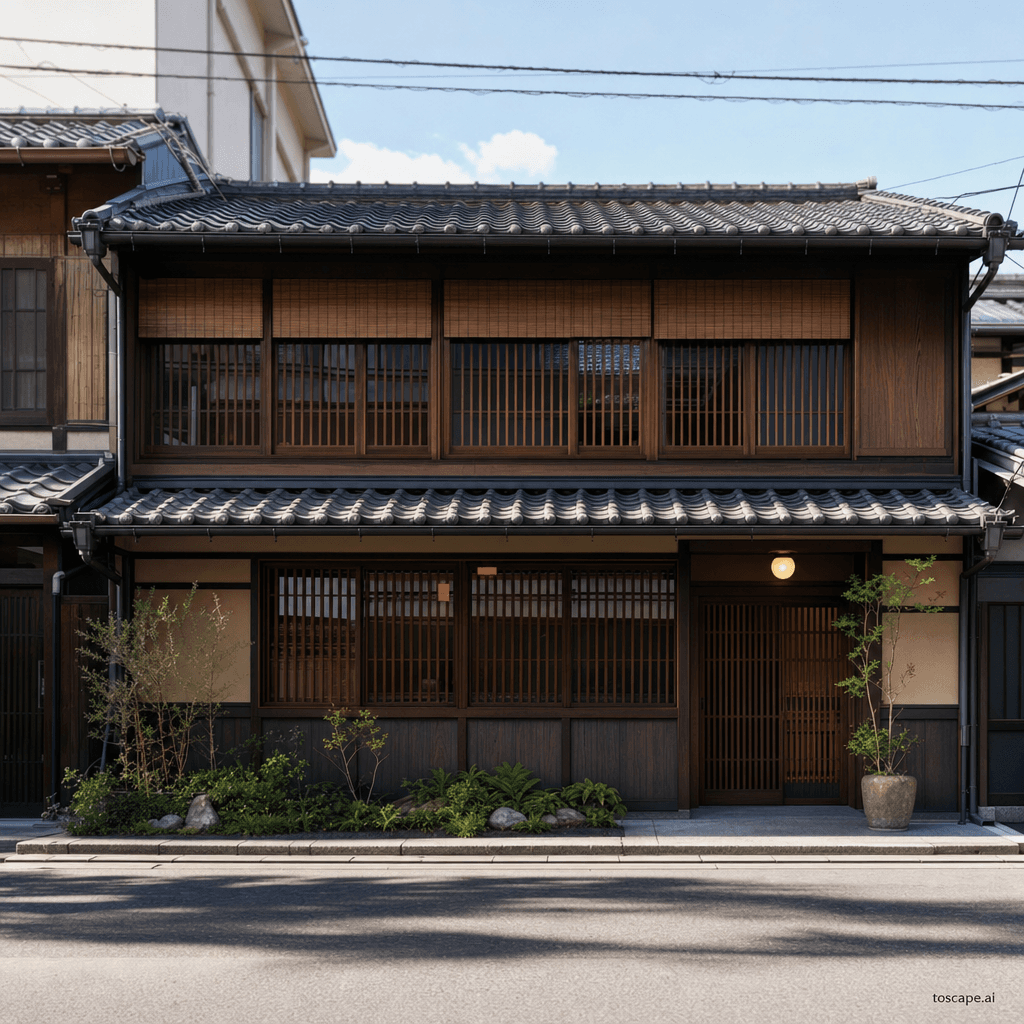
Context Snapshot
The Kyoto machiya — the traditional urban townhouse of Kyoto's merchant and artisan classes, a type that reached its mature form during the Edo period (1603–1868) and defines the character of Kyoto's... Kyoto's climate (hot humid summers 30–38°C, cold winters 0–8°C, high humidity year-round, seasonal typhoon rains) drives the machiya's environmental strategy: Cross-ventilation through the tōri-niwa: The open earthen pas...
Contemporary Relevance
Kyoto Machiya Townhouse is useful today for residential, hospitality, civic, and place-branding work that needs Japan-specific character grounded in local massing, material tone, climate response, and settlement logic rather than generic international styling.
Use this style in Toscape
Explore Kyoto Machiya Townhouse directly inside Toscape using the Facade Re-Style and Design Options workflows.
Open Kyoto Machiya Townhouse in the gallery