Lake Titicaca Altiplano
Peru · architectural identity of the Lake Titicaca basin (Puno region, Peru)
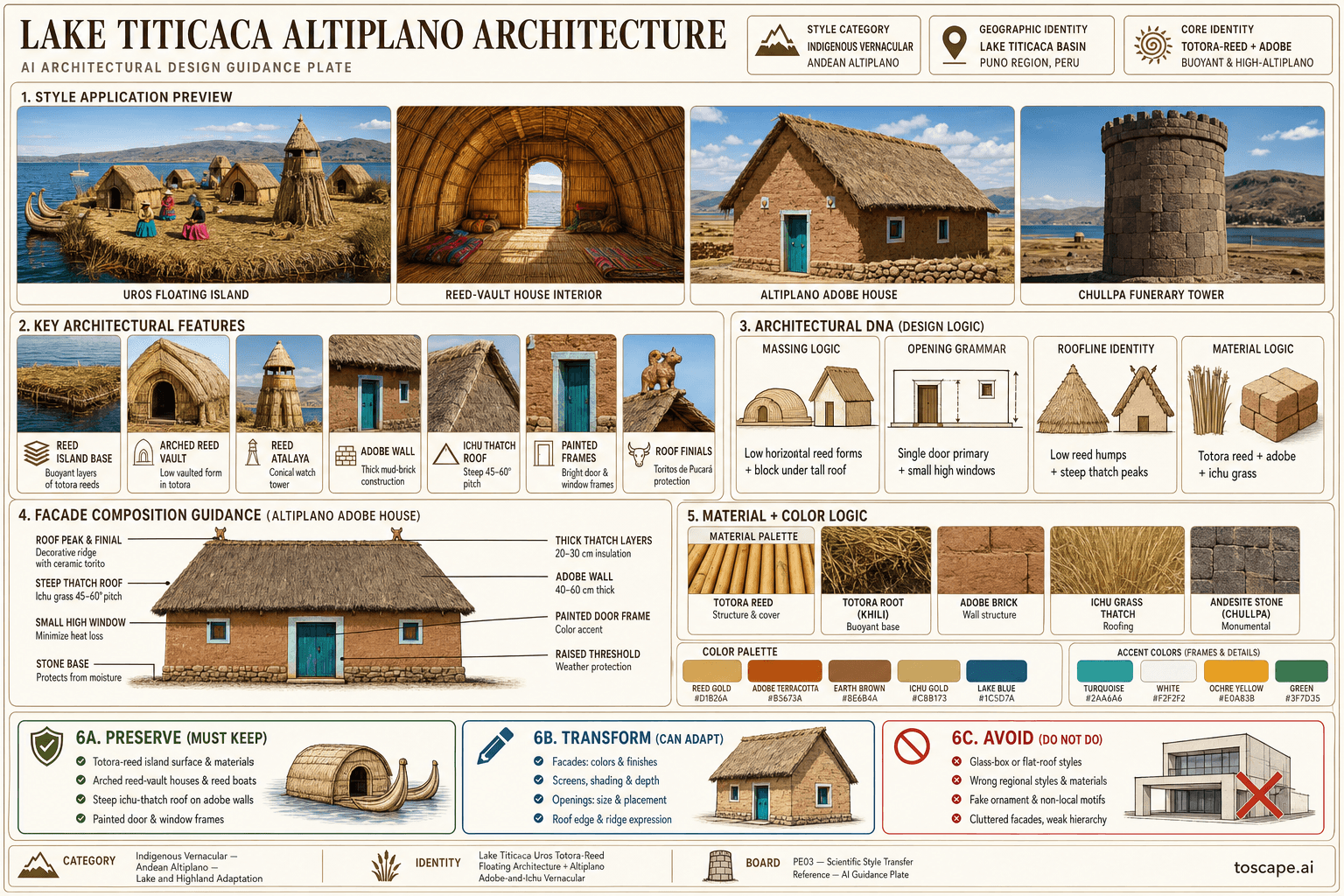
The totora-reed architecture of the Uros floating islands and the adobe-and-ichu vernacular of the Collao Altiplano — where the world's highest navigable lake (3,812 m) generates a...
Overview
Lake Titicaca Altiplano is a regional architectural identity in Peru. The architectural identity of the Lake Titicaca basin (Puno region, Peru) — a dual architectural tradition: (1) The Uros floating islands — artificial islands (70–100 islands, each 15–40 m across) constructed entirely from layers of totora reed (Schoenoplectus californicus subsp. tatora) roots and cut reeds, with houses, watchtowers, and boats also built from the same material — an architecture of buoyancy, biodegrad...
Visual DNA
Massing & Form
The Uros architecture is planar and horizontal — the island is a flat disc of reeds floating on the water, its boundaries defined by the contrast between golden-green reed surface and deep blue lake. Houses on the island are low arched vaults (1.5–2 m high internally), rectangular in plan (3–5 m × 2–3 m), built from bu...
Facade Language
The Uros house facade is the reed-mat surface — a golden-to-tawny woven texture, entirely organic, the color of dried grass. There is no distinction between wall and roof — the arched reed vault forms the entire envelope.
Materials & Texture
The material palettes are site-specific: Uros — exclusively totora reed (Schoenoplectus californicus subsp. tatora), a giant bulrush that grows in the shallows of Lake Titicaca — the reed is used green for construction, dried for mats and fuel, and the white inner pith is eaten (the "lake banana").
Color Palette
White, cream, pale sand, warm timber, and shadow-driven dark metal accents define the palette. The facade should stay bright and climate-aware rather than heavy, gray, or over-saturated.
Ornament & Detail
Uros ornament is minimal and woven: the totora mat weave pattern is the decorative surface — variations in weave create texture. Small totora-reed sculptures of birds and fish may decorate houses.
Climate Response
Lake Titicaca (3,812 m) and the surrounding Altiplano experience extreme high-altitude conditions: intense solar radiation (UV index regularly 11+), very low humidity, diurnal temperature swings of 20–30°C (from near-freezing at night to 20–25°C by day), and a short but intense rainy season (December–March). The Uros f...
Landscape & Ground
The architectural identity of the Lake Titicaca basin (Puno region, Peru) — a dual architectural tradition: (1) The Uros floating islands — artificial islands (70–100 islands, each 15–40 m across) constructed entirely from layers of totora reed (Schoenoplectus californicus subsp. tatora) roots and cut reeds, with house...
Reference elevation
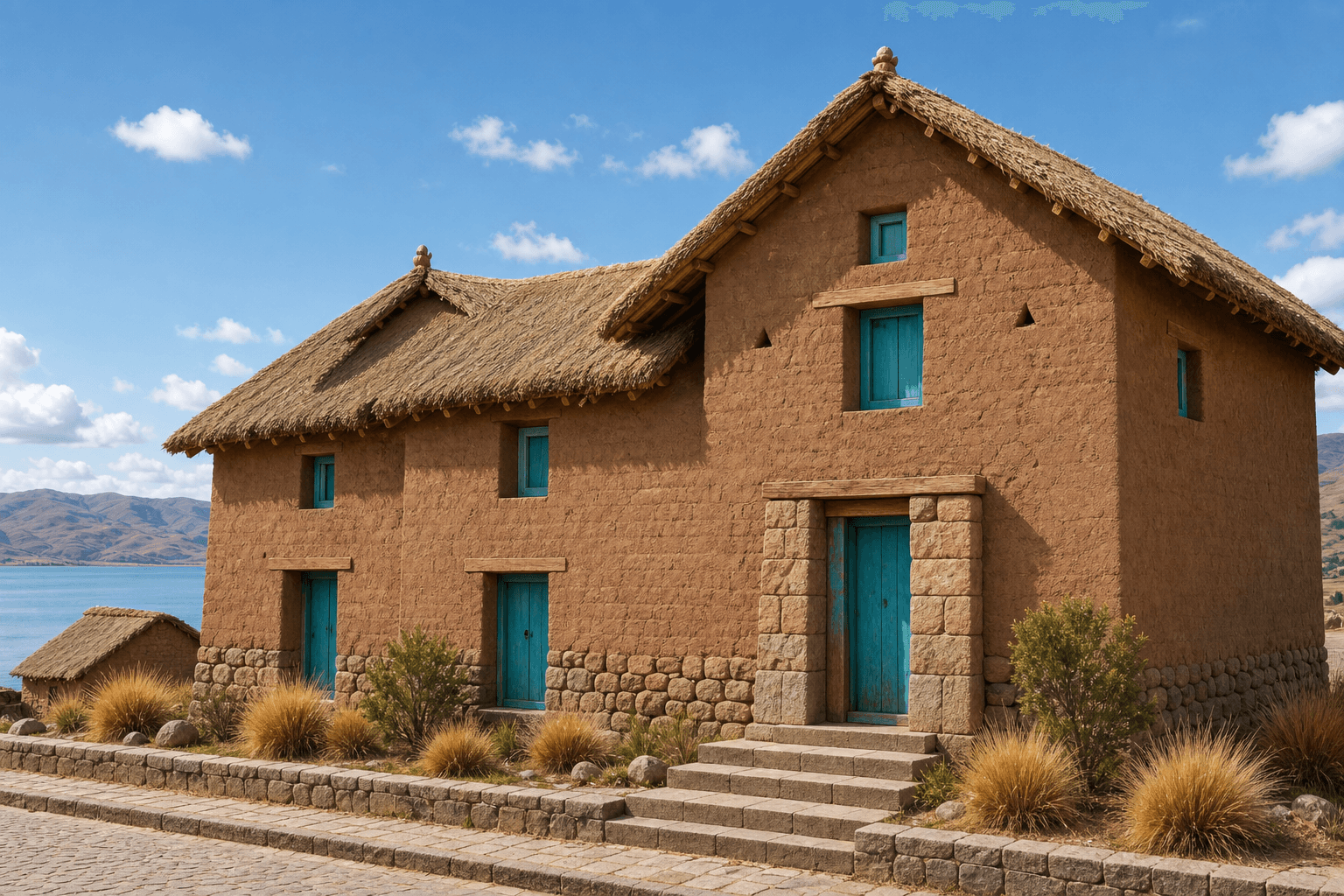
Lake Titicaca Altiplano — characteristic facade composition, architectural identity of the Lake Titicaca basin (Puno region, Peru).
Context Snapshot
The architectural identity of the Lake Titicaca basin (Puno region, Peru) — a dual architectural tradition: (1) The Uros floating islands — artificial islands (70–100 islands, each 15–40 m across) con... Lake Titicaca (3,812 m) and the surrounding Altiplano experience extreme high-altitude conditions: intense solar radiation (UV index regularly 11+), very low humidity, diurnal temperature swings of 20–30°C (from near-fre...
Contemporary Relevance
Lake Titicaca Altiplano is useful today for residential, hospitality, civic, and place-branding work that needs Peru-specific character grounded in local massing, material tone, climate response, and settlement logic rather than generic international styling.
Use this style in Toscape
Explore Lake Titicaca Altiplano directly inside Toscape using the Facade Re-Style and Design Options workflows.
Open Lake Titicaca Altiplano in the gallery