Polish Małopolska Kraków Courtyard Townhouse
Poland · Kraków kamienica
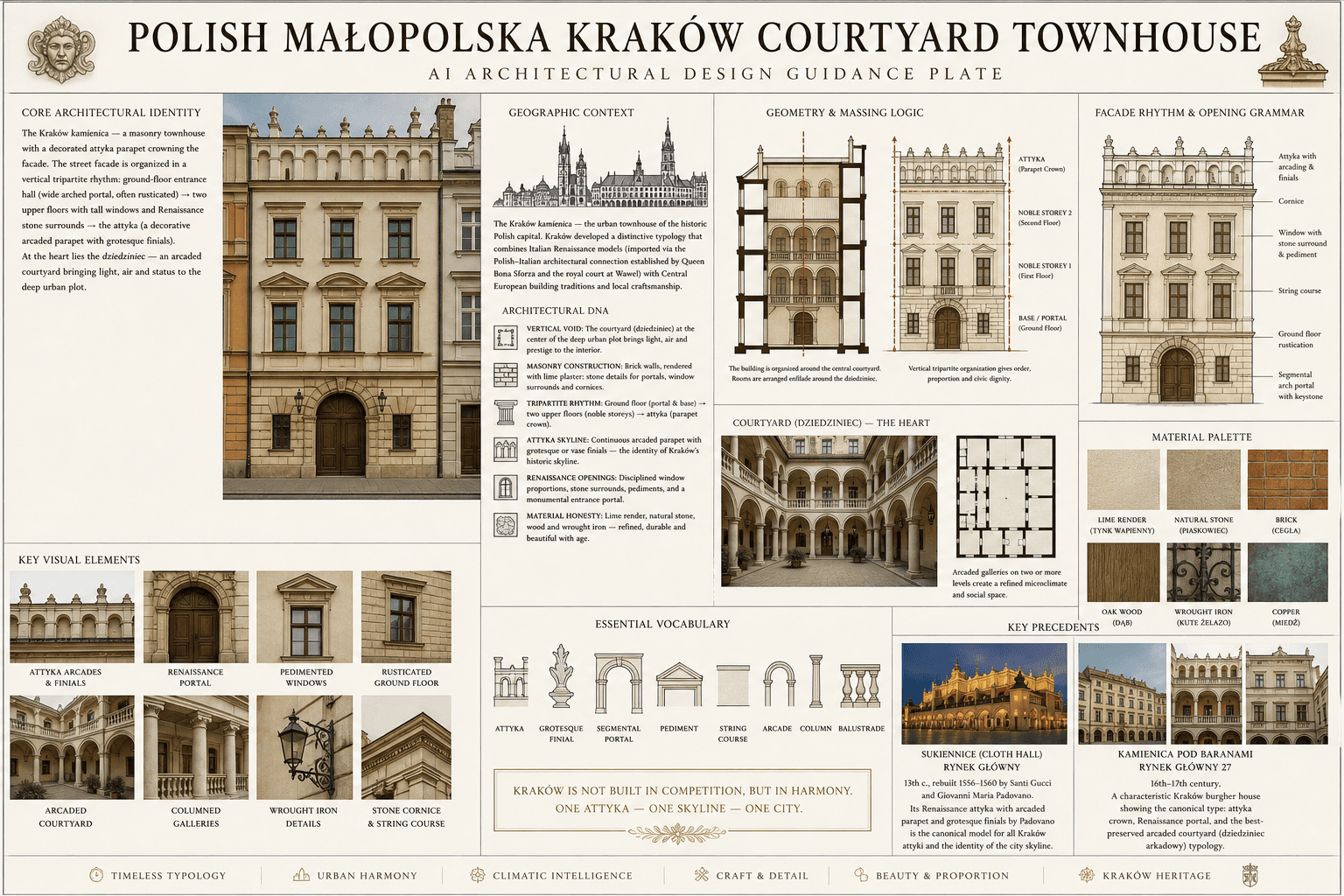
The Kraków burgher townhouse (kamienica krakowska) of the Małopolska region — a Renaissance-Baroque urban house with a decorated attic (attyka), an arcaded internal courtyard (dzie...
Overview
Polish Małopolska Kraków Courtyard Townhouse is a regional architectural identity in Poland. The Kraków kamienica — the urban townhouse of the historic Polish capital — Kraków developed a distinctive typology that combines Italian Renaissance models (imported via the Polish-Italian architectural connection established by Queen Bona Sforza and the royal court at Wawel) with Central European urban traditions — the Kraków townhouse is typically 2–3 stories, 8–12 m wide, with a richly decorated street facade fea...
Visual DNA
Massing & Form
The Kraków kamienica is organized around a vertical void — the courtyard (dziedziniec) at the center of the deep urban plot. The street facade is the narrow face of a much deeper block (8–12 m wide × 25–40 m deep).
Facade Language
The Kraków street facade has a classical tripartite vertical organization: (1) Ground floor — the arched entrance portal (portal bramny), wide enough for a carriage, with rusticated stone voussoirs and a keystone carved with the house emblem or date — flanking the portal are shop windows or smaller doors in the wealthi...
Materials & Texture
The Kraków kamienica employs a refined material palette: (1) Rendered brick — the primary wall finish, lime plaster (tynk wapienny) in a range of warm tones from pale cream (#F5F0E0) through ochre (#D4B896) to warm terracotta-pink (#C4A882) — the color varies by building, creating a warm, varied streetscape. (2) Stone...
Color Palette
White, cream, pale sand, warm timber, and shadow-driven dark metal accents define the palette. The facade should stay bright and climate-aware rather than heavy, gray, or over-saturated.
Ornament & Detail
The Kraków ornament is Italianate Renaissance and Polish Mannerist: (1) The attyka — the primary ornamental element, a screen of rhythmic arcading with finials — derived from Italian Renaissance attic stories but developed into a distinctively Polish form — the attyka of the Cloth Hall (Sukiennice) is the canonical mod...
Climate Response
Kraków occupies a strategic location on the Vistula River in the Małopolska upland: (1) Continental climate with cold winters and warm summers — the thick masonry walls and deep plots provide thermal mass; the courtyard provides summer cooling through the stack effect (hot air rising out of the courtyard); the sień pro...
Landscape & Ground
The Kraków kamienica — the urban townhouse of the historic Polish capital — Kraków developed a distinctive typology that combines Italian Renaissance models (imported via the Polish-Italian architectural connection established by Queen Bona Sforza and the royal court at Wawel) with Central European urban traditions — t...
Reference elevation
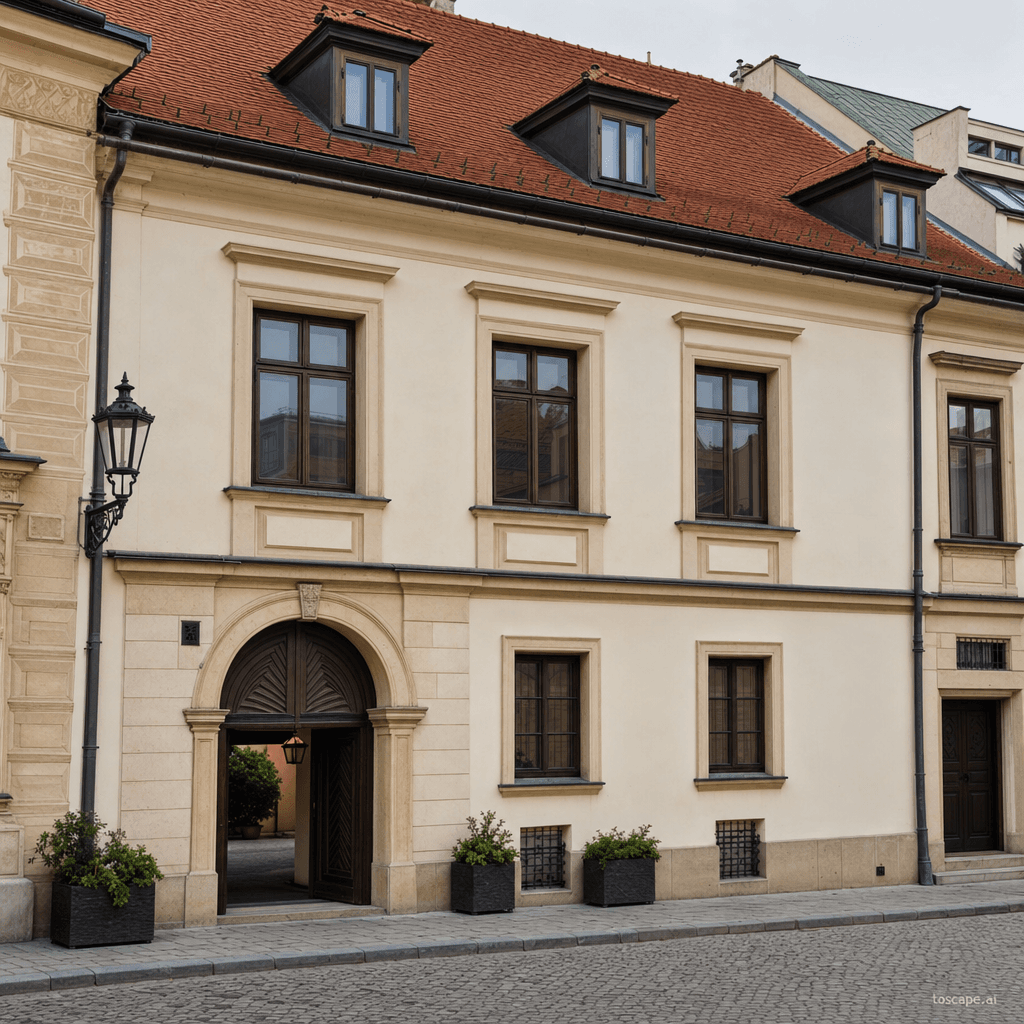
Polish Małopolska Kraków Courtyard Townhouse — characteristic facade composition, Kraków kamienica.
Context Snapshot
The Kraków kamienica — the urban townhouse of the historic Polish capital — Kraków developed a distinctive typology that combines Italian Renaissance models (imported via the Polish-Italian architectu... Kraków occupies a strategic location on the Vistula River in the Małopolska upland: (1) Continental climate with cold winters and warm summers — the thick masonry walls and deep plots provide thermal mass; the courtyard...
Contemporary Relevance
Polish Małopolska Kraków Courtyard Townhouse is useful today for residential, hospitality, civic, and place-branding work that needs Poland-specific character grounded in local massing, material tone, climate response, and settlement logic rather than generic international styling.
Use this style in Toscape
Explore Polish Małopolska Kraków Courtyard Townhouse directly inside Toscape using the Facade Re-Style and Design Options workflows.
Open Polish Małopolska Kraków Courtyard Townhouse in the gallery