Marrakech-Safi Regional
Morocco · domestic architecture of Marrakech and the surrounding Haouz Plain
The southern, semi-desert courtyard architecture of the Haouz Plain — Berber-influenced, reddish-pink, and garden-centered
Overview
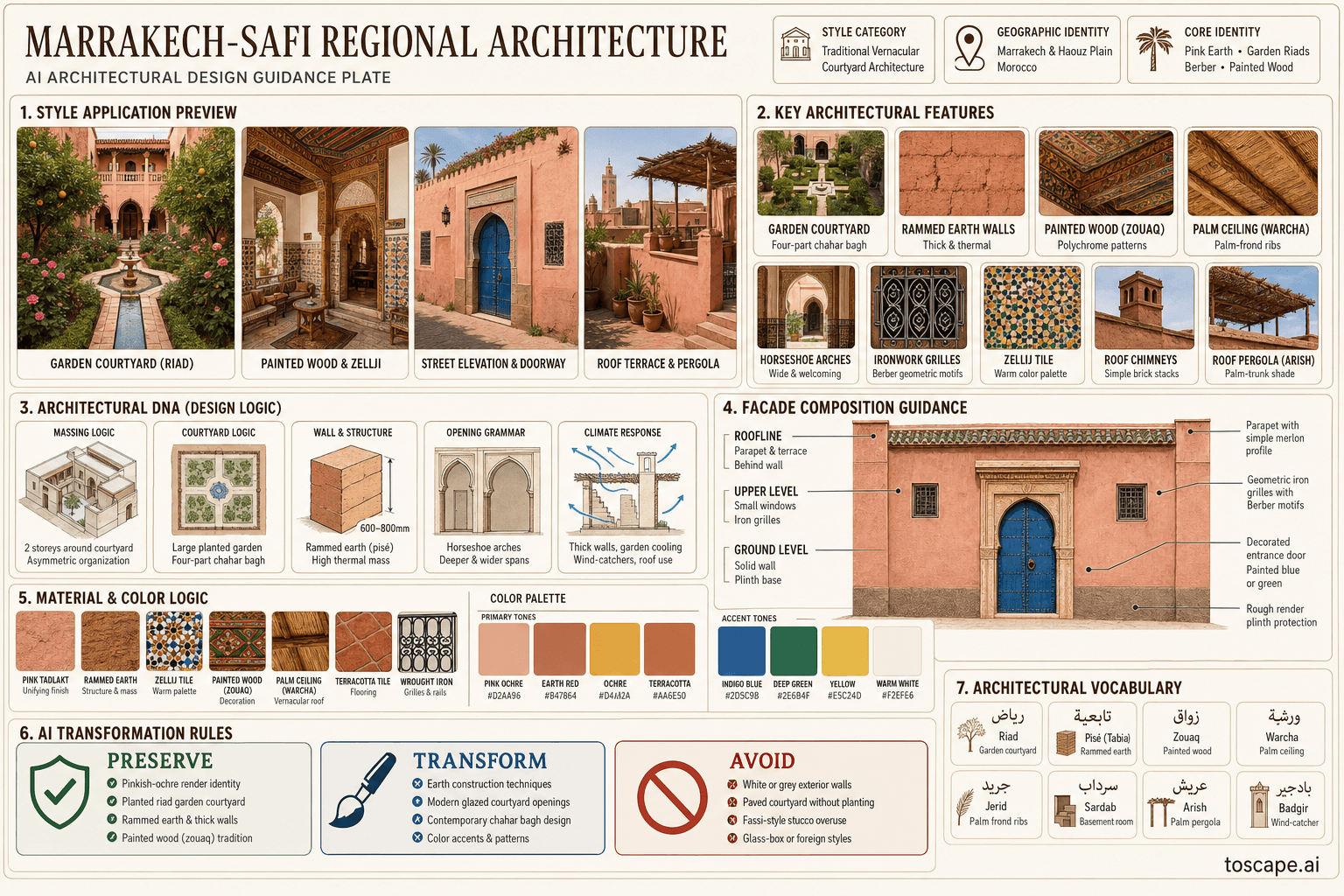
Marrakech-Safi Regional is a regional architectural identity in Morocco. Traditional domestic architecture of Marrakech and the surrounding Haouz Plain — the southern imperial city at the edge of the Sahara, where Arabo-Andalusian courtyard traditions meet Berber (Amazigh) vernacular construction and the climatic demands of a semi-arid environment. Rammed-earth (pisé) and brick construction rendered in pinkish-tadelakt — the "Rose City" color identity — larger, more garden-like courtyards...
Visual DNA
Massing & Form
Marrakchi houses (riads) are typically larger in plan than Fassi dars — the southern medina is less densely packed, and plots are wider (12–20 m width is common). The courtyard is proportionally larger relative to the building — often occupying 30–50% of the plot area compared to Fès's 20–30%.
Facade Language
Marrakchi street elevations follow the same introverted logic as Fès — blank walls, single decorated door — but with regional differences: Pinkish render color: The defining Marrakech visual identity is the uniform warm pinkish-ochre color of all rendered surfaces — mandated by municipal regulation since the French Pro...
Materials & Texture
The Marrakech material palette is earthier, warmer, and more colourful than Fès: Pinkish-ochre tadlakt render — the unifying exterior and interior wall finish — the "Rose City" identity Rammed earth (pisé) — the structural core of the walls — warm red-brown Zellij tile mosaic — the Marrakchi palette shifts toward warme...
Color Palette
White, cream, pale sand, warm timber, and shadow-driven dark metal accents define the palette. The facade should stay bright and climate-aware rather than heavy, gray, or over-saturated.
Ornament & Detail
Marrakchi ornament is bolder, more colourful, and less intricately carved than Fassi: Painted wood (zouaq): The primary Marrakchi decorative craft — floral and geometric patterns painted on wood surfaces (ceilings, doors, cornices, furniture). The painting is freehand and spontaneous compared to the rigid geometry of z...
Climate Response
Marrakech's hotter, drier climate drives key adaptations: Courtyard garden microclimate: The planted riad garden is a more active cooling system than the Fassi paved courtyard — vegetation provides shading, transpiration, and psychological cooling. The chahar bagh water channels add evaporative cooling.
Landscape & Ground
Traditional domestic architecture of Marrakech and the surrounding Haouz Plain — the southern imperial city at the edge of the Sahara, where Arabo-Andalusian courtyard traditions meet Berber (Amazigh) vernacular construction and the climatic demands of a semi-arid environment. Marrakech's hotter, drier climate drives k...
Reference elevation
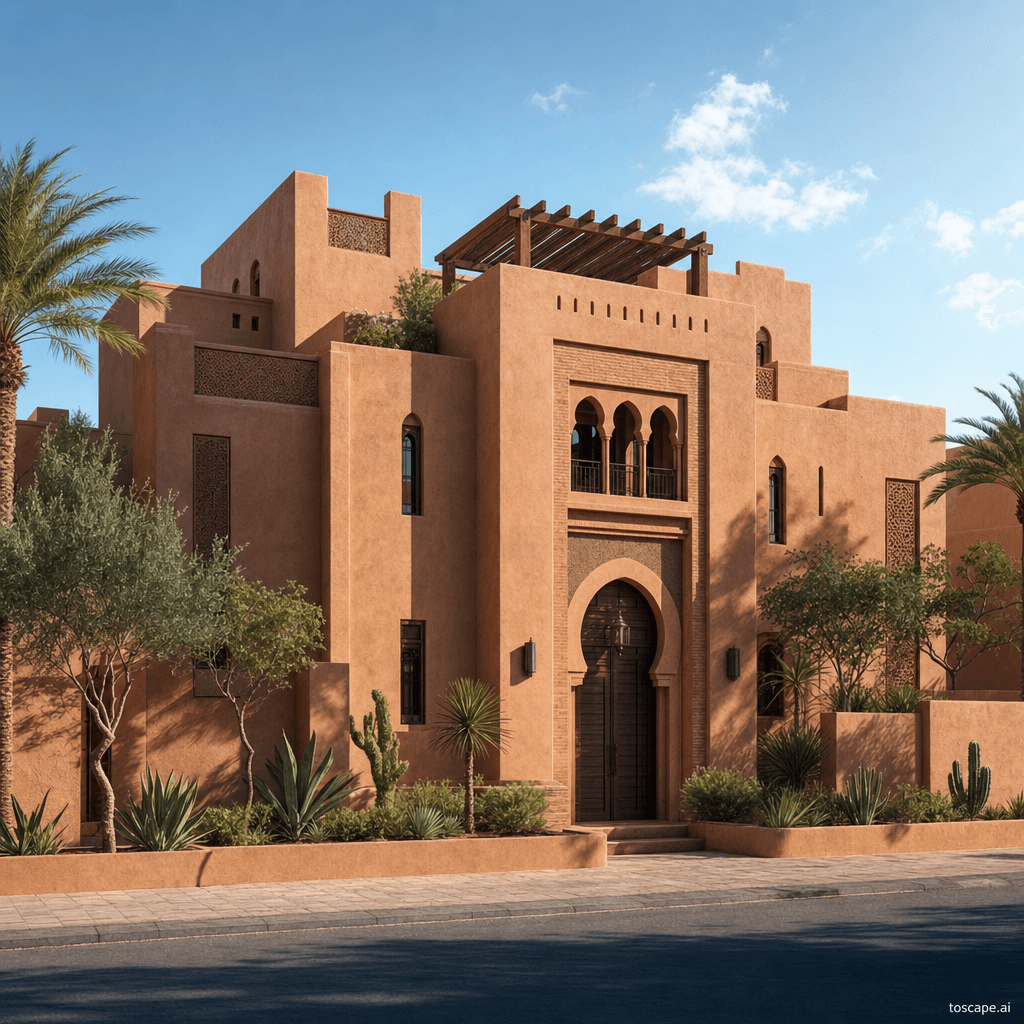
Marrakech-Safi Regional — characteristic facade composition, domestic architecture of Marrakech and the surrounding Haouz Plain.
Context Snapshot
Traditional domestic architecture of Marrakech and the surrounding Haouz Plain — the southern imperial city at the edge of the Sahara, where Arabo-Andalusian courtyard traditions meet Berber (Amazigh)... Marrakech's hotter, drier climate drives key adaptations: Courtyard garden microclimate: The planted riad garden is a more active cooling system than the Fassi paved courtyard — vegetation provides shading, transpiration...
Contemporary Relevance
Marrakech-Safi Regional is useful today for residential, hospitality, civic, and place-branding work that needs Morocco-specific character grounded in local massing, material tone, climate response, and settlement logic rather than generic international styling.
Use this style in Toscape
Explore Marrakech-Safi Regional directly inside Toscape using the Facade Re-Style and Design Options workflows.
Open Marrakech-Safi Regional in the gallery