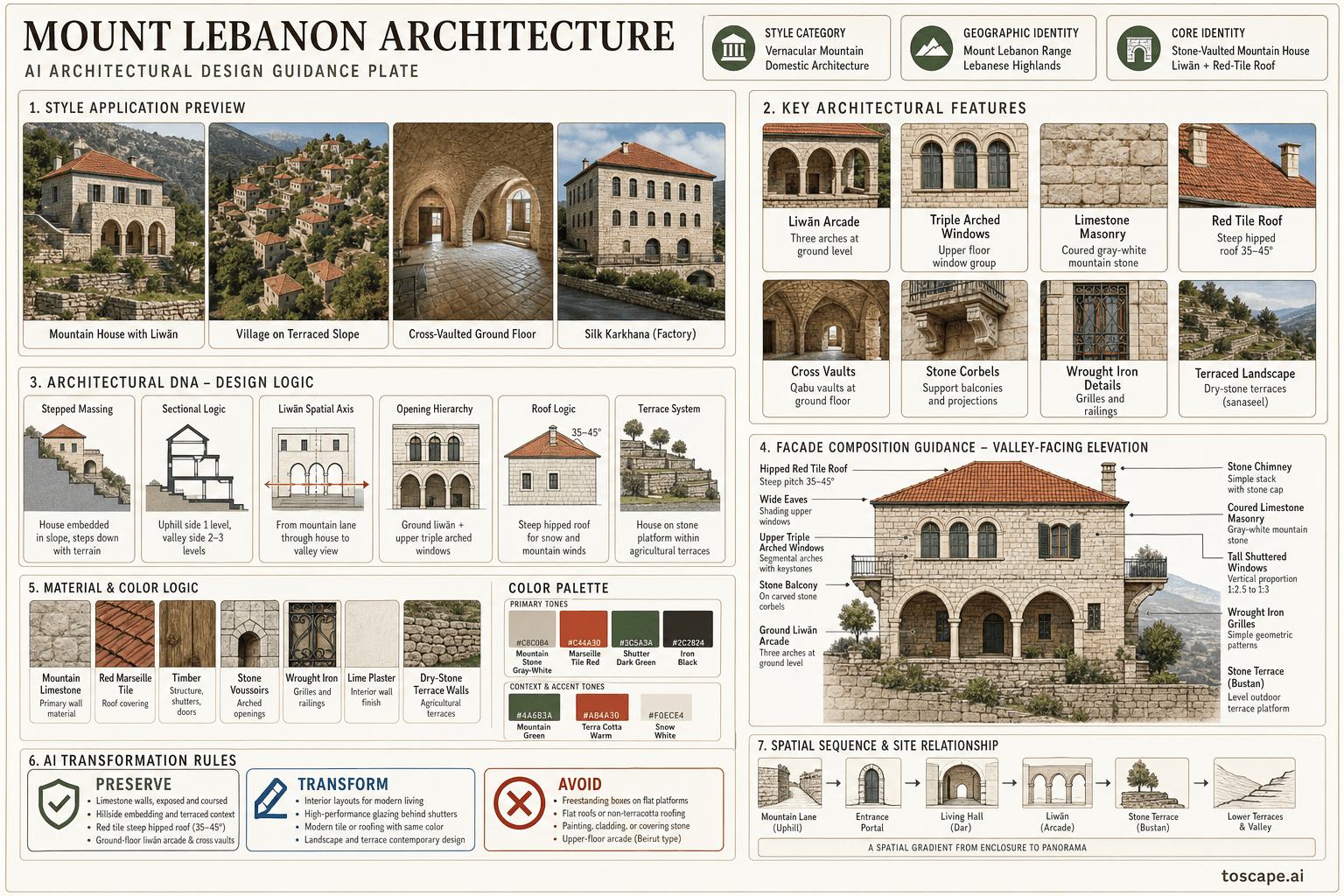
Mount Lebanon
Lebanon · vernacular and late-Ottoman domestic architecture of the Mount Lebanon highlands...
The stone-vaulted mountain house of the Lebanese highlands — pitched red-tile roofs on limestone walls, mulberry terraces, and the silk-culture architecture of the Mount Lebanon Mu...
Overview
Mount Lebanon is a regional architectural identity in Lebanon. Traditional vernacular and late-Ottoman domestic architecture of the Mount Lebanon highlands (600–1,800 m elevation) — the mountain house (al-bayt al-jabali) defined by its limestone masonry, red-tile pitched roof, cross-vaulted ground-floor service rooms (qabu), and the distinctive silk-reeling factory (karkhana) architecture of Lebanon's 19th-century silk boom. The mountain villages form a unique architectural ecol...
Visual DNA
Massing & Form
The Mount Lebanon house is a rectangular volume — 10–16 m wide × 8–14 m deep — sited parallel to the mountain contour, stepping down the slope on two or three levels. The massing is defined by the hillside section: the rear of the house is embedded 2–4 m into the cut slope, while the front elevation faces the valley wi...
Facade Language
The valley-facing front facade features a tripartite or five-bay composition: The liwān / central loggia: A ground-floor arcade of three arches (the mandalun motif, simplified for mountain conditions) opening onto a stone-paved outdoor room facing the valley view. The mountain liwān is typically at ground-floor level (...
Materials & Texture
Mountain limestone — gray-white to pale beige — coursed ashlar or semi-dressed blocks, harder and cooler in tone than coastal sandstone Red Marseille tile — deep terracotta-red-orange, steeper pitch than coastal — the roof identity shared with Beirut but adapted to mountain climate Timber — local pine and cedar (histor...
Color Palette
White, cream, pale sand, warm timber, and shadow-driven dark metal accents define the palette. The facade should stay bright and climate-aware rather than heavy, gray, or over-saturated.
Ornament & Detail
Mount Lebanon ornament is more restrained than coastal Beirut — the mountain aesthetic favors structural honesty and material expression over applied decoration: (1) Stone voussoir arches over windows — the wedge-shaped stones with keystones are the primary decorative element. (2) Carved stone corbels — supporting balc...
Climate Response
Mount Lebanon's Mediterranean mountain climate — warm dry summers (25–30°C), cold snowy winters (0–5°C at upper elevations, with substantial snow accumulation at 1,200 m+) — generates distinctive architectural responses: (1) Hillside embedding — the rear of the house cut into the slope provides thermal insulation and w...
Landscape & Ground
Traditional vernacular and late-Ottoman domestic architecture of the Mount Lebanon highlands (600–1,800 m elevation) — the mountain house (al-bayt al-jabali) defined by its limestone masonry, red-tile pitched roof, cross-vaulted ground-floor service rooms (qabu), and the distinctive silk-reeling factory (karkhana) arch...
Reference elevation
Mount Lebanon — characteristic facade composition, vernacular and late-Ottoman domestic architecture of the Mount Lebanon highlands....
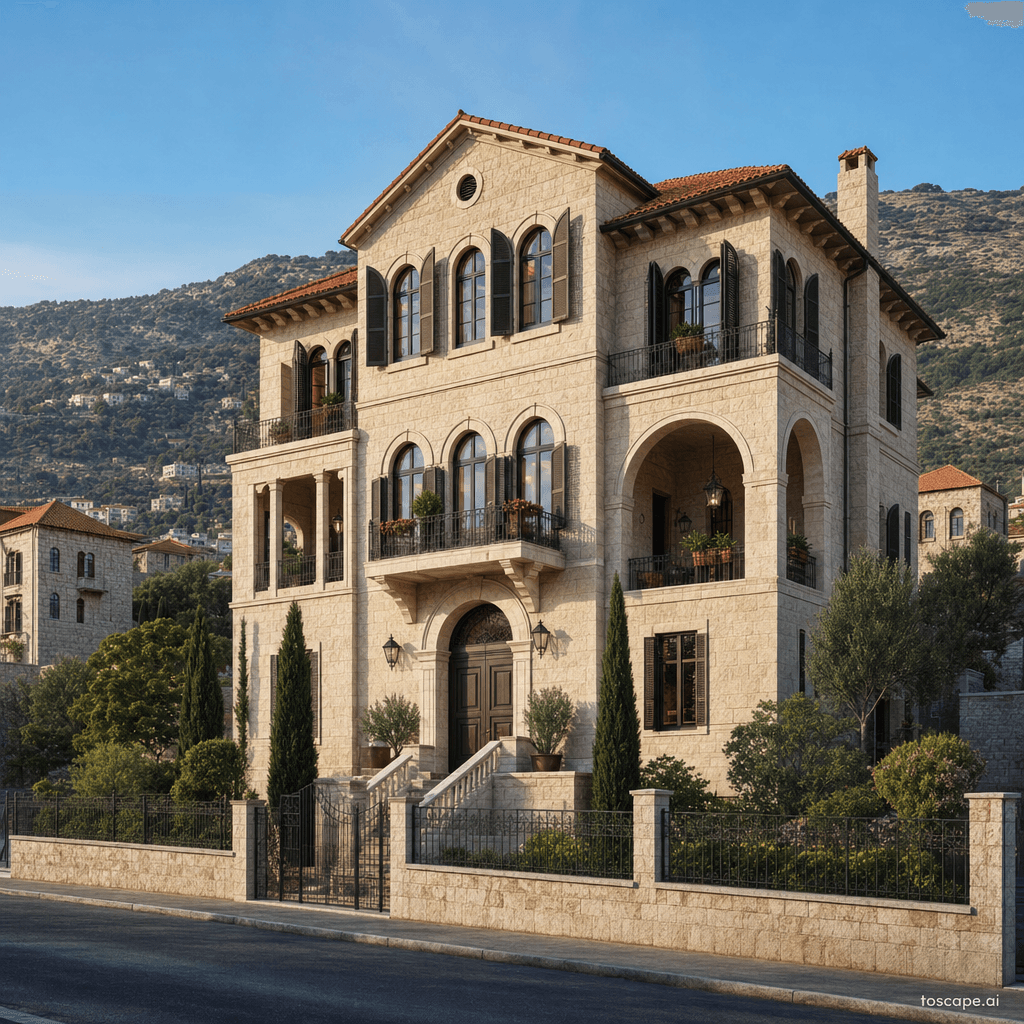
Context Snapshot
Traditional vernacular and late-Ottoman domestic architecture of the Mount Lebanon highlands (600–1,800 m elevation) — the mountain house (al-bayt al-jabali) defined by its limestone masonry, red-tile... Mount Lebanon's Mediterranean mountain climate — warm dry summers (25–30°C), cold snowy winters (0–5°C at upper elevations, with substantial snow accumulation at 1,200 m+) — generates distinctive architectural responses...
Contemporary Relevance
Mount Lebanon is useful today for residential, hospitality, civic, and place-branding work that needs Lebanon-specific character grounded in local massing, material tone, climate response, and settlement logic rather than generic international styling.
Use this style in Toscape
Explore Mount Lebanon directly inside Toscape using the Facade Re-Style and Design Options workflows.
Open Mount Lebanon in the gallery