Nafusa Mountains Berber
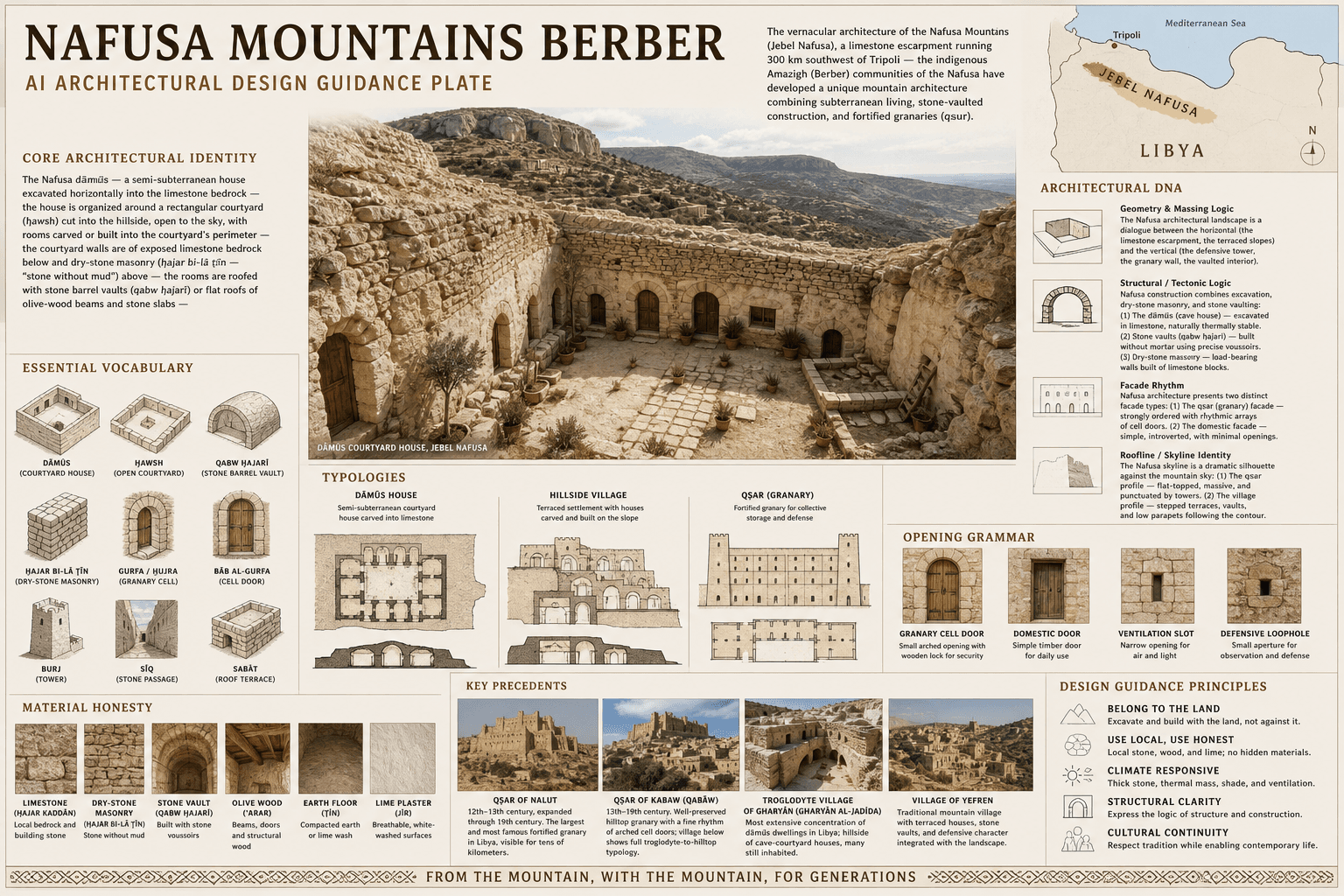
Libya · vernacular architecture of the Nafusa Mountains (Jebel Nafusa), a limestone esca...
The Amazigh (Berber) mountain architecture of the Jebel Nafusa (al-Jabal al-Gharbī) — a defensive highland landscape of troglodyte cave dwellings (dāmūs), fortified granaries (qṣūr...
Overview
Nafusa Mountains Berber is a regional architectural identity in Libya. The vernacular architecture of the Nafusa Mountains (Jebel Nafusa), a limestone escarpment running 300 km southwest of Tripoli — the indigenous Amazigh (Berber) communities of the Nafusa have developed a unique mountain architecture combining subterranean living, stone-vaulted construction, and fortified communal storage — the Nafusa architectural system includes three interrelated typologies: (1) the troglodyte cour...
Visual DNA
Massing & Form
The Nafusa architectural landscape is a dialogue between the horizontal (the limestone escarpment, the terraced slopes) and the vertical (the hilltop qṣar granaries, the square minarets, the domed shrines): (1) The troglodyte dāmūs — the mass is subtractive: the house is carved from the hillside, its volume defined by...
Facade Language
Nafusa architecture presents two distinct facade types: (1) The qṣar (granary) facade — the most formally composed elevation in Nafusa architecture: a vertical rectangular plane of golden limestone, organized as a regular grid of small arched doorways (0.6–0.8 m wide, 1–1.5 m high) — each door serves one ghurfa (storag...
Materials & Texture
Materials are entirely local to the Jebel Nafusa: (1) Limestone (ḥajar kaddān) — the bedrock of the Nafusa Mountains, a soft to medium-hard limestone that is easily quarried and carved — color ranges from pale cream (#D4C5A9) to golden-grey (#B8A88A) to darker grey (#9E8E76) depending on the quarry location. (2) Lime p...
Color Palette
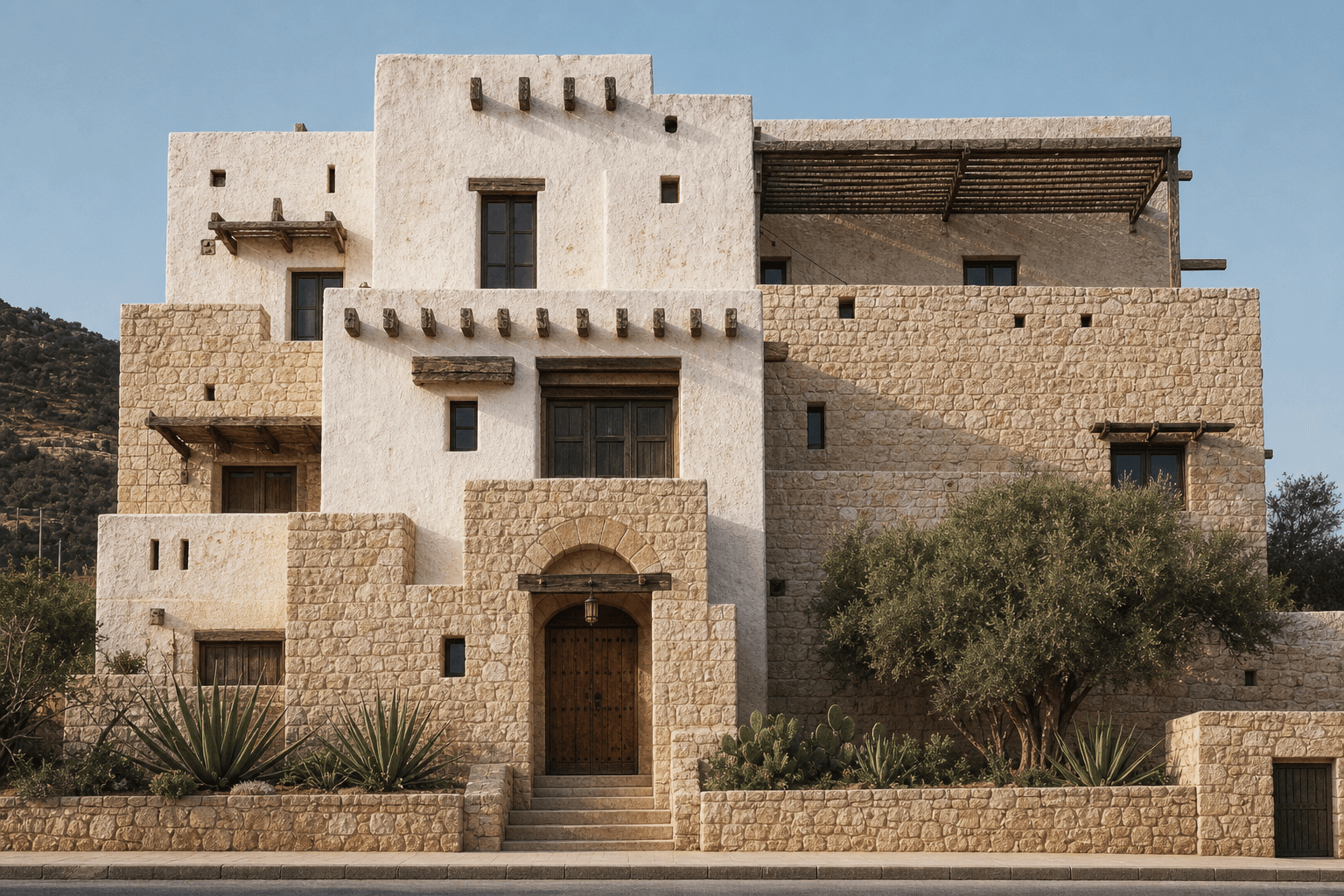
White, cream, pale sand, warm timber, and shadow-driven dark metal accents define the palette. The facade should stay bright and climate-aware rather than heavy, gray, or over-saturated.
Ornament & Detail
Nafusa ornament is restrained and symbolic, rooted in Amazigh visual language: (1) The ⵣ (yaz/aza) symbol — the central glyph of the Tifinagh alphabet, representing the free man — carved on door lintels, stone walls, and granary facades as a mark of Amazigh identity. (2) Geometric Berber motifs — diamond lattice, chevr...
Climate Response
The Nafusa Mountains have a semi-arid Mediterranean-mountain climate (BSk/Csa transition): (1) Elevation ranges from 500–980 m above sea level — the altitude moderates temperatures: summer highs of 30–38°C (compared to 45°C+ on the coastal plain), winter lows of 2–8°C with occasional frost and snow on the highest peaks...
Landscape & Ground
The vernacular architecture of the Nafusa Mountains (Jebel Nafusa), a limestone escarpment running 300 km southwest of Tripoli — the indigenous Amazigh (Berber) communities of the Nafusa have developed a unique mountain architecture combining subterranean living, stone-vaulted construction, and fortified communal stora...
Reference elevation
Nafusa Mountains Berber — characteristic facade composition, vernacular architecture of the Nafusa Mountains (Jebel Nafusa), a limestone esca....
Context Snapshot
The vernacular architecture of the Nafusa Mountains (Jebel Nafusa), a limestone escarpment running 300 km southwest of Tripoli — the indigenous Amazigh (Berber) communities of the Nafusa have develope... The Nafusa Mountains have a semi-arid Mediterranean-mountain climate (BSk/Csa transition): (1) Elevation ranges from 500–980 m above sea level — the altitude moderates temperatures: summer highs of 30–38°C (compared to 4...
Contemporary Relevance
Nafusa Mountains Berber is useful today for residential, hospitality, civic, and place-branding work that needs Libya-specific character grounded in local massing, material tone, climate response, and settlement logic rather than generic international styling.
Use this style in Toscape
Explore Nafusa Mountains Berber directly inside Toscape using the Facade Re-Style and Design Options workflows.
Open Nafusa Mountains Berber in the gallery