Aboriginal Desert
Australia · traditional and contemporary architectural identity of Aboriginal peoples of the...
The architectural identity of Australia's Indigenous desert peoples — the wiltja (shelter), humpy (gunyah), and rock shelter traditions of the Western Desert, Central Desert, and A...
Overview
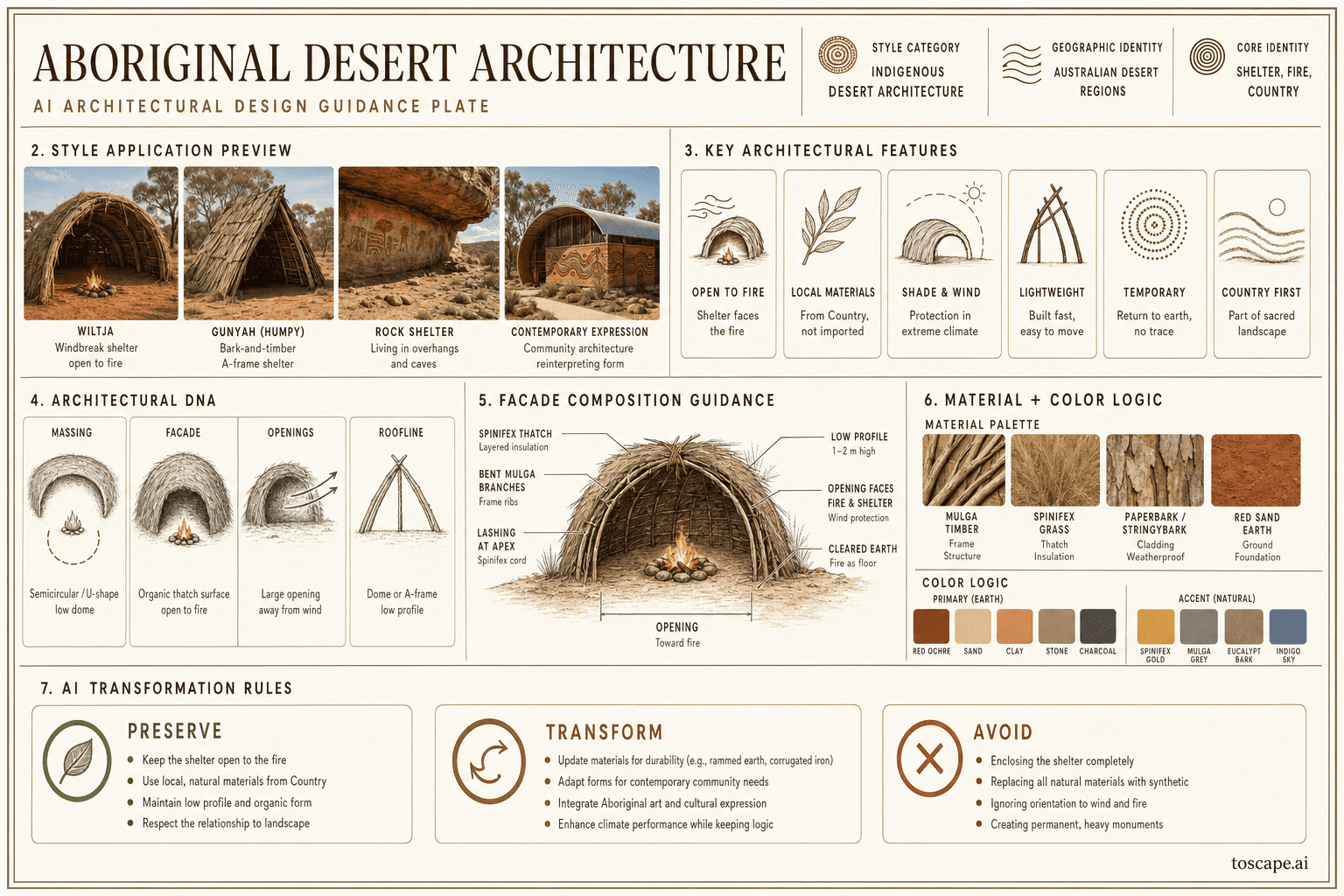
Aboriginal Desert is a regional architectural identity in Australia. The traditional and contemporary architectural identity of Aboriginal peoples of the Australian desert regions — the Western Desert (Pintupi, Pitjantjatjara, Ngaanyatjarra), Central Desert (Arrernte, Warlpiri, Anmatyerre), and Arnhem Land (Yolngu) — the traditional shelter types are minimalist, climate-responsive, and materially ephemeral: the wiltja (or wiltja wiltja) — a semicircular or domed windbreak of mulga (Ac...
Visual DNA
Massing & Form
The wiltja is a semicircular windbreak, not a full enclosure — the geometry is a U-shape or crescent in plan, with the open side facing the fire. The structure is low (1–2 m), dome-like or conical, with no vertical walls — it reads as a thatched mound growing from the red sand.
Facade Language
The wiltja has no facade in the conventional sense — it presents as a thatched mound with a single opening facing the fire. The texture is the dominant visual element: the spun-gold of spinifex thatch, the silver-grey of weathered mulga branches, the dark red-brown of the sand floor.
Materials & Texture
All materials are locally gathered and biogenic, returning to the earth: (1) Mulga (Acacia aneura) — the dominant desert hardwood, a small tree 3–8 m tall with dense, heavy timber (1,100 kg/m³ density) used for the structural frame — the branches are naturally curved, informing the dome geometry. (2) Spinifex grass (Tr...
Color Palette
White, cream, pale sand, warm timber, and shadow-driven dark metal accents define the palette. The facade should stay bright and climate-aware rather than heavy, gray, or over-saturated.
Ornament & Detail
Ornament in Aboriginal desert architecture is not applied to the shelter itself — it is in the LANDSCAPE and the BODY: (1) Rock art — the petroglyphs and pictographs on rock shelter walls and in ranges are the permanent ornament, tens of thousands of years old — geometric designs, animal tracks, ancestral beings — this...
Climate Response
The Australian desert climate is extreme: (1) Summer: 40–50°C daytime, sand surface temperature 60–70°C — the shelter provides SHADE, the primary climatic function; the dome shape maximizes shade footprint for minimum material. (2) Winter nights: -5 to 5°C — the fire provides warmth, and the shelter's windbreak functio...
Landscape & Ground
The traditional and contemporary architectural identity of Aboriginal peoples of the Australian desert regions — the Western Desert (Pintupi, Pitjantjatjara, Ngaanyatjarra), Central Desert (Arrernte, Warlpiri, Anmatyerre), and Arnhem Land (Yolngu) — the traditional shelter types are minimalist, climate-responsive, and...
Reference elevation
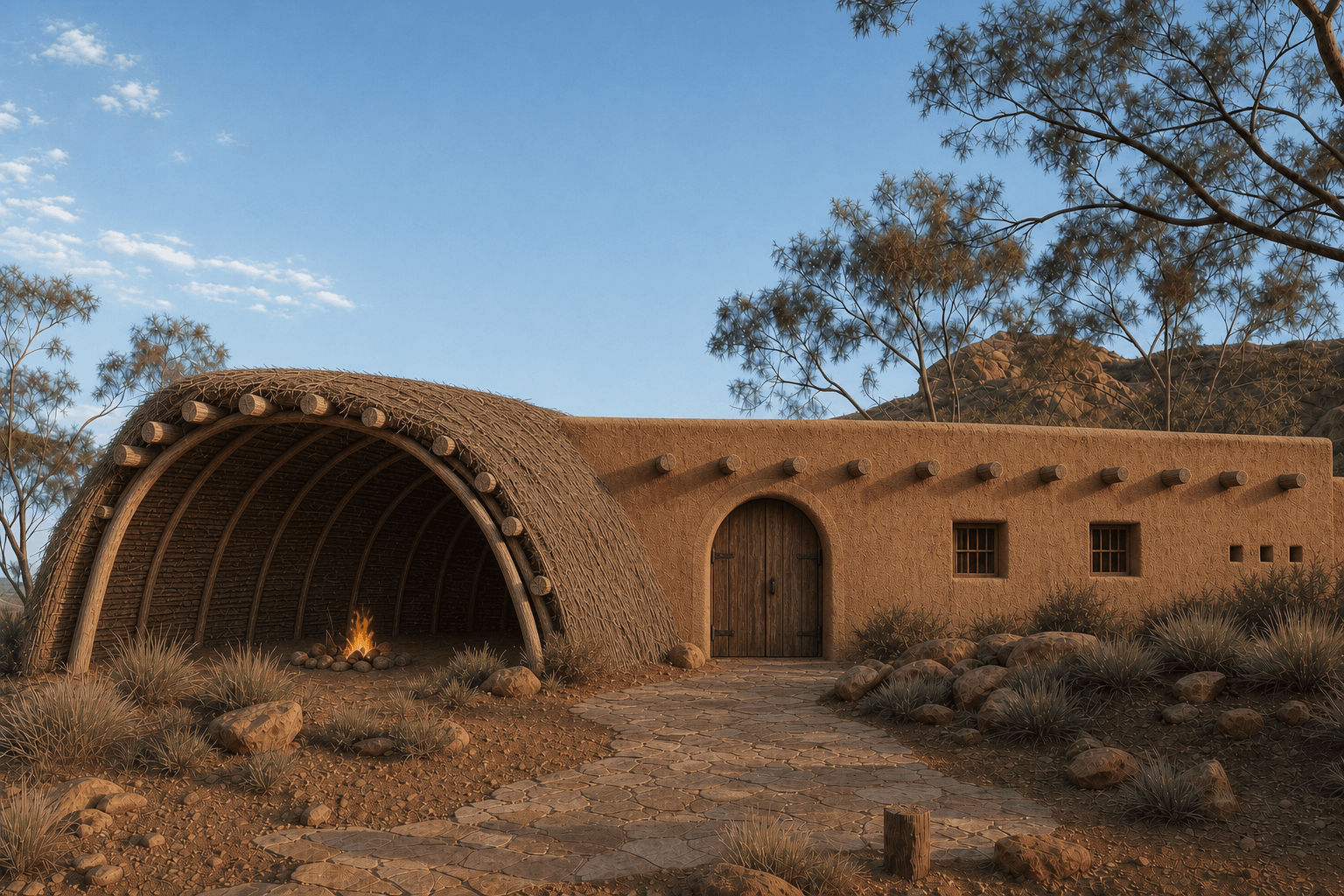
Aboriginal Desert — characteristic facade composition, traditional and contemporary architectural identity of Aboriginal peoples of the....
Context Snapshot
The traditional and contemporary architectural identity of Aboriginal peoples of the Australian desert regions — the Western Desert (Pintupi, Pitjantjatjara, Ngaanyatjarra), Central Desert (Arrernte... The Australian desert climate is extreme: (1) Summer: 40–50°C daytime, sand surface temperature 60–70°C — the shelter provides SHADE, the primary climatic function; the dome shape maximizes shade footprint for minimum ma...
Contemporary Relevance
Aboriginal Desert is useful today for residential, hospitality, civic, and place-branding work that needs Australia-specific character grounded in local massing, material tone, climate response, and settlement logic rather than generic international styling.
Use this style in Toscape
Explore Aboriginal Desert directly inside Toscape using the Facade Re-Style and Design Options workflows.
Open Aboriginal Desert in the gallery