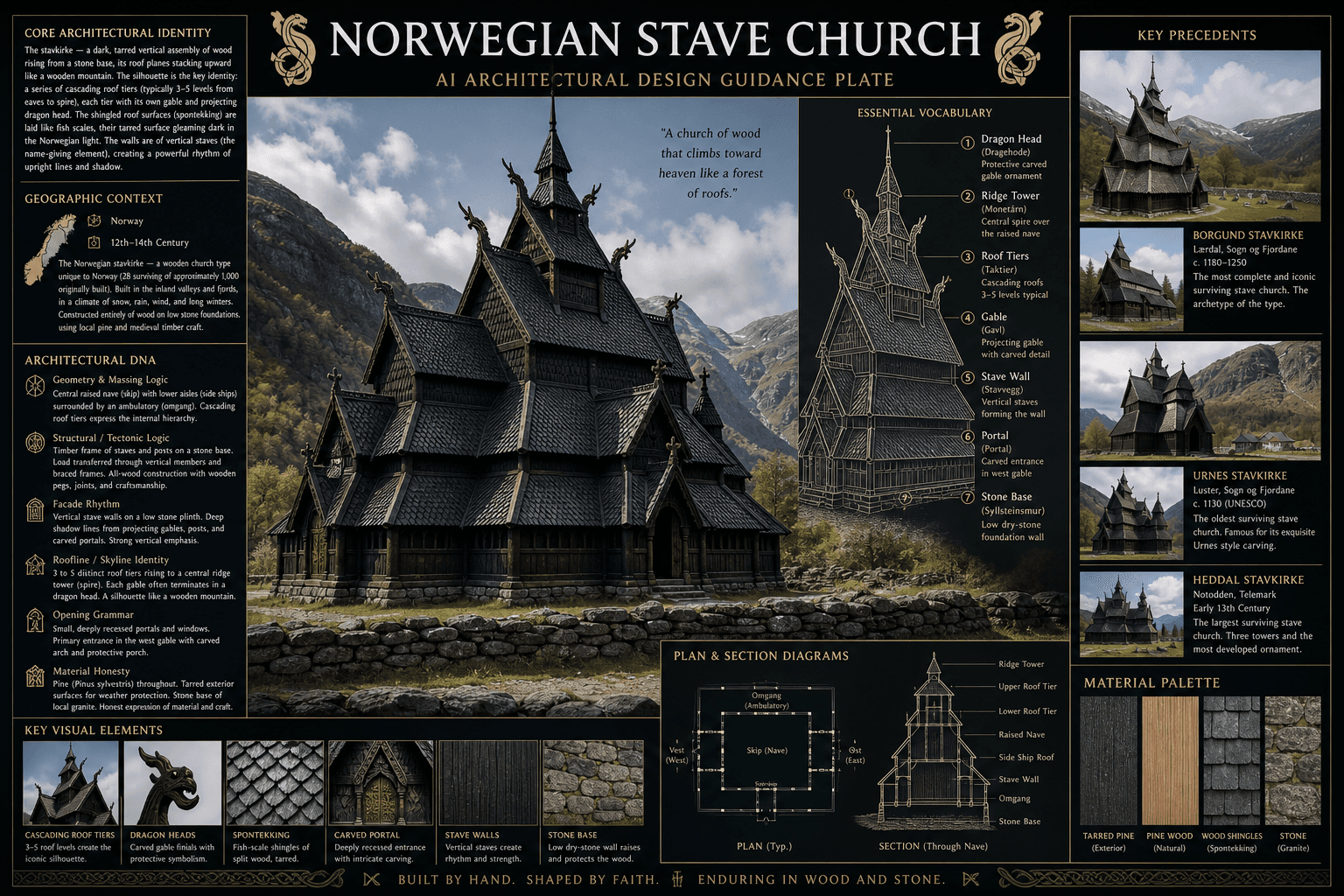
Norwegian Stave Church
Denmark · Norwegian stavkirke
The stavkirke (stave church) of Norway — the medieval wooden church built entirely of vertical staves (stav — load-bearing posts) on a timber sill frame, with a multi-tiered roof s...
Overview
Norwegian Stave Church is a regional architectural identity in Denmark Nordic. The Norwegian stavkirke — a wooden church type unique to Norway (28 surviving of approximately 1,000 originally built, 12th–14th centuries) — constructed entirely of wood: a rectangular nave with a raised central room (høymiddelalderens stavkirke) surrounded by an ambulatory (omgang) and a lower aisle — the structure is built on a foundation of stone (syllsteinsmur) with a horizontal timber sill frame (svill) into wh...
Visual DNA
Massing & Form
The stavkirke has a highly distinctive massing: (1) A central rectangular nave (skip) with a raised roof — this is the highest interior volume — the nave is surrounded on all four sides by a lower ambulatory (omgang) forming a continuous lean-to aisle — the exterior reads as a taller central block surrounded by a lower...
Facade Language
The stavkirke facade (typically the west front or the long side) is articulated as: (1) The stone base — a low rubble wall (0.5–1 m high), the only masonry in the building. (2) The gallery (svalgang) — a low-pitched lean-to roof with a colonnade of small posts, creating a shadowed zone at the base.
Materials & Texture
The stavkirke is wood, and only wood: (1) Pine (Pinus sylvestris) — the primary construction timber — Norwegian pine, slow-grown at altitude, dense and resinous, exceptionally durable — the staves, sill beams, and structural members are pine. (2) Spruce (Picea abies) — used for shingles and interior boarding.
Color Palette
Stone gray, weathered timber brown, mineral white, muted charcoal, and restrained landscape greens define the palette. The building should feel rooted in terrain and craft rather than coated in synthetic contrast.
Ornament & Detail
Stavkirke ornament is concentrated on the portals and gables: (1) The portal carving (portalutskjæring) — the Urnes style (urnesstil, named after Urnes stavkirke, c. 1130) is the definitive Norwegian Romanesque ornament: deeply incised animal interlace — the "great beast" (store dyr) with elongated serpentine body, fou...
Climate Response
The stavkirke is a product of the Norwegian landscape and climate: (1) The church is built in a landscape of fjords, mountains, and forests — wood is the only abundant building material; stone is scarce and difficult to work. (2) The tarred wood construction is adapted to the wet climate — the tar preserves the wood ag...
Landscape & Ground
The Norwegian stavkirke — a wooden church type unique to Norway (28 surviving of approximately 1,000 originally built, 12th–14th centuries) — constructed entirely of wood: a rectangular nave with a raised central room (høymiddelalderens stavkirke) surrounded by an ambulatory (omgang) and a lower aisle — the structure i...
Reference elevation
Norwegian Stave Church — characteristic facade composition, Norwegian stavkirke.
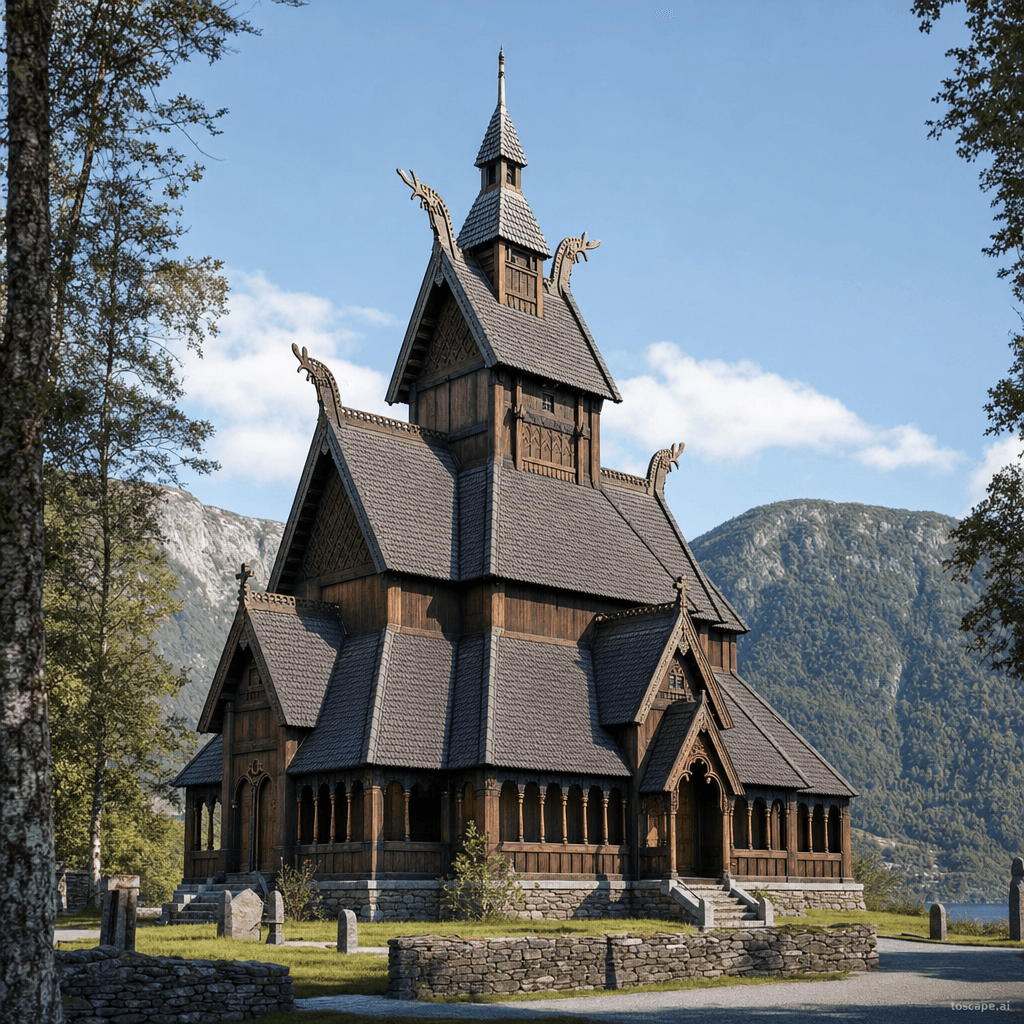
Context Snapshot
The Norwegian stavkirke — a wooden church type unique to Norway (28 surviving of approximately 1,000 originally built, 12th–14th centuries) — constructed entirely of wood: a rectangular nave with a ra... The stavkirke is a product of the Norwegian landscape and climate: (1) The church is built in a landscape of fjords, mountains, and forests — wood is the only abundant building material; stone is scarce and difficult to...
Contemporary Relevance
Norwegian Stave Church is useful today for residential, hospitality, civic, and place-branding work that needs Denmark Nordic-specific character grounded in local massing, material tone, climate response, and settlement logic rather than generic international styling.
Use this style in Toscape
Explore Norwegian Stave Church directly inside Toscape using the Facade Re-Style and Design Options workflows.
Open Norwegian Stave Church in the gallery