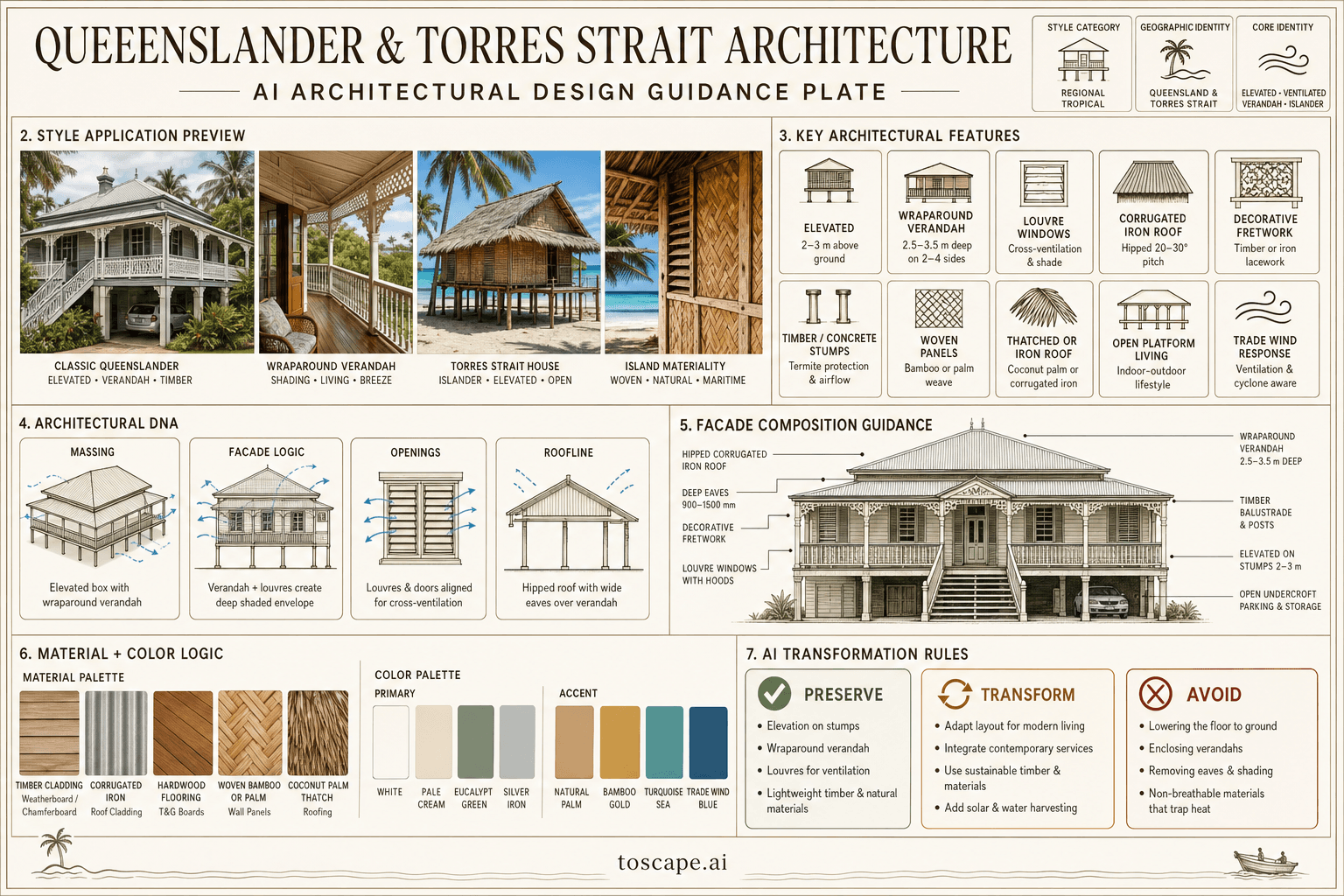
Queenslander & Torres Strait
Australia · Two interconnected but distinct tropical Australian architectural identities: (A...
The elevated timber house of tropical Queensland and the islander architecture of the Torres Strait — where European colonial timber building techniques fused with tropical climate...
Overview
Queenslander & Torres Strait is a regional architectural identity in Australia. Two interconnected but distinct tropical Australian architectural identities: (A) the Queenslander — the elevated single-skin timber house on stilts (2–3 m above ground) with wide wraparound verandahs, corrugated iron hipped roof, decorative timber fretwork and batten screening, louvre windows, and under-house space used for parking and storage — developed from the 1840s through the 1930s across tropical and subtropi...
Visual DNA
Massing & Form
(A) Queenslander: The house is a rectangular or L-shaped plan (10–20 m × 8–12 m), elevated on stumps — this elevation is the defining formal characteristic, creating the "floating box" massing. The hipped roof (often a pyramidal hip or multi-gable hip) projects 0.9–1.5 m beyond the verandah edge, creating a deep shadow...
Facade Language
(A) The Queenslander facade is dominated by the deep verandah shadow: (1) The roof projects as a broad horizontal band, its corrugated iron texture catching tropical light. (2) The verandah balustrade creates a rhythmic horizontal band of timber fretwork or cast-iron lace — panels of geometric, floral, or fern patterns...
Materials & Texture
(A) Queenslander palette: (1) Timber — hoop pine, cypress pine, northern silky oak, or red cedar for framing, joinery, and cladding; VJ boards (vertical joint tongue-and-groove) for exterior walls; tongue-and-groove flooring. (2) Corrugated galvanized iron — the roof material, originally unpainted silver-grey, later pa...
Color Palette
White, cream, pale sand, warm timber, and shadow-driven dark metal accents define the palette. The facade should stay bright and climate-aware rather than heavy, gray, or over-saturated.
Ornament & Detail
The Queenslander's ornament is in the VERANDAH — the most decorated architectural element in Australian domestic architecture: (1) Timber fretwork panels — repeating geometric, floral, or Art Nouveau patterns cut from timber boards, forming the balustrade infill — the "Queenslander lace" that is the most photographed a...
Climate Response
(A) Queenslander: The house is a pure climate machine: (1) Elevation on stumps — catches breezes (the critical thermal strategy), avoids ground moisture, floods, and termites, and provides shaded space beneath. (2) The wraparound verandah — reduces solar gain on walls by 70–90% and creates a cooled buffer zone.
Landscape & Ground
Two interconnected but distinct tropical Australian architectural identities: (A) the Queenslander — the elevated single-skin timber house on stilts (2–3 m above ground) with wide wraparound verandahs, corrugated iron hipped roof, decorative timber fretwork and batten screening, louvre windows, and under-house space us...
Reference elevation
Queenslander & Torres Strait — characteristic facade composition, Two interconnected but distinct tropical Australian architectural identities: (A....
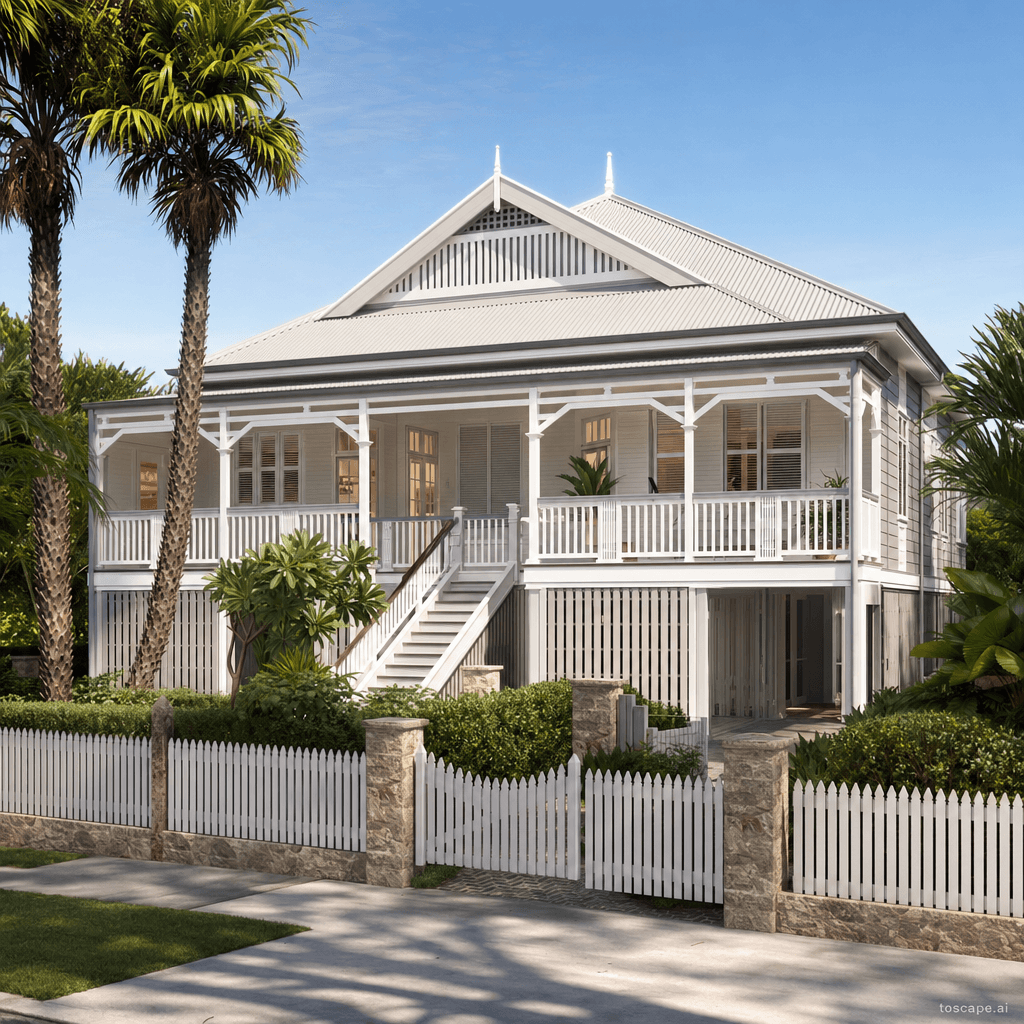
Context Snapshot
Two interconnected but distinct tropical Australian architectural identities: (A) the Queenslander — the elevated single-skin timber house on stilts (2–3 m above ground) with wide wraparound verandahs... (A) Queenslander: The house is a pure climate machine: (1) Elevation on stumps — catches breezes (the critical thermal strategy), avoids ground moisture, floods, and termites, and provides shaded space beneath.
Contemporary Relevance
Queenslander & Torres Strait is useful today for residential, hospitality, civic, and place-branding work that needs Australia-specific character grounded in local massing, material tone, climate response, and settlement logic rather than generic international styling.
Use this style in Toscape
Explore Queenslander & Torres Strait directly inside Toscape using the Facade Re-Style and Design Options workflows.
Open Queenslander & Torres Strait in the gallery