Rhineland
Germany · Rhineland / Rheinland (Middle Rhine, Eifel, Moselle valley)
Slate-Clad Facades, Rhine Valley Fachwerk & Rheinisches Schiefergebirge Vernacular
Overview
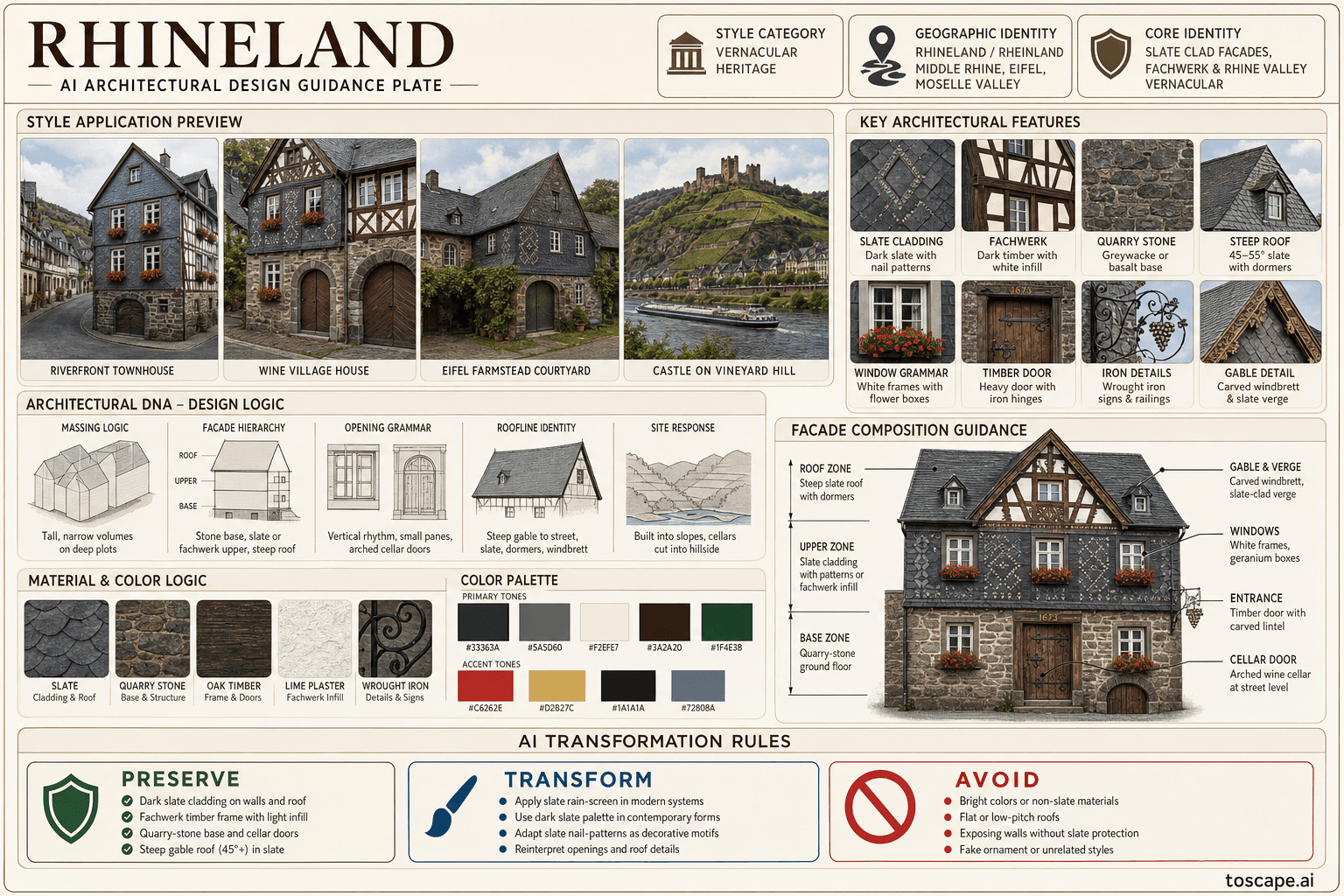
Rhineland is a regional architectural identity in Germany. Rhineland / Rheinland (Middle Rhine, Eifel, Moselle valley) — slate-clad and half-timbered architecture. Dark grey-black slate-hung facades (Schieferverkleidung/Schieferfassade) with ornamental nail patterns (Schieferornamente) — diamond, fish-scale, and scallop motifs, exposed half-timbering (Fachwerk) with dark timber and white or ochre rendered infill on upper floors, steep slate roofs (Schieferdach), quarry-stone...
Visual DNA
Massing & Form
Urban Rhine towns: tall narrow houses, 3-4 stories with steep gable to street or Rhine, deep narrow plots, often with rear garden descending to river. Wine villages: compact terraced settlement climbing steep valley slopes.
Facade Language
Dark grey-black slate surfaces dominate — either entire facade clad in slate, or stone ground with slate upper, or half-timbered upper with slate on gable. Slate patterns: geometric shapes created by nail-head arrangement — diamonds (Rauten), fish-scales (Fischschuppen), scallops (Bögen), herringbone (Fischgrät), and w...
Materials & Texture
Schiefer (slate): dark grey to black, split into tiles — wall cladding, roofing, the fundamental Rhineland material identity. Bruchstein (quarry stone): greywacke (dark grey, blue-grey), basalt (black), or red sandstone — ground floor walls, church construction.
Color Palette
White, cream, pale sand, warm timber, and shadow-driven dark metal accents define the palette. The facade should stay bright and climate-aware rather than heavy, gray, or over-saturated.
Ornament & Detail
Slate ornament (Schieferornament): the primary decorative system — patterns created by varying nail placement, slate size, and coursing, unique to each building and often to each slate-worker (Schieferdecker). Diamond patterns (Rautenmuster), fish-scales, scalloped bands, and date inscriptions formed by contrasting nai...
Climate Response
Rhenish transitional: mild maritime-influenced valleys with moderate rainfall (600-800mm), cold winters at elevation in Eifel. Slate cladding: the essential climate response — slate is impermeable, durable, and the dominant local material of the Rhenish Massif.
Landscape & Ground
Rhineland / Rheinland (Middle Rhine, Eifel, Moselle valley) — slate-clad and half-timbered architecture. Rhenish transitional: mild maritime-influenced valleys with moderate rainfall (600-800mm), cold winters at elevation in Eifel.
Reference elevation
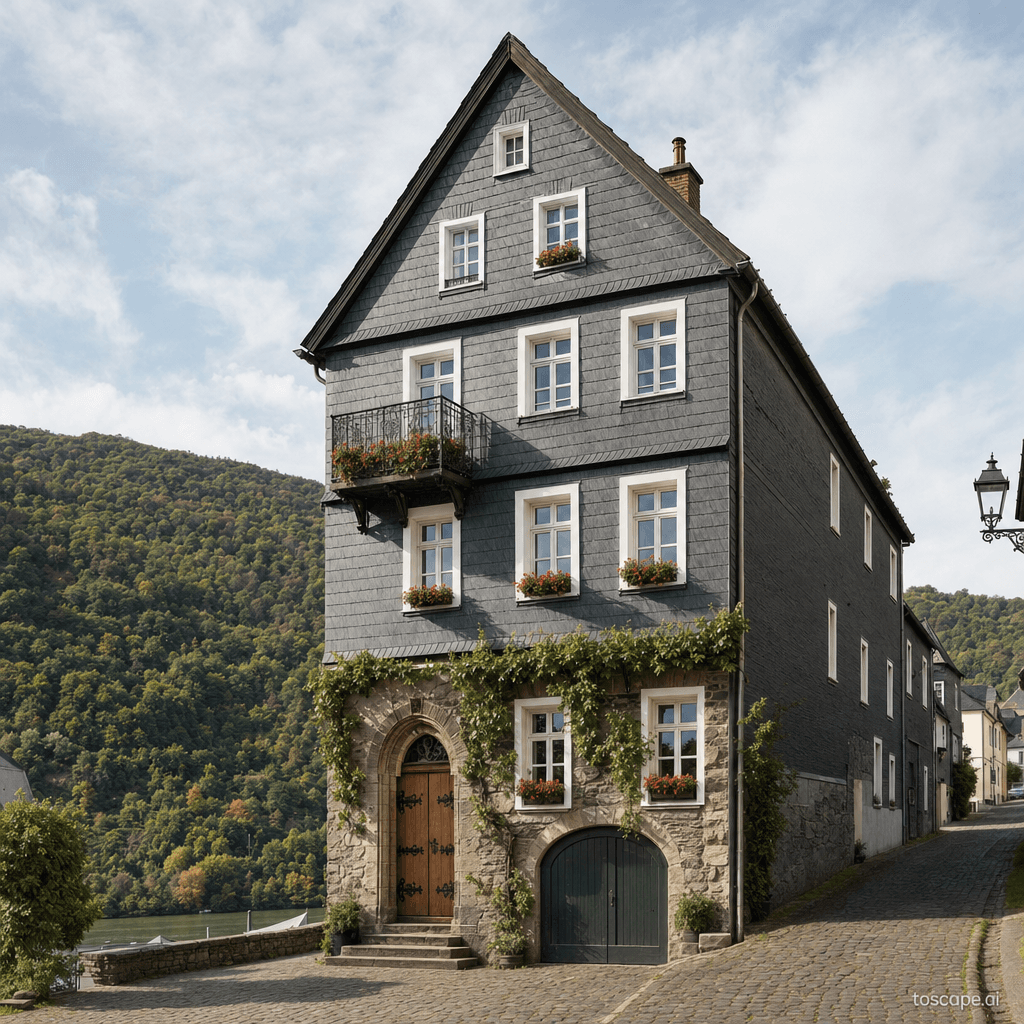
Rhineland — characteristic facade composition, Rhineland / Rheinland (Middle Rhine, Eifel, Moselle valley).
Context Snapshot
Rhineland / Rheinland (Middle Rhine, Eifel, Moselle valley) — slate-clad and half-timbered architecture Rhenish transitional: mild maritime-influenced valleys with moderate rainfall (600-800mm), cold winters at elevation in Eifel.
Contemporary Relevance
Rhineland is useful today for residential, hospitality, civic, and place-branding work that needs Germany-specific character grounded in local massing, material tone, climate response, and settlement logic rather than generic international styling.
Use this style in Toscape
Explore Rhineland directly inside Toscape using the Facade Re-Style and Design Options workflows.
Open Rhineland in the gallery