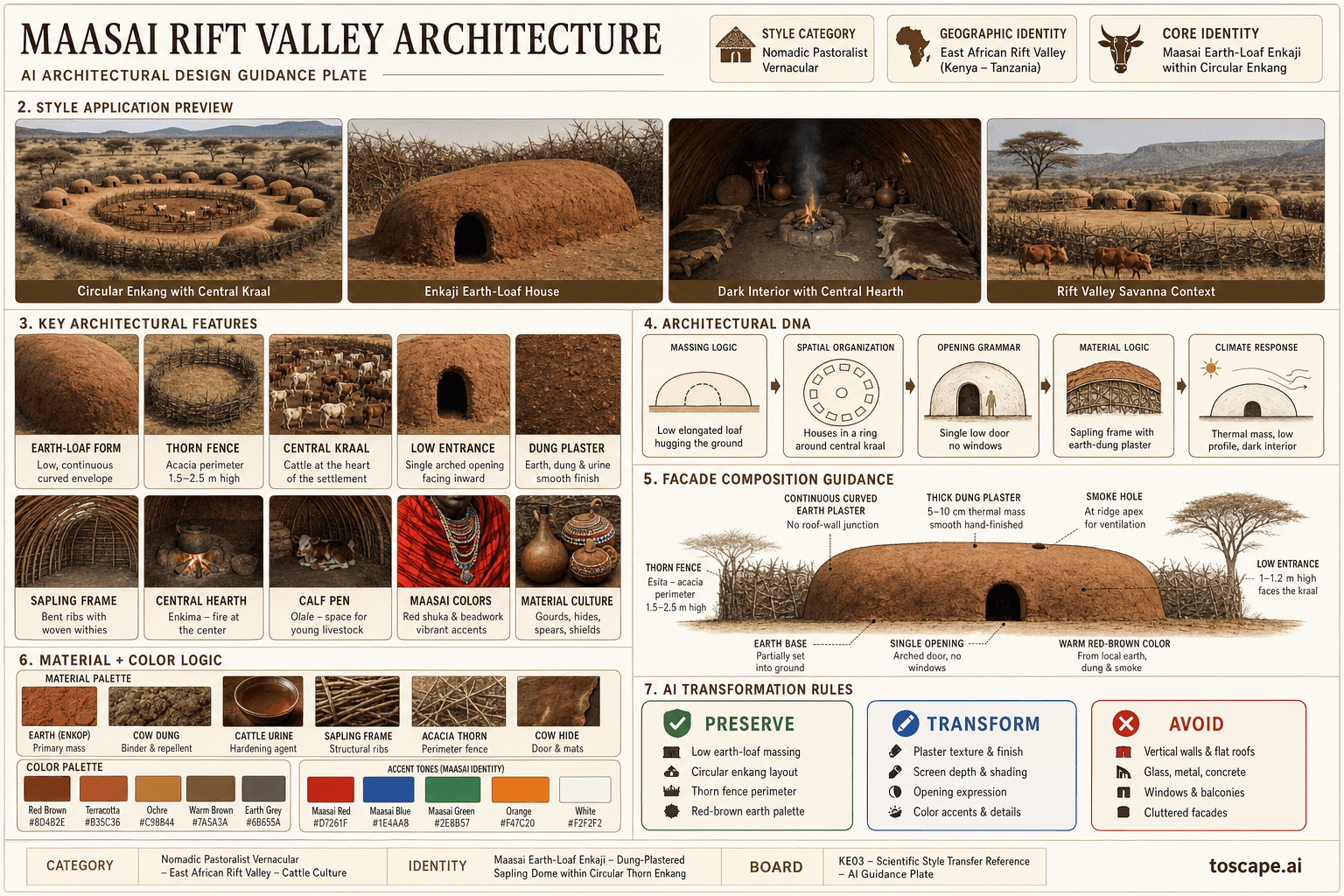
Maasai Rift Valley
Kenya · architectural identity of the Maasai (Maa-speaking pastoralists) of the Kenya Ri...
The enkaji of the Maasai — the low, elongated mud-and-dung house built by women within the circular thorn-bush enkang, the portable domestic architecture of East Africa's most icon...
Overview
Maasai Rift Valley is a regional architectural identity in Kenya. The architectural identity of the Maasai (Maa-speaking pastoralists) of the Kenya Rift Valley — the enkaji (house, plural inkajijik), a low rectangular-to-oval structure (3–5 m long × 2–3 m wide × 1.2–1.6 m high) constructed entirely by women from a sapling frame plastered with a mixture of mud, cow dung, and cattle urine — the house has a distinctive rounded loaf profile with no sharp distinction between wall and ro...
Visual DNA
Massing & Form
The enkaji is a low elongated loaf — a continuous curved envelope with no vertical walls, no roof-wall junction, and no sharp ridge. The cross-section is a low parabolic arch or flattened semi-circle, the longitudinal section a gentle barrel vault.
Facade Language
The enkaji has no distinct facade — the entire envelope is a single earth-textured surface. The plaster surface is smooth but irregular, bearing the hand-prints of its women builders.
Materials & Texture
The palette is radically limited to what the cattle-based economy provides: (1) Earth (enkop) — the red-brown lateritic soil of the Rift Valley, dug from the homestead site itself. (2) Cow dung (ol-ng'ejuk) — the primary binder, waterproofing agent, and insect repellent — the house is literally made from cattle.
Color Palette
Warm earth, sandy beige, ochre, clay brown, and sun-softened mineral tones should dominate, with palm green or weathered timber as secondary accents. The palette should read as land-derived rather than polished or urban-generic.
Ornament & Detail
Maasai ornament is personal (body) rather than architectural. The enkaji surfaces are undecorated — the smooth earth plaster is the finish.
Climate Response
The Maasai range across the Rift Valley savanna (1,000–2,000 m elevation, semi-arid, 400–800 mm annual rainfall, temperatures 15–35°C). The enkaji is thermally ingenious: (1) The thick earth-dung plaster (5–10 cm) provides excellent thermal mass — interior temperatures remain 10–15°C cooler than the midday savanna and...
Landscape & Ground
The architectural identity of the Maasai (Maa-speaking pastoralists) of the Kenya Rift Valley — the enkaji (house, plural inkajijik), a low rectangular-to-oval structure (3–5 m long × 2–3 m wide × 1.2–1.6 m high) constructed entirely by women from a sapling frame plastered with a mixture of mud, cow dung, and cattle ur...
Reference elevation
Maasai Rift Valley — characteristic facade composition, architectural identity of the Maasai (Maa-speaking pastoralists) of the Kenya Ri....
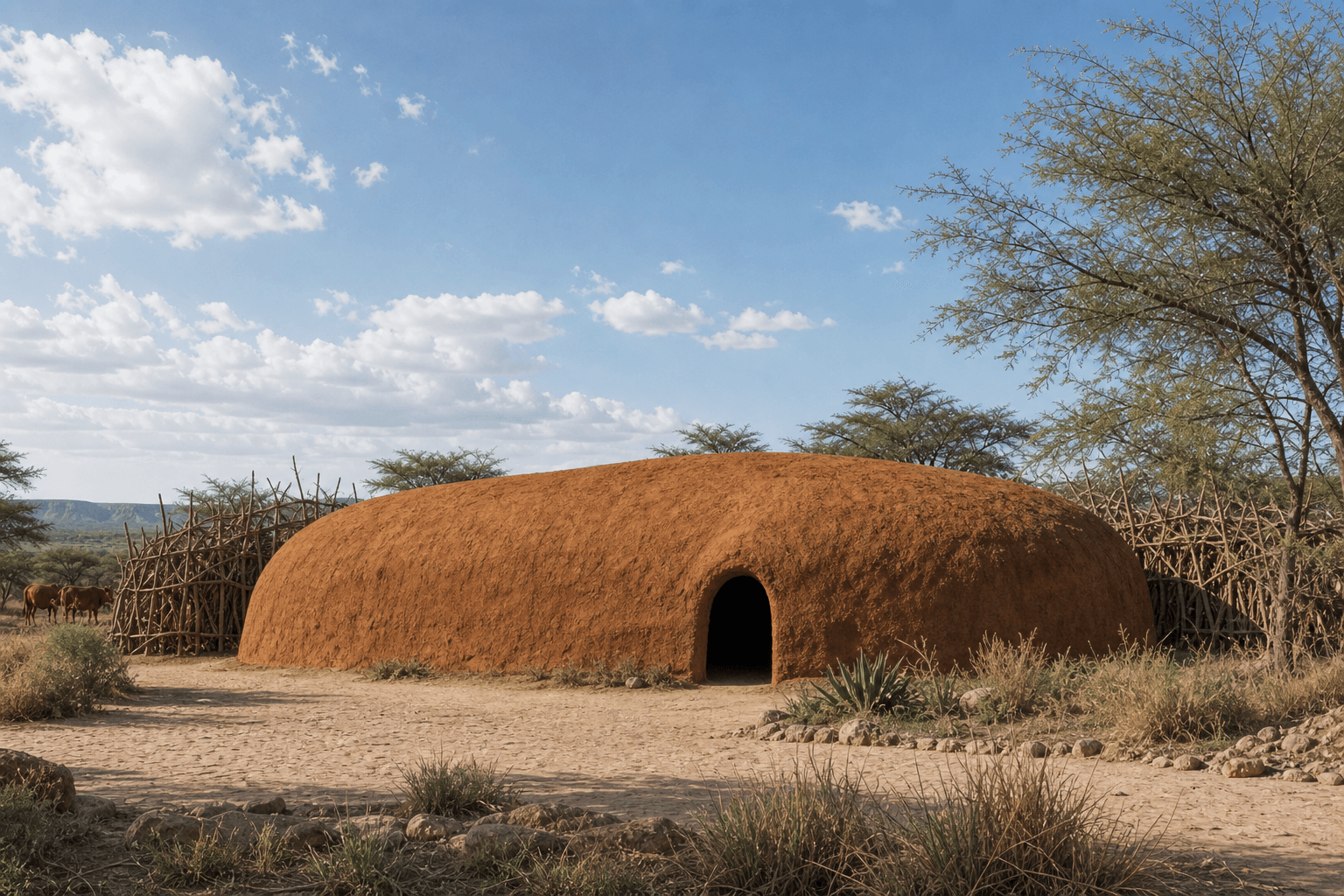
Context Snapshot
The architectural identity of the Maasai (Maa-speaking pastoralists) of the Kenya Rift Valley — the enkaji (house, plural inkajijik), a low rectangular-to-oval structure (3–5 m long × 2–3 m wide × 1.2... The Maasai range across the Rift Valley savanna (1,000–2,000 m elevation, semi-arid, 400–800 mm annual rainfall, temperatures 15–35°C).
Contemporary Relevance
Maasai Rift Valley is useful today for residential, hospitality, civic, and place-branding work that needs Kenya-specific character grounded in local massing, material tone, climate response, and settlement logic rather than generic international styling.
Use this style in Toscape
Explore Maasai Rift Valley directly inside Toscape using the Facade Re-Style and Design Options workflows.
Open Maasai Rift Valley in the gallery