Tabuk Coast Traditional
Saudi Arabia · Tabuk Coast
The rustic Red Sea port vernacular — coral stone walls with lime-washed render, horizontal tripartite massing, punched openings with loose alignment, timber banding, projecting rai...
Overview
Tabuk Coast Traditional is a Saudi architectural identity rooted in Tabuk Coast. Northern Red Sea Coastal Architecture — Traditional level (Full Strength). Tabuk Coast — Red Sea coastal plain from Duba south to Umluj, including Al Wajh — narrow coastal strip between the Hejaz Mountains and the Red Sea.
Visual DNA
Massing & Form
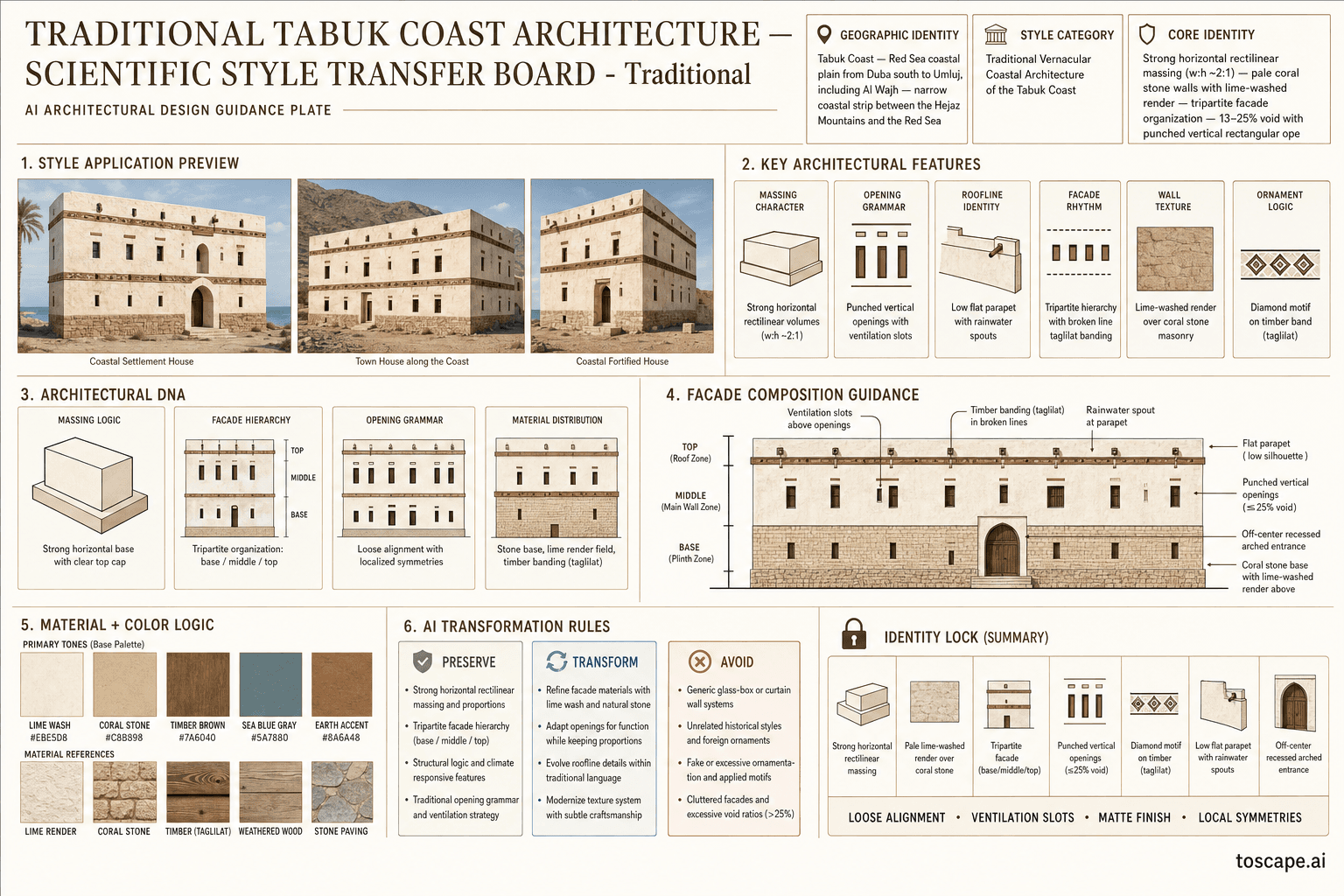
Traditional Tabuk Coast buildings have predominantly flat facades with strong horizontal proportions — width-to-height ratio between 1:0.36 and 1:0.68 (approximately 2:1 horizontal) . Buildings are 1–2 storeys, occasionally rising to 3 storeys.
Facade Language
Facades are divided vertically into three clear tiers: base, middle, and top of varying heights — the base is typically the highest tier . The horizontality is emphasized by timber banding that runs in broken lines across the facade.
Materials & Texture
Primary wall: pale lime-washed render over coral stone — matte finish, protective coastal seal . Coral stone may be left exposed in some areas for textural variety.
Color Palette
Use a light mineral field of sand, shell, coral, and sun-softened white, then introduce timber, bronze, or darker screened shadow as accent. Coastal and oasis palettes should feel bright, breathable, and climate-tempered rather than heavy or monochrome.
Ornament & Detail
The architecture is relatively unembellished — presenting simpler, more basic forms . Decoration is expressed through simple motifs, often carved into timber elements — the most prevalent motif is the simple diamond shape, typically applied to timber doors and window shutters .
Climate Response
Extremely warm summer temperatures (up to 40°C), high evaporation rates, and seasonally changing Red Sea currents . Heaviest rainfall November–January.
Landscape & Ground
Tabuk Coast — Red Sea coastal plain from Duba south to Umluj, including Al Wajh — narrow coastal strip between the Hejaz Mountains and the Red Sea. Extremely warm summer temperatures (up to 40°C), high evaporation rates, and seasonally changing Red Sea currents .
Reference elevation
Tabuk Coast Traditional — characteristic facade composition, Tabuk Coast.
Context Snapshot
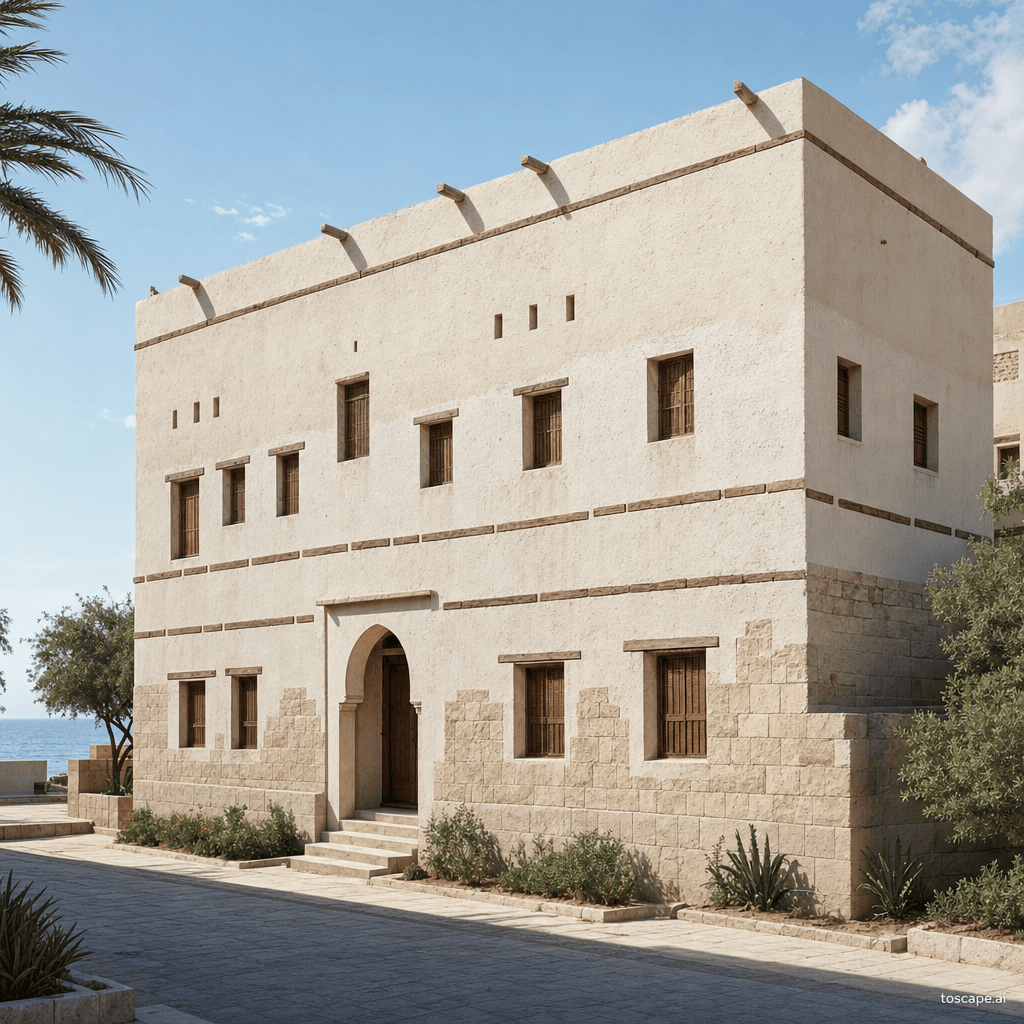
Faithful interpretation of Tabuk Coast vernacular — the simpler, more basic Red Sea coastal architecture of Duba, Al Wajh, and Umluj — characterized by coral stone walls with protective lime-washed re... Northern Red Sea Coastal Architecture — Traditional level (Full Strength) Tabuk Coast — Red Sea coastal plain from Duba south to Umluj, including Al Wajh — narrow coastal strip between the Hejaz Mountains and the Red Sea
Contemporary Relevance
Tabuk Coast Traditional operates as the heritage reference layer for Tabuk Coast and is most useful today in conservation work, cultural tourism districts, and accurate AI rendering direction. Its value in current practice comes from preserving proportion, material hierarchy, and climate logic without flattening them into generic nostalgia.
Use this style in Toscape
Explore Tabuk Coast Traditional directly inside Toscape using the Facade Re-Style and Design Options workflows.
Open Tabuk Coast Traditional in the gallery