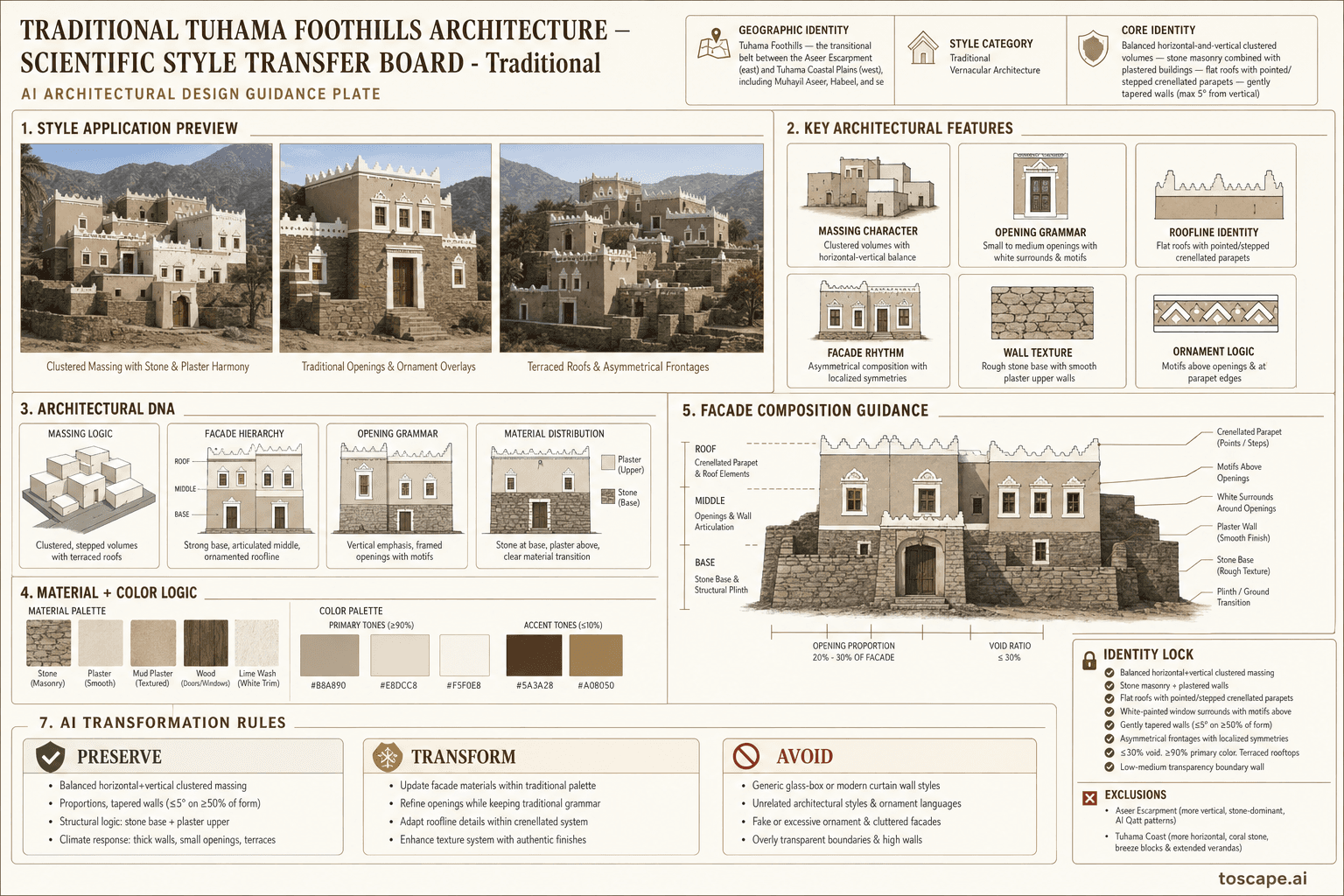
Tuhama Foothills Traditional
Saudi Arabia · Tuhama Foothills
The escarpment-to-coastal transitional vernacular — balanced horizontal and vertical stone-and-plaster volumes, terraced slopes, crenellated parapets, white-painted window surround...
Overview
Tuhama Foothills Traditional is a Saudi architectural identity rooted in Tuhama Foothills. Southwestern Arabian Escarpment-Foothills Architecture — Traditional level (Full Strength). Tuhama Foothills — the transitional belt between the Aseer Escarpment (east) and Tuhama Coastal Plains (west), including Muhayil Aseer, Habeel, and settlements adapting to sloping terrain.
Visual DNA
Massing & Form
Traditional Tuhama Foothills buildings develop as balanced horizontal and vertical volumes, clustered together and built on slopes using terracing . Forms are compact with strong geometric shapes and inclined massing (maximum 5 degrees from vertical).
Facade Language
Facades express external solid walls grounded to the street level, with recessed/punched openings . The overall frontage is asymmetrical, with localized symmetries maintained in the placement, size, rhythm, and patterns of openings.
Materials & Texture
Primary facade material: local stone (or equivalent matching texture, color, and appearance), with 70–80% of the facade composed of one consistent material . Wood or equivalent for window frames, shutters, and shading structures.
Color Palette
Stone greys, lime white, sun-aged timber, and selective mineral accents shape the palette. Highland and escarpment identities can carry stronger painted or stratified contrast, but the wall mass should still feel geologic and rooted in terrain.
Ornament & Detail
Traditional decorative motifs displayed above window openings . Patterns replicate traditional art — focused on doors, window screens, and shutter doors — limited to geometric patterns and ≤10% of total facade area.
Climate Response
Settlements are compact within the foothills, adapting to topography through terracing that also functions as spaces for social interaction . Internal courtyards and terraces function as open spaces within housing clusters.
Landscape & Ground
Tuhama Foothills — the transitional belt between the Aseer Escarpment (east) and Tuhama Coastal Plains (west), including Muhayil Aseer, Habeel, and settlements adapting to sloping terrain. Settlements are compact within the foothills, adapting to topography through terracing that also functions as spaces for social int...
Reference elevation
Tuhama Foothills Traditional — characteristic facade composition, Tuhama Foothills.
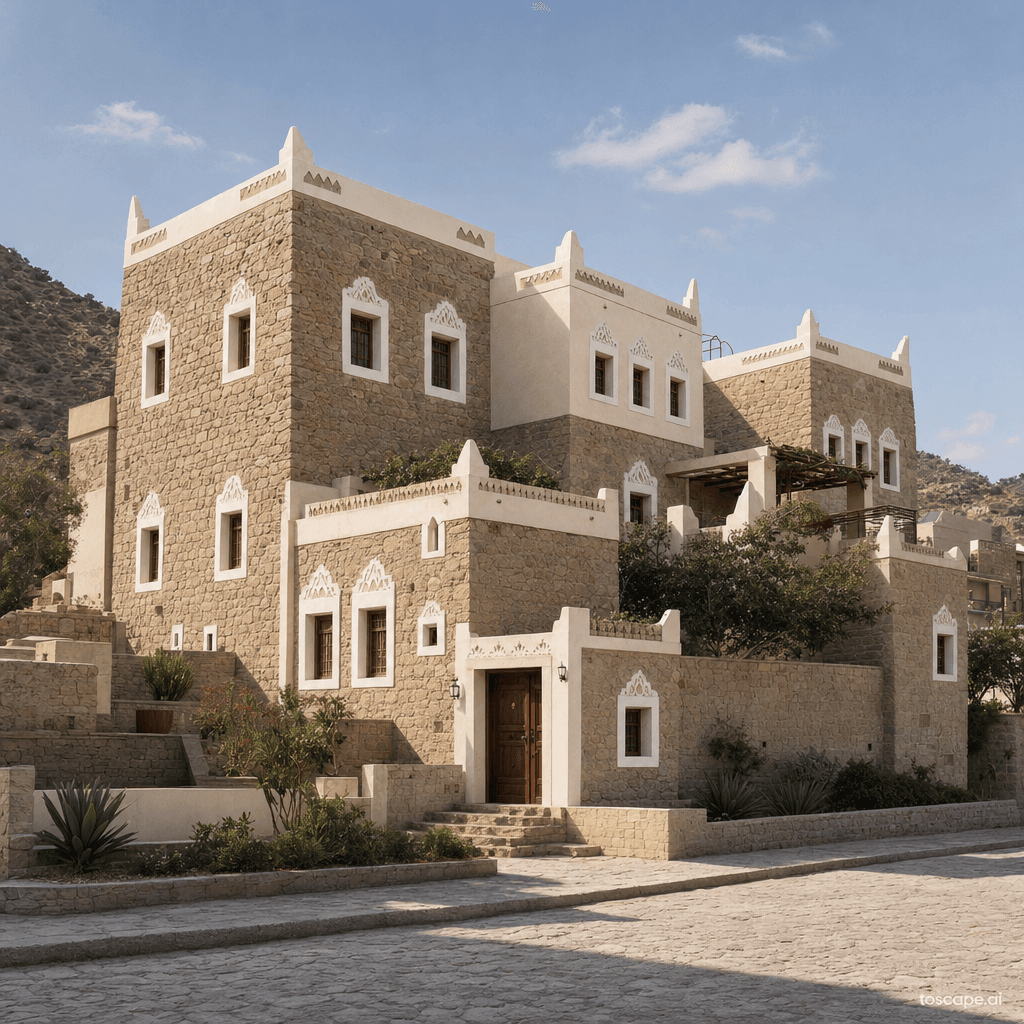
Context Snapshot
Faithful interpretation of Tuhama Foothills vernacular — a transitional zone between the Aseer Escarpment and Tuhama Coastal Plains — characterized by balanced clustered massing, stone masonry combine... Southwestern Arabian Escarpment-Foothills Architecture — Traditional level (Full Strength) Tuhama Foothills — the transitional belt between the Aseer Escarpment (east) and Tuhama Coastal Plains (west), including Muhayil Aseer, Habeel, and settlements adapting to sloping terrain
Contemporary Relevance
Tuhama Foothills Traditional operates as the heritage reference layer for Tuhama Foothills and is most useful today in conservation work, cultural tourism districts, and accurate AI rendering direction. Its value in current practice comes from preserving proportion, material hierarchy, and climate logic without flattening them into generic nostalgia.
Use this style in Toscape
Explore Tuhama Foothills Traditional directly inside Toscape using the Facade Re-Style and Design Options workflows.
Open Tuhama Foothills Traditional in the gallery