Tunis Medina
Tunisia · Medina of Tunis
The Andalusian-Maghrebi courtyard houses of the Tunis Medina — blue-and-white palette, horseshoe arches, ceramic tilework, and the architectural identity of Tunisia's historic capi...
Overview
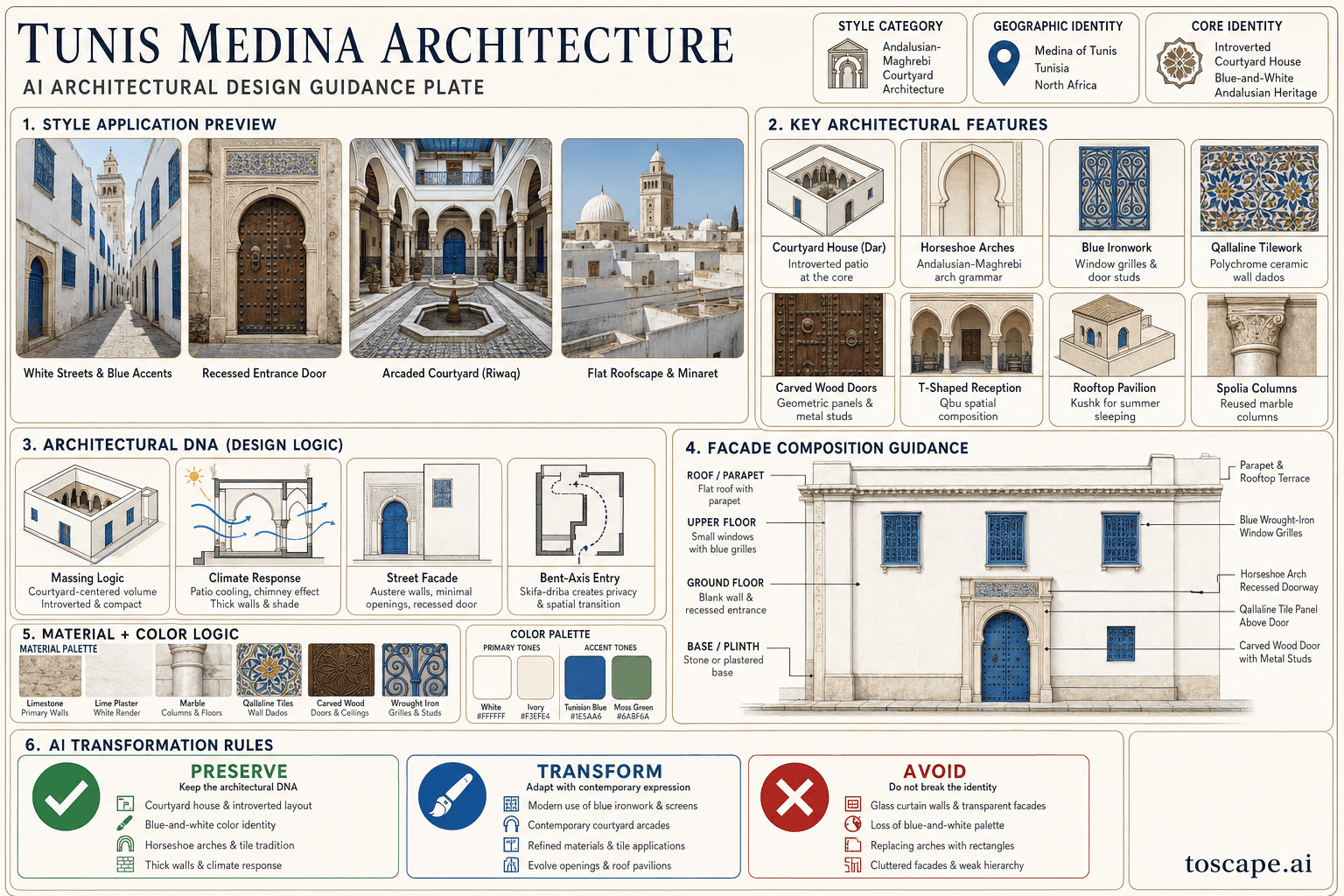
Tunis Medina is a regional architectural identity in Tunisia. Traditional architecture of the Medina of Tunis — a UNESCO World Heritage site since 1979, representing one of the most intact Arabo-Muslim medinas in the Mediterranean, defined by courtyard houses (dar), Andalusian-influenced decorative arts, horseshoe and multifoil arches, and a distinctive blue-and-white architectural palette shaped by Andalusian refugee craftsmen who settled in Tunis after the Reconquista. Introv...
Visual DNA
Massing & Form
The Tunis medina house (dar) is a multi-storey (typically single-storey or two-storey) courtyard-centered volume — 6–12 m wide × 8–18 m deep. The plan is organized around a central square or rectangular courtyard (wast al-dar), which provides light, air, and spatial organization.
Facade Language
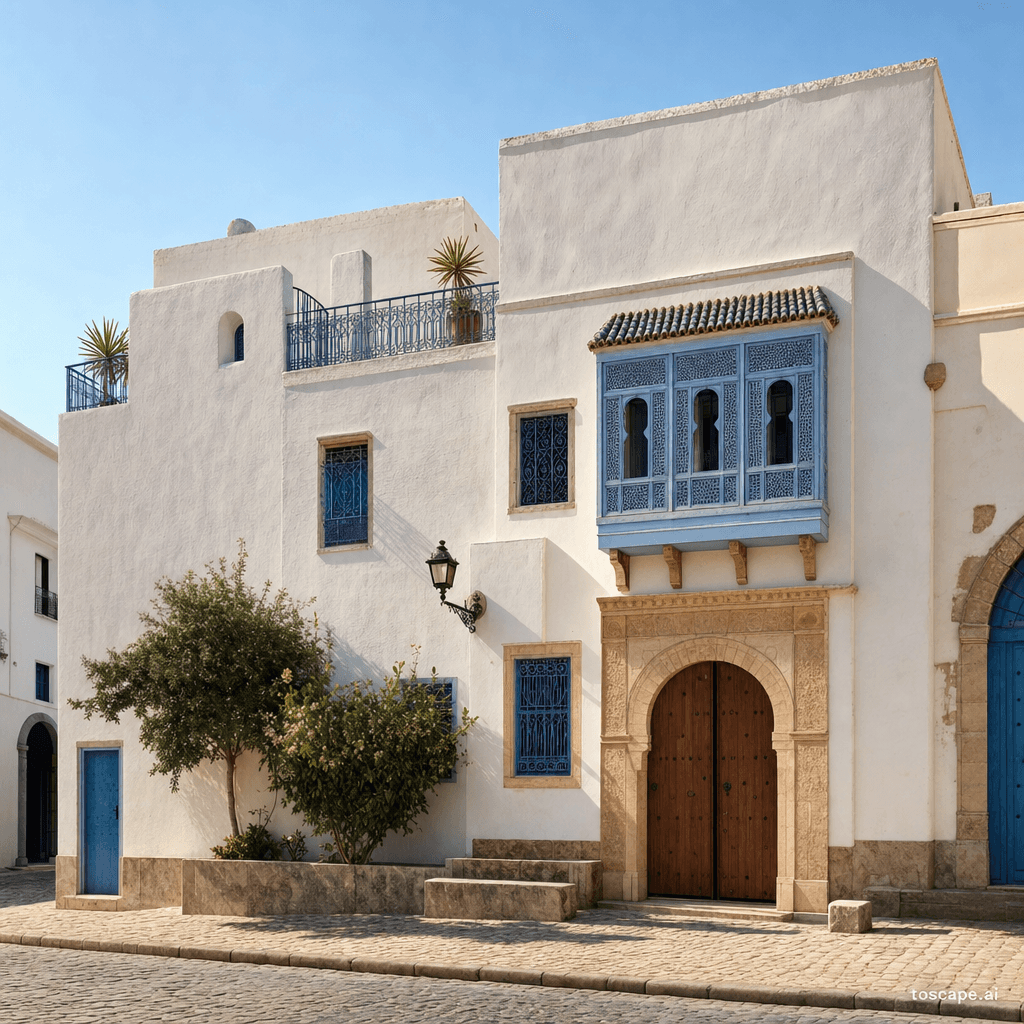
The Tunis medina street facade is blank and austere — white or cream lime-rendered walls with minimal openings. The entrance door is the primary architectural element: a recessed doorway with a horseshoe-arch surround, a carved wooden door leaf (often painted in blue, green, or dark brown) with geometric panels, and de...
Materials & Texture
Limestone — primary wall material Lime plaster — white or cream render for external walls Fired brick — for arches and vaults Marble — for courtyard columns (often Roman/Byzantine spolia), fountain basins, and flooring Ceramic tiles (qallaline) — polychrome wall dados, distinctive Tunisian ceramic tradition Carved stuc...
Color Palette
White, cream, pale sand, warm timber, and shadow-driven dark metal accents define the palette. The facade should stay bright and climate-aware rather than heavy, gray, or over-saturated.
Ornament & Detail
Tunis medina ornament is a fusion of Andalusian-Maghrebi and Ottoman traditions: (1) Qallaline tilework — polychrome ceramic wall panels with floral and geometric patterns — the distinctive Tunisian ceramic tradition (named after the Qallaline quarter of Tunis), (2) carved stucco — intricate vegetal and geometric wall...
Climate Response
The Tunis medina architecture responds to the Mediterranean coastal climate: (1) Courtyard microclimate — the central patio provides shade, evaporative cooling (via fountain), and thermal chimney ventilation. (2) Thick walls + thermal mass — stabilize interior temperatures.
Landscape & Ground
Traditional architecture of the Medina of Tunis — a UNESCO World Heritage site since 1979, representing one of the most intact Arabo-Muslim medinas in the Mediterranean, defined by courtyard houses (dar), Andalusian-influenced decorative arts, horseshoe and multifoil arches, and a distinctive blue-and-white architectur...
Reference elevation
Tunis Medina — characteristic facade composition, Medina of Tunis.
Context Snapshot
Traditional architecture of the Medina of Tunis — a UNESCO World Heritage site since 1979, representing one of the most intact Arabo-Muslim medinas in the Mediterranean, defined by courtyard houses (d... The Tunis medina architecture responds to the Mediterranean coastal climate: (1) Courtyard microclimate — the central patio provides shade, evaporative cooling (via fountain), and thermal chimney ventilation.
Contemporary Relevance
Tunis Medina is useful today for residential, hospitality, civic, and place-branding work that needs Tunisia-specific character grounded in local massing, material tone, climate response, and settlement logic rather than generic international styling.
Use this style in Toscape
Explore Tunis Medina directly inside Toscape using the Facade Re-Style and Design Options workflows.
Open Tunis Medina in the gallery