Urban Contemporary
Dense urban contexts globally - city centers, transit corridors, mixed-use districts,... / Regional contemporary
Compact stacked urban volumes, durable metropolitan materials, and efficient city-facing facade logic.
Overview
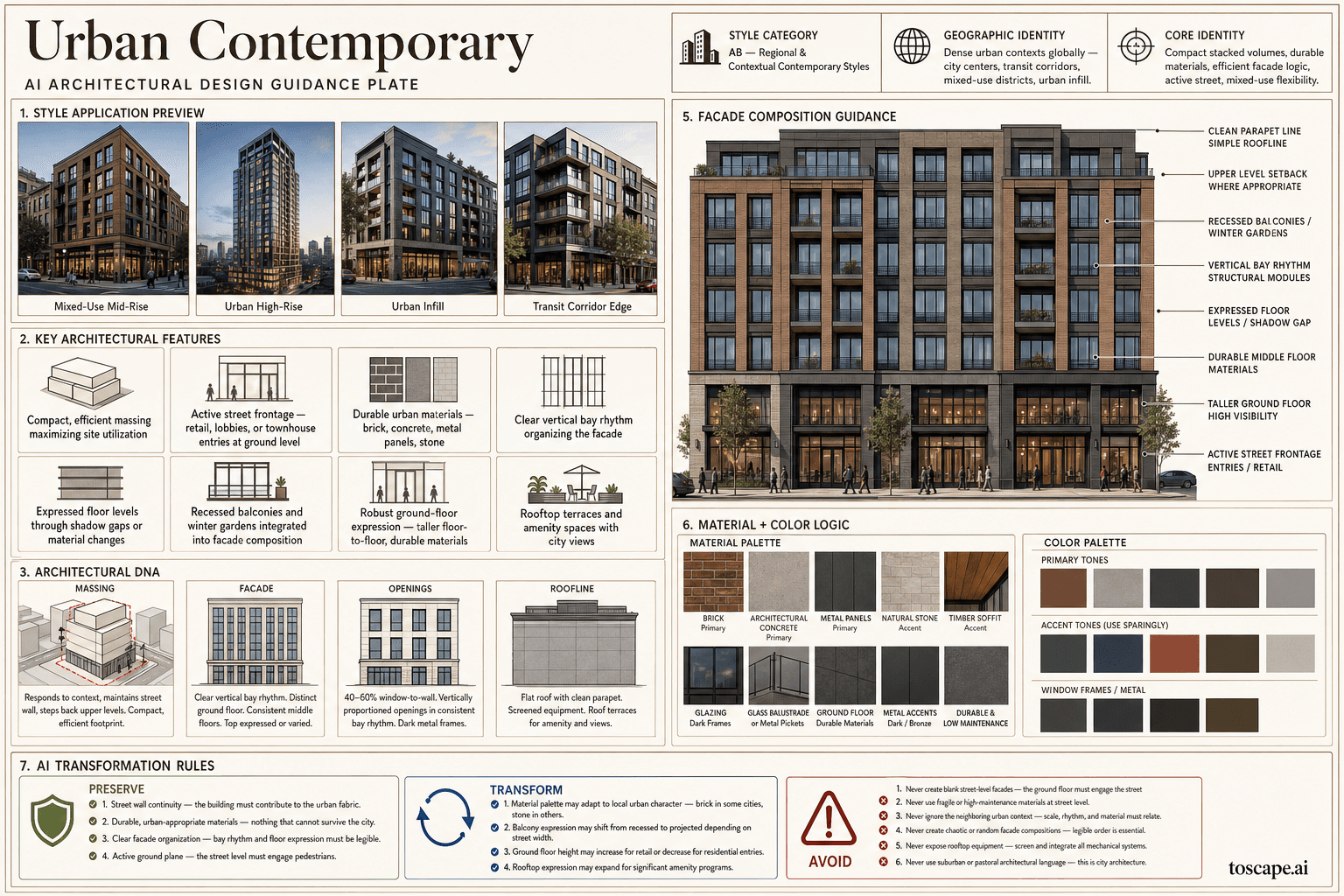
Urban Contemporary is a global architectural style rooted in Dense urban contexts globally - city centers, transit corridors, mixed-use districts, and urban infill sites. Defined by tight sites, street wall continuity, mixed-use programs, and the need to contribute positively to the public realm. Compact stacked urban volumes, durable metropolitan materials, and efficient city-facing facade logic. Confident, metropolitan, and street-smart.
Visual DNA
Massing & Form
Massing responds to urban context. maintaining street wall continuity, respecting neighboring building heights, and stepping back at upper levels where appropriate.
Facade Language
The facade is organized as a clear vertical bay rhythm. each bay comprising a structural module with windows, solid panels, and shading devices.
Materials & Texture
Primary materials: brick (clay or concrete), architectural concrete, metal panels Accent materials: natural stone at ground level, timber soffits at entries Glazing: dark anodized aluminum frames. robust and urban Balcony balustrades:...
Color Palette
Primary tones: warm brick reds/browns, concrete grey, charcoal, dark bronze Ground floor: slightly darker or richer tone than upper floors Window frames: dark grey, charcoal, or black. consistent throughout Accent tones: muted urban colors.
Ornament & Detail
Street wall continuity. the building must contribute to the urban fabric.
Climate Response
Dense urban contexts globally. city centers, transit corridors, mixed-use districts, and urban infill sites.
Landscape & Ground
Dense urban contexts globally. city centers, transit corridors, mixed-use districts, and urban infill sites.
Reference elevation
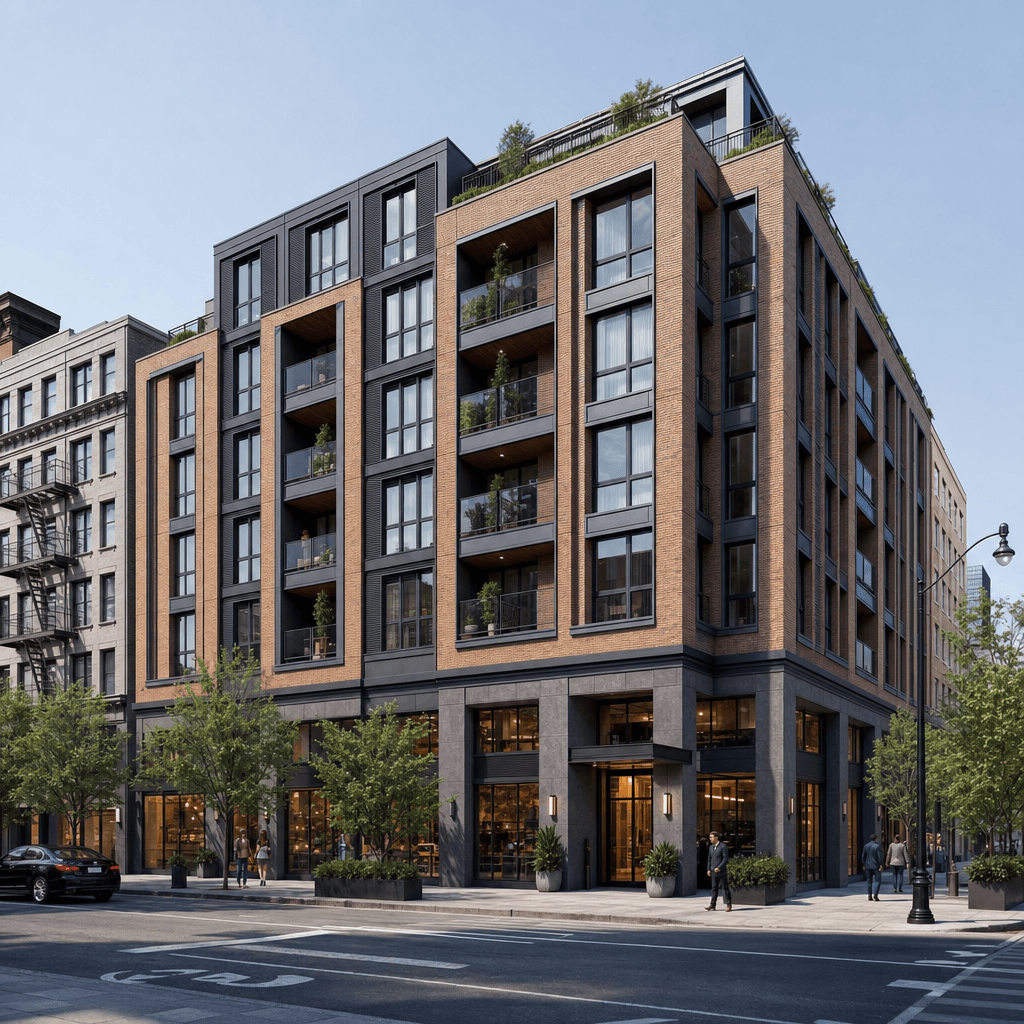
Urban Contemporary - characteristic facade composition within the regional contemporary.
Context Snapshot
Confident, metropolitan, and street-smart. Massing responds to urban context - maintaining street wall continuity, respecting neighboring building heights, and stepping back at upper levels where appropriate. Dense urban contexts globally - city centers, transit corridors, mixed-use districts, and urban infill sites.
Contemporary Relevance
Today, Urban Contemporary remains relevant wherever projects need regional contemporary cues without losing performance or contemporary usability. In Toscape it responds best when prompts emphasize massing responds to urban context - maintaining street wall continuity, respecting neighboring building heights, and stepping back at upper levels where appropriate. primary materials: brick (clay or concrete), architectural concrete, metal panels accent...
Use this style in Toscape
Explore Urban Contemporary directly inside Toscape using Facade Re-Style and design workflow prompts tuned for global architectural references.
Open Urban Contemporary in the gallery